

Growing up in Malawi, the label “Made in China” suggested something cheap, something temporary, something that might break sooner than expected.
If a product was Made in China, it was often viewed as an inferior alternative to goods from Europe, America, or Japan. The label became a shorthand for low quality.
Looking back, that perception is remarkable.
Today, China is one of the most important industrial and technological powers in the world. Chinese companies compete directly with some of the most powerful firms on earth. Huawei has become a global force in telecommunications and consumer technology. BYD has emerged as a serious competitor in electric vehicles. DJI dominates large segments of the global drone market. China leads in batteries, renewable energy manufacturing, and increasingly artificial intelligence infrastructure.
The country that was once associated with cheap manufacturing is now associated with industrial capability.
I just finished reading [or rather listening to] Patrick McGee‘s Apple in China, and I found myself thinking less about Apple and more about how that transformation occurred. While the book is presented as the story of Apple’s relationship with China, it is ultimately a story about development. More specifically, it is a story about how countries learn.
One of the book’s most important insights is that Apple did not simply use China. In many ways, Apple helped build China. Conventional narratives often describe the relationship as one in which China provided cheap labour and manufacturing capacity while Apple captured the value through design and innovation. There is truth in that interpretation, but it is incomplete.
What McGee illustrates is that Apple transferred far more than production contracts. Through decades of engagement, Apple helped establish standards, train suppliers, develop production systems, and expose Chinese firms to some of the most sophisticated manufacturing practices in the world. Apple entered China looking for efficiency. China used the relationship to accumulate capability.
That distinction matters because it reveals something fundamental about economic transformation. Factories do not simply produce goods. They produce learning.
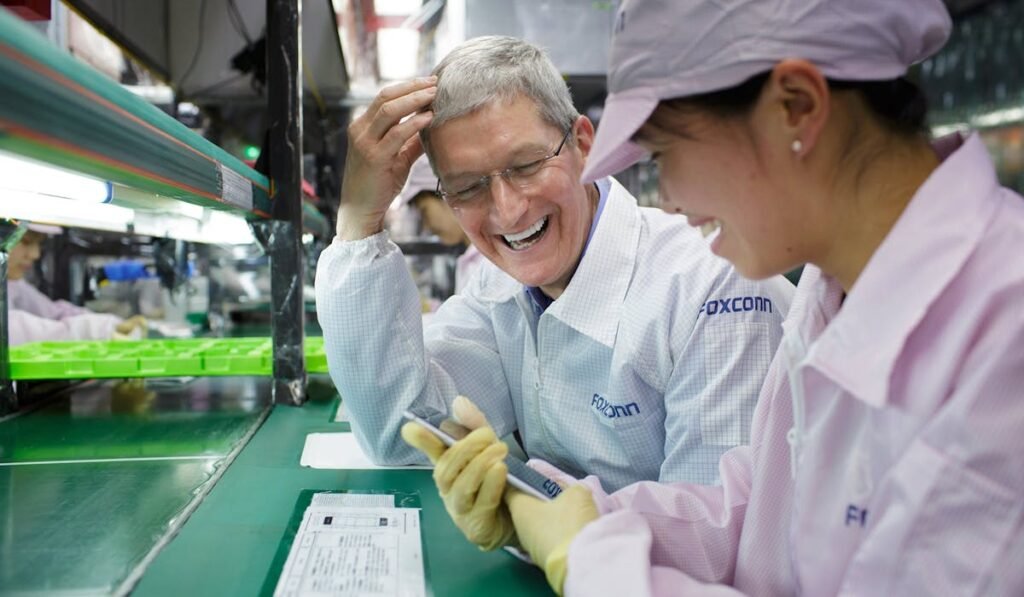
CEO of Apple, Tim Cook, at a Shenzhen Foxconn factory in China
Delve into Business and International Development with Nthanda Manduwi
Systems Don’t Have to Be Broken to Produce Bad Outcomes
I contemplated not publishing an episode this week [I explain why in the podcast], and then ended up recording my longest episode yet.
And to make up for publishing a little late the past two weeks, I am publishing this a day early. You’re welcome, or I am sorry?
I woke up to a message from a friend sharing a video of President William Ruto demanding Veto power for African nations at the 80th United Nations General Assembly [I happened to be in attendance], and I jumped out of bed and got to writing about my favorite beverage: tea! I also got to pen about slave trade, and colonization, and war [I know, what does any of this have to do with Hibiscus tea??!]
This week’s episode explores one of the central ideas behind the third book in the Lessons Book series – Systemic Nonsense: what if many of the frustrations we experience in institutions are not accidents or failures, but predictable outcomes of how those systems were designed?
It often feels like bureaucracy feels so resistant to change, and that reforms often produce more process than progress. It also seems that good intentions so rarely translate into meaningful outcomes. If you’ve pondered on these thoughts before, then these conversations are for you.
This Week’s Book
📖 Systemic Nonsense [Book 3]
This week only, from 27–31 July, the Kindle edition of Systemic Nonsense is available free as part of its Founders Edition launch.
Systemic Nonsense explores several ideas on international development in much greater depth. It asks a simple question:
What if the system isn’t failing? What if it’s doing exactly what it was designed to do?
Whether you listen, read, or dive into the book, I hope it leaves you asking better questions about the systems we inherit—and the ones we choose to build next.
How to Read
To receive your free Kindle copy:
* Click the Amazon link below.
* Select the Kindle edition while the promotion is active.
* Add it to your Kindle library.
You do not need a Kindle device. The free Kindle app works on iPhone, Android, tablets, Macs, and PCs, allowing you to build your digital library wherever you read.
Helpful Links
📚 Read this week’s book for free [search on Amazon or in Kindle for the book that is free for the week, and feel free to purchase the others]:http://amazon.com/dp/B0FQNJ61SB
📰 Subscribe to The Lessons Conversation:
Africa paperback pre-orders:https://forms.office.com/r/RMRMKTNd1M
Enjoyed listening to the Lessons Conversation? This post is public so feel free to share it.
This is a public episode. If you would like to discuss this with other subscribers or get access to bonus episodes, visit podcast.lessonsconversation.com
![Book 3: Systemic Nonsense [lessonsbooks.com]](https://byntha.com/wp-content/uploads/2026/07/podcast-episode-image-5a3bbb435029c89d668c5fa2682893ef-768x768.jpg)
#LessonsWeekly
[Listen to the Podcast for Context, Or Keep Reading Below]
- Manufacturing is a learning system: Factories create skills, standards, suppliers, managers, and technical capability—not just products.
- Foreign investment is only transformative when it leaves capability behind: Jobs matter, but knowledge transfer matters more.
- Apple sought efficiency; China accumulated knowledge: The deeper value of globalization is not access to capital but access to learning.
- Cheap labour is not enough: Prosperity emerges from coordinated systems, not low wages alone.
- Industrial policy is coordination: Infrastructure, education, logistics, finance, and industry must work together.
- National reputations can change: “Made in China” demonstrates that countries are not permanently assigned a place in the global economy.
- Learning compounds: Small capability gains accumulated over decades can transform entire economies.
- Scale matters: Large integrated markets create opportunities for specialization, production, and innovation.
- Supply chains are sources of power: Economic influence increasingly comes from production ecosystems rather than natural resources alone.
- Dependency can masquerade as success: Efficiency without resilience creates vulnerability.
- Africa’s opportunity lies in integration: No African country can achieve China-like scale alone, but Africa collectively can.
- AfCFTA should be a production strategy, not merely a trade strategy: The goal is capability-building, not simply moving goods across borders.
- Human capital is Africa’s most scalable resource: Talent, entrepreneurship, technical expertise, and creativity can become the continent’s greatest export.
- Every partnership should function as a classroom: Africa must approach global engagement with an intentional learning mindset.
- Development is capability accumulation: Prosperity comes from increasing what societies know how to build, maintain, improve, and export.
- The future belongs to societies that learn deliberately: Countries that systematically absorb, adapt, and apply knowledge are the ones that shape the future.
Manufacturing is often discussed as if it were the lower end of the value chain. Development conversations frequently focus on innovation, entrepreneurship, technology, and knowledge economies while treating production as, somehow, a less sophisticated activity. Yet the history of industrialization suggests the opposite. Manufacturing is one of the most powerful learning systems ever created.
Factories train workers. They develop engineers. They strengthen suppliers. They improve logistics networks. They force organizations to master quality control, coordination, and scale. Behind every successful manufacturing sector sits an ecosystem of accumulated knowledge.
This is what China understood.
For decades, the world looked at China and saw cheap labour. China looked at the same factories and saw classrooms.
Every multinational represented an opportunity to learn. Every supplier relationship represented an opportunity to improve. Every production challenge represented an opportunity to build capability. What many outside observers interpreted as manufacturing, China increasingly treated as education.
This helps explain why cheap labour alone cannot account for China’s rise.
If cheap labour created prosperity, many developing countries would already be industrial powers. Labour costs may attract investment, but they do not automatically generate capability. What distinguished China was not simply the availability of workers. It was the existence of systems that allowed learning to compound.
Infrastructure expanded. Ports were built. Industrial zones emerged. Supplier networks developed. Local governments competed for growth. Universities produced technical talent. Firms became more sophisticated. Capabilities accumulated across multiple sectors simultaneously.
China was not simply building factories.
China was building an ecosystem.
The result was a gradual but profound shift. The country initially became known for assembling products designed elsewhere. Over time, it learned how to manufacture increasingly complex goods. Then it learned how to improve them. Then it learned how to design them. Eventually, it began producing firms capable of competing with the very companies that had once dominated global markets.
Huawei illustrates this transformation particularly well.
For much of my childhood, Chinese technology companies were rarely discussed alongside firms such as Apple, Microsoft, Sony, or Samsung. Chinese manufacturers occupied a different category in the global imagination. They produced. Others innovated.
Today, that distinction is far less clear.
Huawei is not simply a manufacturing company. It is a technology company. It competes in telecommunications infrastructure, cloud computing, consumer electronics, artificial intelligence, and enterprise technologies. Whether one prefers Apple or Huawei is not the point. The point is that a Chinese firm now occupies a position that would have been difficult to imagine a few decades ago.
The lesson is not that China became good at copying.
The lesson is that China became good at learning.
And learning, when sustained over decades, becomes capability. Capability eventually becomes competitiveness. Competitiveness can ultimately become leadership.
This may be the most important development lesson in the entire story.
Development is often discussed through the language of GDP, aid, investment, or economic growth. Those indicators matter, but they do not always reveal the underlying process. At its core, development is capability accumulation. It is the gradual expansion of a society’s ability to produce, maintain, improve, finance, regulate, and export increasingly sophisticated goods and services.
Countries become prosperous not because they consume advanced products, but because they learn how to create them.
For Africa, this raises important questions.
Too often, African economies participate in globalization primarily as markets, resource suppliers, or labour pools. Foreign investment arrives. Projects are implemented. Goods are imported. Technology is adopted. Yet the critical question is frequently overlooked:
What are we learning?
Are local firms becoming stronger?
Are local engineers becoming more capable?
Are suppliers upgrading?
Are institutions improving?
What remains after the investment arrives?
China’s experience suggests that the long-term value of global engagement lies not only in access to capital but also in access to knowledge. Every partnership can function as a classroom. Every multinational can become a source of capability transfer. Every supply chain can become a learning opportunity.
This is where I increasingly believe Africa’s future will be determined.
The conversation often focuses on trade, particularly through the African Continental Free Trade Area. Trade matters. Lower barriers matter. Larger markets matter. But the deeper opportunity is not simply moving goods across borders.
The deeper opportunity is production.
The deeper opportunity is learning.
The deeper opportunity is capability accumulation at continental scale.
No African country can replicate China’s domestic market alone. Malawi cannot. Zambia cannot. Rwanda cannot. Ghana cannot. Even Africa’s largest economies face constraints when operating independently.
Collectively, however, the continent possesses something far more significant. Africa is home to more than a billion people, some of the world’s youngest populations, rapidly growing cities, expanding digital adoption, extraordinary natural resources, and increasingly vibrant entrepreneurial ecosystems.
The challenge is integration. Integration as a production strategy.
The future may not be Made in Malawi.
It may not be Made in Kenya.
It may not be Made in Nigeria.
Increasingly, and in my personal opinion, the more compelling vision is Made in Africa.
A continent where products are designed in one country, manufactured in another, financed in another, and sold across integrated markets. A continent where value chains stretch across borders. A continent where knowledge moves as freely as goods. A continent where scale enables learning and learning generates capability.
That is ultimately what I took away from Apple in China.
The book begins as the story of one of the world’s most successful companies. It becomes the story of one of the world’s most successful development transformations. Apple entered China looking for manufacturing excellence. China used the relationship to build industrial capability. That capability eventually produced companies capable of competing with Apple itself. The deeper lesson is not about Apple. It is not even about China. It is about how economies learn. The countries that shape the future are rarely the ones that possess the most resources. They are often the ones that learn most effectively from the opportunities available to them.
For much of my childhood, “Made in China” sounded like weakness. Today, it sounds like power.
The transformation occurred because China spent decades treating production as learning and globalization as an opportunity to accumulate capability. The question for Africa is not whether we can become China. The question is whether we can become equally serious about learning.
If you’d like to go deeper into my journey — from Malawi, through the United Nations to Microsoft, you can find it in my books.
P.S. for 2026, you can get any of my books via Kindle for only $2.99.
This offer is valid till the end of the year.
Links to purchase are as below:



Nthanda Manduwi is a Malawian storyteller, entrepreneur, digital transformation advocate, and community builder driven by the mission to empower Africa’s economic landscape through innovation and technology.