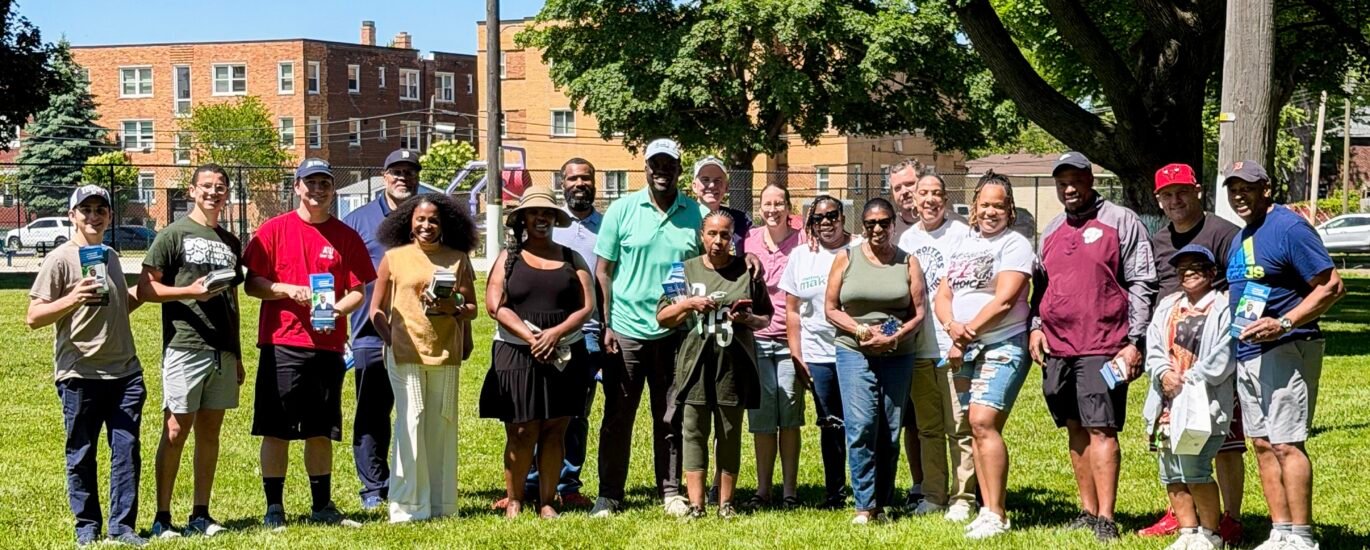
I had reached out to Justin Onwenu to ask how I could support his campaign. He was amenable, and invited me to join a canvass over the weekend. The team was meeting at Memorial Park in the City of Ecorse, part of Michigan State Senate District 1.
I had shared that I do not drive in Detroit, and when I spoke with his campaign manager, Cal, he was more than happy to pick me up and bring me to Ecorse. It was a small logistical detail, but a make or break one, for me. In conversation with him as he dropped me back home later that day, Cal joked that there is roughly a 50% flake rate in volunteer organizing, which made him even more committed to making sure as many people as possible were able to participate.
Campaigns are often narrated through the visible things: the candidate, the speeches, the endorsements, the policy platform, the fundraising numbers, the election results. But the day-to-day running of a campaign depends on the people doing the practical work on the ground: organizing volunteers, moving people, assigning turf, answering questions, solving problems, and making sure others are able to show up.
For me, that was my entry point into the day. That was how the day started.
Delve into Business and International Development with Nthanda Manduwi
Systems Don’t Have to Be Broken to Produce Bad Outcomes
I contemplated not publishing an episode this week [I explain why in the podcast], and then ended up recording my longest episode yet.
And to make up for publishing a little late the past two weeks, I am publishing this a day early. You’re welcome, or I am sorry?
I woke up to a message from a friend sharing a video of President William Ruto demanding Veto power for African nations at the 80th United Nations General Assembly [I happened to be in attendance], and I jumped out of bed and got to writing about my favorite beverage: tea! I also got to pen about slave trade, and colonization, and war [I know, what does any of this have to do with Hibiscus tea??!]
This week’s episode explores one of the central ideas behind the third book in the Lessons Book series – Systemic Nonsense: what if many of the frustrations we experience in institutions are not accidents or failures, but predictable outcomes of how those systems were designed?
It often feels like bureaucracy feels so resistant to change, and that reforms often produce more process than progress. It also seems that good intentions so rarely translate into meaningful outcomes. If you’ve pondered on these thoughts before, then these conversations are for you.
This Week’s Book
📖 Systemic Nonsense [Book 3]
This week only, from 27–31 July, the Kindle edition of Systemic Nonsense is available free as part of its Founders Edition launch.
Systemic Nonsense explores several ideas on international development in much greater depth. It asks a simple question:
What if the system isn’t failing? What if it’s doing exactly what it was designed to do?
Whether you listen, read, or dive into the book, I hope it leaves you asking better questions about the systems we inherit—and the ones we choose to build next.
How to Read
To receive your free Kindle copy:
* Click the Amazon link below.
* Select the Kindle edition while the promotion is active.
* Add it to your Kindle library.
You do not need a Kindle device. The free Kindle app works on iPhone, Android, tablets, Macs, and PCs, allowing you to build your digital library wherever you read.
Helpful Links
📚 Read this week’s book for free [search on Amazon or in Kindle for the book that is free for the week, and feel free to purchase the others]:http://amazon.com/dp/B0FQNJ61SB
📰 Subscribe to The Lessons Conversation:
Africa paperback pre-orders:https://forms.office.com/r/RMRMKTNd1M
Enjoyed listening to the Lessons Conversation? This post is public so feel free to share it.
This is a public episode. If you would like to discuss this with other subscribers or get access to bonus episodes, visit podcast.lessonsconversation.com
![Book 3: Systemic Nonsense [lessonsbooks.com]](https://byntha.com/wp-content/uploads/2026/07/podcast-episode-image-5a3bbb435029c89d668c5fa2682893ef-768x768.jpg)
Justin is running for Michigan State Senate District 1, covering Detroit, Ecorse, Lincoln Park, River Rouge, and Wyandotte. I first knew Justin through Detroit’s entrepreneurship and economic opportunity ecosystem, particularly because the Detroit Tech Residency Fellowship I am part of falls under his jurisdiction in the City of Detroit. Before I knew him as a candidate, I knew him as someone working inside the city to support entrepreneurs, small businesses, startups, and the systems that make local economic growth possible.
There are candidates who begin to discover the language of community when they start running for office. Justin, from what I have come to know about him, is different. His campaign sits naturally at the intersection of work he has already been doing: small businesses, workers, neighborhoods, affordability, environmental justice, and ethical government. These are not separate issues. They are the everyday conditions that determine whether people can live with dignity, and whether communities can build power.
Justin’s campaign is strongest when understood as a governing argument.
District 1 needs leadership that can hold multiple realities at once. Detroit and Downriver communities are not identical, but many of the concerns overlap: the cost of living, wages, utility bills, housing, healthcare, small business survival, infrastructure, public schools, transportation, environmental harm, and trust in government.
Justin’s platform speaks to these issues directly. He is focused on lowering costs for working families, strengthening protections for workers, supporting small businesses and startups, investing in neighborhoods, protecting clean air and water, and making government more transparent and accountable.
This is a systemic combination, and an important one.
Too often, politics separates workers from entrepreneurs, neighborhoods from economic development, environmental justice from health, and ethics from service delivery. But in practice, people experience these issues together. A small business owner is also a resident. A worker is also a parent, tenant, driver, patient, and voter. A neighborhood is not just a collection of houses; it is infrastructure, memory, health, safety, opportunity, and trust.
With that in mind, Justin’s candidacy feels coherent. He is not offering a single-issue campaign. He is offering a systems view of what District 1 needs, grounded in the real mechanics of local and state government.
What struck me most was not only Justin. It was the people who showed up around him.
Campaigns reveal something about a candidate through the people willing to stand beside them. Yesterday, I saw a coalition: local leaders, organizers, founders, campaign workers, volunteers, neighbors, and residents moving through the day with a shared sense of purpose.
That matters because public leadership is never individual work. A candidate may carry the name on the sign, but campaigns are built through relationships. They depend on people who lend credibility, labor, memory, local knowledge, technical skill, and trust.
Before I fully understood the turf we had been assigned, I understood the civic ecosystem around Justin.
One of the people who stood out to me was Theresa Landrum.
Theresa is a longtime environmental justice activist in Detroit, especially associated with Southwest Detroit and the 48217 community. Her presence gave the day a different kind of depth. Environmental justice can easily become a paragraph in a policy platform. Around people like Theresa, it becomes much harder to treat it abstractly.
Clean air is not abstract. Clean water is not abstract. The placement of industrial facilities is not abstract. Pollution is not abstract. The health consequences borne by specific neighborhoods are not abstract.
Seeing Theresa there reminded me that some communities have been carrying the costs of policy failure for decades. Their residents know what it means when government does not listen quickly enough, regulate strongly enough, or respond honestly enough. They know what it means when harm becomes normalized because the people experiencing it do not have enough power.
That is why Justin’s environmental justice priorities matter. They are not side issues. They are governance issues. They are health issues. They are economic issues. They are neighborhood issues. They are dignity issues.
As someone from Malawi, I felt that connection immediately. I come from a country shaped by Lake Malawi, agriculture, climate pressures, tourism, and infrastructure gaps. Water is not simply landscape. It is life, economy, memory, food, transport, and identity. Michigan, too, is shaped by water. The Great Lakes carry ecological, economic, and political meaning.
The contexts are different, but the governing question is familiar: who gets clean air, who gets clean water, who lives closest to environmental risk, and whose suffering becomes visible enough to demand action?
The Mayor of Ecorse, Lamar Tidwell, was also present and moved with Justin during the canvass.
That mattered because District 1 is not only Detroit. It includes Downriver communities with their own histories, local governments, struggles, and ambitions. Ecorse is not a footnote in a Detroit-centered story. It is a city with residents, leadership, institutions, businesses, and its own development questions.
That is one of the first lessons of local politics: place matters.
People do not experience governance first through national speeches or state-level abstractions. They experience it through the street outside their house, the school their child attends, the utility bill they pay, the bus that does or does not come, the business district nearby, the air they breathe, the water they drink, and the leaders who show up when there is no camera.
In Malawi, we often speak about transformation through national frameworks: Malawi 2063, industrialization, youth development, agricultural productivity, urbanization, digital transformation. Those frameworks matter. But transformation is ultimately felt locally. A national vision only becomes real when a young person in Mangochi, Mzuzu, Blantyre, Zomba, Lilongwe, Karonga, or Nsanje can point to something in their own life that has changed.
Michigan reminded me of that.
People experience governance locally long before they experience it nationally.
One of the people I met during the canvass was Paris Randolph.
Paris is an entrepreneur with deep roots in Michigan. One of the things I noticed throughout the day was that many of the people supporting Justin were not professional political operatives. They were community members, business owners, organizers, local leaders, and residents who had chosen to give up part of their weekend because they believed the outcome of the election mattered. Paris was one of those people.
As we moved through neighborhoods and conversations, I found myself thinking about the different ways people become invested in a place. Some people arrive and learn a city over time. Others inherit generations of family history, relationships, businesses, and memories tied to the same streets and communities.
For people like Paris, Michigan is not simply a place where opportunity exists. Michigan is home.
My canvassing partner was Farai Gundan.
Farai and I connected through Merlinda-Loriane Sewavi, who introduced us because we are both African women building in Michigan. That connection itself says something about the Detroit ecosystem. The technology, entrepreneurship, and civic spaces here are not as separate as they may appear. Founders introduce founders. Builders connect builders. People working on mobility, biotech, economic development, public systems, and community work end up in the same rooms, and sometimes on the same streets.
Farai is the founder of Bhadala, a company working around mobility, digital payments, transportation access, and data-driven systems. Merlinda is the founder of Syntheia Labs, working in biotech and cardiac drug safety. .
There was something quietly meaningful about walking that turf with Farai. Two African [one naturalized American] women founders in Michigan, using American campaign technology, knocking on doors for a Detroit and Downriver political campaign, and thinking about what these systems might mean beyond the United States.
The most interesting part of the day, for me, was the technology.
We used MiniVAN, a canvassing app that helps campaigns assign turf, guide volunteers through voter contact lists, record responses, and sync field data back into the campaign’s broader database. I had known, generally, that American politics was highly organized. But using the app made that organization visible in a new way.
We were not moving randomly. We had a defined area. We had streets to cover. We had households to approach. We had a system for logging what happened at each door.
Farai and I had to make practical decisions. We worked from the bottom upward. I would take one street; she would take another. We coordinated so we did not duplicate effort. We moved through the assigned area with a mix of structure and improvisation.
That may sound simple, but it was instructive.
Politics is not only speeches, slogans, debates, and social media. It is logistics. It is data. It is volunteer coordination. It is field intelligence. It is repetition. It is knowing where people are, who has been contacted, who needs follow-up, which neighborhoods are engaged, and where trust still needs to be earned.
MiniVAN turned volunteer energy into organized action. That was the systems lesson for me.
At the same time, the doors reminded me of the limits of technology.
Throughout the canvass, MiniVAN helped assign turf, organize routes, record interactions, and coordinate volunteers across the district. As somebody who spends a lot of time thinking about systems, I found myself paying almost as much attention to the app as I was to the doors. It clearly stood out to me how intentionally the campaign seemed to be using it.
Cal was sure to remind us that connecting with voters was the most important part of the day, and the tech was just a tool. He described canvassing as an opportunity to listen. The goal was not simply to knock on as many doors as possible. The goal was to understand what residents were experiencing and what they expected from someone seeking to represent them.
As conversations happened across different neighborhoods, they were being captured in a way that meant they would not simply disappear at the end of the day. We had to hold on to the real concerns, and hold memory. Residents raised concerns. Volunteers recorded them. The campaign could then step back and look across hundreds of individual conversations and identify patterns. You could say MiniVAN was the quantitative part, and we were the qualitative part. It was a complementary effort.
In a campaign built around affordability, neighborhoods, environmental justice, small businesses, and government accountability, that creates a structured way of hearing from people rather than relying on assumptions about what they care about.
Every address in an app is still a home. Every home belongs to a person or family. Every unanswered door still [hopefully] has a life behind it. Every conversation, however brief, represents someone’s time, privacy, concern, or fatigue.
Political technology must never make people feel reduced to data points.
That is especially important when thinking about how these tools might translate to other contexts. As a demographer, I was fascinated by the mapping, segmentation, routes, and field data. As an entrepreneur, I immediately began thinking about what an Africa-adapted civic platform could look like. But as someone from a continent where politics can be shaped by ethnicity, region, tribe, religion, class, language, and historical grievance, I also felt the ethical weight of the question.
The goal should never be to build better tools for manipulation.
The more interesting question is whether we can build civic infrastructure that helps leaders and communities listen better. A system designed for African contexts would need to be offline-first, low-data, multilingual, and compatible with feature phones and USSD where necessary. It would need strong safeguards around consent, privacy, political misuse, and identity-based targeting. It would need to support voter education, community issue mapping, volunteer coordination, and post-election accountability.
Most importantly, it would need to be designed around trust.
Africa does not lack political organizing. It does not lack mobilization. It does not lack people who understand their communities. What remains underbuilt in many contexts is ethical civic infrastructure that can connect community concerns to organized action and, eventually, to accountable governance.
That is where my mind went. This is where my mind is.
Michigan is teaching me that development questions exist everywhere.
The language changes. The income levels change. The institutional context changes. But the questions remain recognizable:
These are Michigan questions. They are also Malawi questions. They are African questions. They are governance questions.
Michigan has an industrial legacy. Africa still has has industrial aspirations. Detroit and Downriver carry the memory of what industry built, what it damaged, and what it left behind. Malawi and many African countries are still asking how to industrialize in ways that create jobs, protect communities, build local wealth, and avoid repeating harms that other regions now have to repair.
That is why canvassing felt larger than a campaign activity to me. It was a field lesson in governance.
By the end of the day, I understood Justin’s campaign more clearly.
He is not simply running on biography, although his biography matters. He is not simply running on energy, although energy matters. He is not simply running as a young leader, although generational transition matters too.
The stronger case is that Justin is running with a practical understanding of the systems District 1 needs to improve. He has worked in entrepreneurship and economic opportunity. He understands the relationship between workers and small businesses. He recognizes that affordability is not a talking point but a daily pressure. He treats environmental justice as central to health and neighborhood life. He speaks about ethical government because without trust, even good policy struggles to land.
That is why people showed up for him.
The coalition around him made sense because the campaign itself makes sense. It gives workers, entrepreneurs, organizers, local officials, environmental justice advocates, founders, and residents a reason to see their concerns in the same governing project.
That is not easy to do.
After canvassing, Cal and I ended the day in East Africa at Baobab Fare: East African restaurant in Detroit.
He recommended the restaurant when he learnt I am from South East Africa, and I am so glad he did. He said he first came to the restaurant on Justin’s recommendation.
I had their signature Mbuzi dish, and I am not exaggerating when I say it was the best meal I have had in Michigan.
The ending to the day felt fitting. I had spent the day learning Michigan at the doorstep and ended it with East African food in Detroit. The worlds I am moving between felt present in the same day: Africa, America, politics, technology, entrepreneurship, community, food, friendship, and public life.
I am rooted in Africa. I am learning America. I am building in Michigan. And I am constantly thinking about what the systems I encounter here might teach me about the futures we still need to build back home.
Yesterday reminded me that leadership begins with proximity.
Proximity to people.
Proximity to place.
Proximity to memory.
Proximity to systems.
Proximity to the concerns people carry quietly until someone knocks and asks.
I left thinking that anyone who hopes to lead must first learn how communities see themselves.
And yesterday, one door at a time, Michigan was teaching me.
If you’d like to go deeper into my journey — from Malawi, through the United Nations to Microsoft, you can find it in my books.
P.S. for 2026, you can get any of my books via Kindle for only $2.99.
This offer is valid till the end of the year.
Links to purchase are as below:



Nthanda Manduwi is a Malawian storyteller, entrepreneur, digital transformation advocate, and community builder driven by the mission to empower Africa’s economic landscape through innovation and technology.