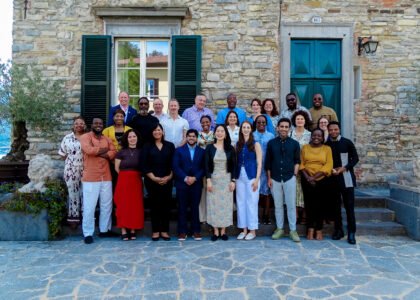

Six months into the Rockefeller Foundation Big Bets Fellowship, I find myself returning to a problem that predates the fellowship itself.
For several years, much of my work was organised around a relatively straightforward proposition.
Africa had a rapidly growing young population, technology was changing the structure of work, and young people needed access to the skills that would allow them to participate in that future. Digital Skills for Africa grew out of that conviction. We designed courses, trained young people, worked with schools, experimented with different delivery models and tried, repeatedly, to understand how an education platform serving a predominantly price-sensitive market could become commercially sustainable.
The difficult part was rarely persuading people that digital skills were valuable. Learners understood their importance. Schools understood them. Parents understood them. Employers increasingly did too. The more difficult question was economic: who had sufficient incentive, authority and purchasing power to pay for the capability being created?
Our experiments with direct-to-consumer learning were instructive. Learners would complete training with considerable enthusiasm, but willingness to pay became clearer when certification entered the transaction. That distinction forced me to reconsider what the customer believed they were buying. Knowledge mattered, but certification carried a labour-market signal. In a context where formal employment is scarce and employers need mechanisms for distinguishing among applicants, the credential could have greater immediately perceived economic value than the underlying learning itself.
Schools exposed a different version of the same problem. A headteacher could agree that students should have better access to technology. A school owner could understand that a credible digital-skills programme might strengthen the institution’s value proposition to parents. Yet institutional agreement did not automatically produce a budget. Decisions travelled through approval processes, competing priorities, fee structures and the economics of the school itself. We had approached the institution with an educational proposition while the institution still had to answer a financial question.
Over time, one question began appearing underneath almost every project I touched: what makes money move?
It followed me from Digital Skills for Africa into agriculture, universities, gaming, simulation, robotics and cyber-physical infrastructure. It has followed me into consumer products and, more recently, into thinking about the economics of sport and intellectual property. The sectors look unrelated when placed beside one another. The underlying inquiry has been remarkably consistent. I have been trying to understand what causes people and institutions to allocate scarce resources toward building capability, how that capability becomes productive, and why so much potential remains economically dormant even when the need is obvious.
The Big Bets Fellowship has brought me back to human capital with a more complicated understanding of the problem.
Africa certainly needs more capable people. The continent’s demographic trajectory makes that imperative difficult to overstate. But capable people are only one part of the development system. Human capital has to be formed, financed, absorbed, organised and allowed to compound. A child must first learn. An adult must acquire increasingly sophisticated capability. A firm or institution must then have productive use for that capability. Firms need the conditions to scale. Public institutions need the competence to coordinate systems markets cannot build alone. Without those links, education can improve individual possibility while leaving the wider productive structure substantially unchanged.
The human-capital problem is therefore much larger than education.
Delve into Business and International Development with Nthanda Manduwi
Systems Don’t Have to Be Broken to Produce Bad Outcomes
I contemplated not publishing an episode this week [I explain why in the podcast], and then ended up recording my longest episode yet.
And to make up for publishing a little late the past two weeks, I am publishing this a day early. You’re welcome, or I am sorry?
I woke up to a message from a friend sharing a video of President William Ruto demanding Veto power for African nations at the 80th United Nations General Assembly [I happened to be in attendance], and I jumped out of bed and got to writing about my favorite beverage: tea! I also got to pen about slave trade, and colonization, and war [I know, what does any of this have to do with Hibiscus tea??!]
This week’s episode explores one of the central ideas behind the third book in the Lessons Book series – Systemic Nonsense: what if many of the frustrations we experience in institutions are not accidents or failures, but predictable outcomes of how those systems were designed?
It often feels like bureaucracy feels so resistant to change, and that reforms often produce more process than progress. It also seems that good intentions so rarely translate into meaningful outcomes. If you’ve pondered on these thoughts before, then these conversations are for you.
This Week’s Book
📖 Systemic Nonsense [Book 3]
This week only, from 27–31 July, the Kindle edition of Systemic Nonsense is available free as part of its Founders Edition launch.
Systemic Nonsense explores several ideas on international development in much greater depth. It asks a simple question:
What if the system isn’t failing? What if it’s doing exactly what it was designed to do?
Whether you listen, read, or dive into the book, I hope it leaves you asking better questions about the systems we inherit—and the ones we choose to build next.
How to Read
To receive your free Kindle copy:
* Click the Amazon link below.
* Select the Kindle edition while the promotion is active.
* Add it to your Kindle library.
You do not need a Kindle device. The free Kindle app works on iPhone, Android, tablets, Macs, and PCs, allowing you to build your digital library wherever you read.
Helpful Links
📚 Read this week’s book for free [search on Amazon or in Kindle for the book that is free for the week, and feel free to purchase the others]:http://amazon.com/dp/B0FQNJ61SB
📰 Subscribe to The Lessons Conversation:
Africa paperback pre-orders:https://forms.office.com/r/RMRMKTNd1M
Enjoyed listening to the Lessons Conversation? This post is public so feel free to share it.
This is a public episode. If you would like to discuss this with other subscribers or get access to bonus episodes, visit podcast.lessonsconversation.com
![Book 3: Systemic Nonsense [lessonsbooks.com]](https://byntha.com/wp-content/uploads/2026/07/podcast-episode-image-5a3bbb435029c89d668c5fa2682893ef-768x768.jpg)
Consider a case of one of my peers at MSU. He is African, and in his mid-thirties. He grew up in one of his country’s cities dense working-class neighbourhoods in a household where financial scarcity shaped the ordinary decisions of family life. School fees mattered. Transport mattered. A sickness could become an economic event. An unexpected expense could alter plans for months. There was no inherited portfolio waiting at adulthood, no property against which to borrow and no expectation that a parent could finance an extended period of experimentation while he found himself professionally.
He did what development policy often asks people in such circumstances to do. He stayed in school. He performed well enough to continue. He became the first person in his immediate family to reach university and eventually completed a degree. Through a combination of education, persistence, work and international mobility, he later found himself living in the United States.
The visible story is one of upward mobility.
The balance sheet tells a more complicated story.
He earns considerably more than the household in which he was raised ever earned. He also supports relatives who did not make the same transition. A parent’s medical need can become his expense. A younger relative’s school fees may enter his budget. An emergency at home can interrupt savings accumulated abroad. His income is higher, but some of that income performs functions that pension systems, insurance markets, student finance, healthcare systems and accumulated household assets perform for people born into more economically secure families.
Another professional earning the same salary may begin from an entirely different position. Their parents may be financially independent. Their university education may have been paid for. They may have received help with a first car, a rental deposit or a down payment on a house. They may be able to take a six-month entrepreneurial risk because failure does not threaten the entire family system around them. They may inherit networks that reduce the cost of finding opportunity and assets that allow income to compound into wealth earlier.
I say this, because I have lived this privilege, and I am now more aware of it that I have been in the past.
The labour market sees two people earning the same salary.
Their economic starting points remain very different.
This is one reason I have become increasingly dissatisfied with the binary language of “breaking the cycle of poverty.”
Poverty is rarely crossed at a single threshold. Education can raise earnings substantially without immediately generating assets. International migration can increase income without eliminating obligations created by the economic conditions from which someone migrated. A person can move far beyond the circumstances of childhood while continuing to carry parts of those circumstances financially well into adulthood.
The first generation to achieve educational mobility may therefore spend a significant portion of its productive life repairing inherited deficits rather than accumulating new capital. Parents need retirement support because there was no pension. Younger relatives need educational support because the household has no accumulated savings. Housing needs investment because the family never owned a durable asset. Health shocks consume income because insurance coverage is weak. The graduate has escaped one aspect of poverty while becoming the mechanism through which several other manifestations of poverty are managed.
None of this means education failed. It means human capital and financial capital do different work.
Education can alter a person’s productive capacity quickly. Wealth generally compounds more slowly.
That distinction matters enormously for how Africa thinks about mobility.
My friend Santos Akhilele, a data scientist and education specialist with Human Capital Africa, wrote a reflection in 2024 titled Foundational Education Is A Matter Of Life And Death! The title emerged from a Human Capital Africa presidential briefing in Accra, where the conversation turned to the consequences of Africa’s foundational-learning crisis.
His central argument was simple and uncomfortable. Africa has made considerable progress in getting children into school, but schooling is not synonymous with learning.
The underlying data remain severe. UNESCO describes foundational learning as the cornerstone of subsequent education and estimates that nearly nine in ten children in sub-Saharan Africa are in learning poverty, meaning they cannot read and understand a simple age-appropriate text by around age ten.
Santos illustrated the problem through a fictional ten-year-old girl named Asabe. The obvious policy response to a child with constrained educational opportunity is usually to get her into school. But if most children who are failing to learn are already enrolled, access solves only part of the problem. Santos put the point more starkly: Africa has succeeded in changing the location where many children are not learning.
The distinction between enrolment and learning is foundational to any serious discussion of human capital. Expanding access remains necessary. A child outside school is substantially harder to reach through formal learning systems. But the economic return to schooling ultimately depends on what happens inside the school. Teacher capability matters. Instructional time matters. Nutrition matters. Curriculum design matters. Assessment matters. Language of instruction matters. School leadership matters. Ministries need the data and administrative capacity to identify where learning is failing and to respond accordingly.
The reason the foundational stage matters so much is that learning accumulates.
A child who becomes a fluent reader early has acquired much more than a discrete competency called literacy. Reading becomes an instrument through which that child subsequently learns science, history, mathematics, agriculture, technology and almost every other discipline presented through written material. A child who has not acquired fluency does not simply remain one skill behind. As the curriculum becomes more demanding, later instruction increasingly assumes knowledge and cognitive tools that may never have been consolidated. The gap can therefore widen through the educational system.
Human capital is cumulative.
This is important because the development sector often becomes excited by advanced interventions while the foundational system beneath them remains weak. Coding programmes, AI training, entrepreneurship accelerators, university scholarships and sophisticated technical education all matter, but they sit on top of literacy, numeracy, cognition, health and the ability to learn independently.
A society cannot sustainably build advanced human capital while accepting mass foundational-learning failure as normal.
The implications extend beyond individual earnings. Education is associated with health outcomes, fertility decisions, maternal and child survival, civic participation and the educational attainment of the next generation. A child who learns well is acquiring an individual capability, but the effects of that capability can move through an entire household over time.
Santos was therefore right to frame foundational learning as more than a schooling issue. It is part of the productive architecture of a society.
The argument becomes more complicated once the child learns.
For years, much of the youth-development ecosystem has understandably focused on expanding skills. Digital Skills for Africa emerged within that tradition. The apparent constraint was capability. Teach people more useful things and their economic prospects should improve.
That remains true at the individual level. But labour markets contain demand as well as supply.
Training ten thousand software developers does not create ten thousand software jobs. Producing engineers does not create an engineering industry. A country can train agricultural scientists faster than its agricultural firms become sophisticated enough to employ them. Universities can increase graduation rates while the productive economy remains unable to absorb graduates into work commensurate with their capabilities.
The World Bank’s current work on employment in sub-Saharan Africa brings the firm side of this problem into focus. Approximately 73 per cent of employment in the region is concentrated in own-account and family-run enterprises. The Bank argues that Africa needs a greater share of organised medium-sized and large firms because those organisations are better positioned to achieve economies of scale and generate specialised, higher-productivity employment.
Firm size matters partly because organisational scale determines the kinds of work an economy can sustain.
A five-person enterprise rarely employs a specialist in procurement, a data analyst, a mechanical engineer, a cybersecurity professional, an operations manager and a research scientist. Each additional layer of organisational sophistication creates room for more specialised forms of human capital.
A large productive firm can also become an educational institution in its own right. Workers learn processes, technical standards, management systems, quality control, equipment operation and organisational discipline through work. Engineers accumulate experience solving actual production problems. Managers learn to coordinate increasingly complex systems. Employees leave and carry knowledge into suppliers, competitors and new ventures.
Firms therefore do not simply absorb human capital.
They also produce it.
This is why education policy and enterprise policy cannot be treated as unrelated policy portfolios. The return to investments in education depends partly on whether an economy contains organisations capable of using what educated people know. At the same time, firms cannot become more sophisticated without workers and managers capable of supporting that transition.
Human-capital formation and firm development reinforce each other.
Where both remain weak, weakness compounds.
In January 2025, The Economist gave this problem an intentionally provocative formulation: “Africa has too many businesses, too little business.”
The argument challenged one of the continent’s most familiar narratives. Africa is routinely described as entrepreneurial, and the description is not invented. Across the continent, millions of people trade, produce, repair, transport, farm, design and sell. Self-employment is ubiquitous. Markets are full of economic activity.
The question is what kind of economic activity that enterprise generates.
Many African businesses remain extremely small. They operate with little capital, employ few people outside the immediate household, generate modest productivity gains and have limited capacity to invest in technology or management. The prevalence of entrepreneurship can therefore coexist with a shortage of firms capable of operating at scale.
Sayuri Sharper objected to the framing.
Sharper is the CEO of the Kuo Sharper Initiative and President of KSF Impact. In 2025, the former Legatum Center for Development and Entrepreneurship at MIT was renamed the MIT Kuo Sharper Center for Prosperity and Entrepreneurship following a gift from Sayuri and Craig Sharper. The Center’s mission focuses on entrepreneurship and innovation across global growth markets.
Responding to The Economist, Sharper agreed that Africa needed more large businesses but resisted the implication that the abundance of small enterprise represented a developmental mistake. “Businesses do not start large,” she wrote. They grow when they have access to the right ingredients, particularly talent, capital and infrastructure.
She also challenged the tendency to describe informal self-employed Africans as “unemployed in disguise.” Many are indeed financially insecure and operate at subsistence scale, but they are also working within economies that have failed to create enough formal jobs. Informal enterprise often represents a household’s adaptation to the labour market that actually exists.
There is important truth on both sides of this debate.
The Economist is right that a high-productivity economy cannot be built entirely from microenterprises. Sharper is right that declaring a need for larger firms does not explain how firms become large.
The more useful policy question is what happens between those two states.
How does an enterprise employing three people become a company employing thirty? What allows the thirty-person business to employ three hundred? What allows it to purchase better machinery, adopt technology, hire professional management, survive a currency shock, enter a neighbouring country or eventually compete internationally?
This is the question of enterprise graduation.
The answer cannot simply be “capital,” although capital is central. Firms also require markets, management, infrastructure, predictable institutions, technology and demand. They need financial institutions able to assess growth potential rather than lending only against existing collateral. They need customers large enough to support expansion. They need reliable electricity and logistics. They need employees who can operate systems more sophisticated than those with which the founder began.
Some firms will never make that transition, and that is not necessarily evidence of policy failure. Small businesses serve different functions. A roadside food trader supporting a household and a technology company developing intellectual property may both appear in an SME dataset while possessing completely different growth potential. Policy needs to distinguish between livelihood enterprises whose productivity and security should be improved and growth-oriented firms capable of becoming larger productive organisations.
Treating every microenterprise as an infant large corporation is as misleading as treating every microenterprise as disguised unemployment.
The development task is to understand which enterprises can scale, what prevents them from doing so, and which institutions are capable of removing those constraints without turning enterprise policy into indiscriminate subsidy.
Enterprise graduation returns us immediately to human capital.
Capital can purchase machinery. It cannot guarantee that the organisation knows how to use the machinery well.
A firm becomes larger partly by becoming organisationally more sophisticated. Accounting has to improve. Inventory systems become more important. Recruitment becomes formalised. Legal compliance expands. Quality control has to become repeatable. Procurement has to be managed. Sales cannot depend indefinitely on the founder’s personal relationships. Information has to move through the organisation without every decision returning to one person.
Scale is partly organisational technology.
This is one reason Africa’s human-capital conversation cannot stop with founders. The continent needs entrepreneurs, but it also needs managers, engineers, accountants, technicians, operations specialists, researchers and supervisors capable of building organisations that survive beyond the individual who created them.
The founder is only one human-capital input into the firm.
The lender is another.
A financial institution unable to evaluate the productive potential of a growing company will naturally retreat toward collateral, short maturities and businesses whose risk is easier to understand. A technically capable lender can distinguish more effectively between a firm with a credible growth trajectory and one whose cash flow cannot support expansion.
Regulators require capability too. So do standards bodies, procurement agencies and trade authorities. A business attempting to scale operates within a network of institutions whose competence affects its own cost structure.
Development does not occur because one entrepreneur becomes sophisticated while every institution around the entrepreneur remains weak.
Capability has to thicken across the system.
Seen through this lens, I no longer interpret the difficulty of monetising Digital Skills for Africa simply as evidence that the market did not value education.
The more useful lesson concerns incentive architecture.
Learners valued capability, but many operated under severe purchasing constraints. Certification created a clearer willingness to pay because certification could be understood as a labour-market asset. Schools valued digital learning, but school budgets reflected many competing needs. Administrators could agree intellectually with our proposition without possessing sufficient discretionary resources to finance it.
The mistake was not necessarily in identifying a need.
The incomplete part was our understanding of the economic system surrounding the need.
Education is particularly instructive because the beneficiary and payer are frequently different actors. Governments finance schooling because educated populations produce social and economic benefits beyond the individual learner. Employers finance workforce development because they capture part of the return through productivity. Parents pay because they expect improvements in their children’s future opportunities. Universities pay for learning technologies because those technologies may support institutional objectives. Foundations and development partners finance education where social returns exceed what households can privately afford.
The relevant question is therefore not simply whether a person values the learning.
It is who captures sufficient return from the learning to finance its production.
That realisation has changed how I think about DSA.
Perhaps the viable model is not a conventional course marketplace charging low-income learners repeatedly for content. Certification may finance open learning. Employers may finance particular skill pathways. Schools may purchase institutional access where the programme helps them differentiate their offering. Governments or development institutions may finance foundational digital capability where the return is primarily social. The platform may serve several customers because the economic value of human-capital formation is distributed across several actors.
Once the problem is framed this way, “who pays?” stops being merely a startup question.
It becomes part of education policy.
A conversation at Michigan State University gave me another version of the same lesson.
I had become increasingly interested in gamified simulation as a learning environment. AI was changing the economics of higher education, and simulation appeared capable of doing something that conventional instruction could not easily replicate. A student could manipulate a system, test decisions, observe consequences and learn from repeated interaction rather than receiving only a written description of how the system behaves.
My Professor of Marketing, Raymond Pirouz pushed me to look more carefully at the institution around the technology.
Universities are educational institutions, but their economics are not determined by teaching quality alone. Research universities also care deeply about research output, grants, faculty productivity, rankings, enrolment, retention and institutional prestige. Faculty themselves operate within promotion and tenure systems that reward research and publication alongside teaching.
That changes the proposition for an educational technology.
A simulation platform becomes institutionally more valuable when it can preserve academic rigour while reducing repetitive instructional burden, support research, generate useful data, allow experimentation that would be prohibitively expensive in a physical setting or help an institution serve more students without degrading quality.
The question was no longer simply whether simulation made learning better.
It was whether simulation solved a problem the university already had an incentive to finance.
That is a much more general principle than anything specific to higher education.
Institutions allocate resources according to their incentive structures. A technically excellent solution can remain unfunded when it solves a problem nobody with budget authority is rewarded for solving. A less elegant solution may scale rapidly because it aligns precisely with how an institution measures success.
Understanding markets therefore requires understanding institutions.
When I came to Michigan, agriculture was becoming increasingly difficult to ignore.
The shift had begun earlier in Malawi. Through our innovation hub, I had spent time speaking with young entrepreneurs, development practitioners and public officials about the problems they were encountering. Agriculture kept returning to the conversation. Given its significance to Malawi’s economy, employment and food security, this was unsurprising.
I knew technology much better than agriculture.
That gap became part of the attraction.
Michigan State University gave me an environment in which agriculture, engineering, business and technology could be studied within the same institutional ecosystem. I began with a relatively open question: what would a genuinely technology-enabled agricultural production system look like?
The early idea was a smart farm.
That sounds simple until one begins designing the system rather than the marketing language around it. Agricultural production depends on land, soil, seed, water, machinery, energy, storage, labour, logistics, finance, markets, weather information and technical knowledge. Once advanced technology enters, additional dependencies appear. Sensors need connectivity. Autonomous machines need information about the physical environment. Data has to be stored and interpreted. Equipment requires maintenance. Digital models depend on reliable operational information. Each technological layer introduces a requirement beneath it.
This was the beginning of what later became Kwathu Smart Innovation Farms and the broader cyber-physical infrastructure work. I was able to trace that movement from agriculture into IoT, digital twins, simulation, robotics, autonomy and the infrastructure required to connect the digital and physical environment.
The important lesson was not that every African farm needs advanced robotics.
It was that sophisticated technology makes foundational constraints harder to ignore.
The more advanced the system, the less romantic one can afford to be about electricity, connectivity, maintenance, roads, technical skill and institutional capability.
My summer at Microsoft Xbox initially looked like a departure from that agricultural trajectory.
In practice, it changed the way I understood the problem.
Games are sophisticated simulated environments. They contain rules, constraints, actors, resources, incentives, progression and feedback. A game designer can alter one variable and observe changes throughout the system. Players learn the logic of a world by acting inside it.
While working within the Xbox ecosystem, I began looking at the agricultural system I had been designing differently. The farm contained interacting variables. It contained decisions. It contained limited resources. It contained uncertainty and consequences.
I realised that I had already designed much of the underlying logic of a simulation without calling it one.
That mattered educationally, but it also mattered commercially. Farming simulators, city builders, logistics games and other complex simulations already had paying audiences. Simulation did not need to exist only as a donor-funded learning intervention. It could potentially function as intellectual property with both educational and entertainment value.
There was a collision between those ideas and the eventual emergence of Q2 Systems, a framework connecting real-world systems, digital representations and interactive simulation.
Yet once again, following the technology outward eventually led back to human capital.
Someone has to design the simulation.
Someone has to understand the agricultural system being represented.
Someone has to build the autonomous machine.
Someone has to maintain it.
Someone has to analyse the data.
Someone has to manage the company commercialising it.
Someone in government has to understand enough about the technology to regulate or procure it intelligently.
The technological frontier is therefore also a human-capital frontier.
The Rockefeller Foundation Big Bets Fellowship arrived while those ideas were still expanding.
I entered the fellowship with a proposition centred on food security, autonomous agricultural systems, simulation and experiential learning. At Bellagio, the technology remained important, but it became harder to treat it as the centre of the problem.
The system around the technology was larger.
I had followed hunger into IoT, robotics, AI, digital twins and autonomous systems, but eventually found myself thinking about the productive, technical, fiscal and institutional environment required for those technologies to matter.
The smart farm became interesting not only because it might produce food.
It could also produce people who understand productive systems.
Agriculture forces disciplines together in ways universities often do not. A farm using connected technology may involve agronomy, mechanical engineering, software, networking, data science, AI, operations, energy, logistics, finance and maintenance. The physical system does not respect the departmental boundaries through which academic institutions usually organise knowledge.
That creates an educational possibility.
Students could encounter the physical system, study its digital representation, manipulate a simulation and eventually operate within the real environment. Theory would remain necessary, but the distance between theoretical knowledge and operational competence could become smaller.
This matters because one of Africa’s human-capital problems is precisely that distance.
A graduate may know the concept.
The economy needs people who can execute it.
The term “human capital” is sometimes used so routinely that its economic meaning disappears.
Human capital is not simply education expenditure or years of schooling. It is the stock of health, knowledge, cognitive capacity, judgement, technical skill and experience embodied in people.
Those capabilities affect what an economy can produce.
A country can increase enrolment without increasing learning proportionately. It can increase degrees without producing corresponding professional competence. It can train people in skills for which there is little productive demand. It can build excellent individuals who then leave because organisations at home cannot use what they know.
The policy objective therefore cannot be credentials alone.
It is capability.
Foundational literacy and numeracy sit at the base. Secondary education can deepen analytical and conceptual skills. Technical and vocational education can build occupational competence. Universities can develop advanced disciplinary knowledge and research capacity.
Then work continues the educational process.
A graduate entering a competent engineering company learns things university cannot fully teach. A junior public servant entering a capable ministry learns how policy is formulated, negotiated, budgeted and implemented. A technician operating industrial machinery becomes more sophisticated through repeated interaction with the system. A researcher in a functioning laboratory acquires tacit knowledge through practice.
This makes the quality of firms and institutions part of national human-capital policy.
Where sophisticated organisations are scarce, opportunities for sophisticated learning at work are scarce too.
African policy systems often separate the institutions responsible for different parts of this process.
Education ministries produce graduates. Labour ministries worry about employment. Trade ministries focus on commerce. Industry ministries focus on production. Finance ministries allocate public resources. Infrastructure ministries build physical systems.
The citizen experiences all of those functions as one economy.
A child goes to school. The student acquires capability. The graduate enters a labour market. That labour market consists of firms and institutions. Those organisations depend on electricity, transport, digital connectivity, finance and functioning markets. Infrastructure depends partly on public investment. Public investment depends on fiscal capacity. Fiscal capacity depends on the productive economy from which the state can collect revenue.
Eventually the loop returns to the school.
This is why education policy cannot be separated indefinitely from productive policy.
A country that trains engineers should care whether engineering firms exist.
A country investing in agricultural education should care whether agricultural production is becoming technologically sophisticated enough to use that capability.
A country teaching AI should care about compute infrastructure, energy, data governance and the domestic companies within which AI expertise will be applied.
The question is not whether governments should predict every future occupation.
They cannot.
The question is whether the broader economic strategy creates increasingly sophisticated places for increasingly sophisticated people to work.
Without that absorption mechanism, human-capital policy can generate educated precarity.
The urgency of this discussion becomes clearer when placed against Africa’s demographic trajectory.
Sub-Saharan Africa is expected to account for a growing share of the world’s working-age population over the coming decades. The continent’s unusually young age structure is regularly described as a demographic opportunity.
It is an opportunity.
It is not yet a dividend.
A demographic dividend arises under particular conditions. Fertility falls, dependency ratios become more favourable, health improves, education improves, women participate more fully in economic life, and the economy creates productive work capable of absorbing a growing labour force.
A large young population on its own guarantees none of those outcomes.
More people require more food, housing, education, transport, healthcare and electricity. More young adults require more productive employment. If economic growth remains concentrated in low-productivity activities, population growth can increase pressure on household incomes and public systems rather than automatically raising prosperity.
The relevant question is therefore not simply how many young Africans there will be in 2050.
It is what those young Africans will be capable of doing and whether productive systems exist in which they can do it.
The demographic conversation should begin there.
The same shift is necessary in Africa’s entrepreneurship conversation.
Entrepreneurship is valuable because economies require people willing to identify opportunities and organise resources around them. But a productive economy ultimately depends on organisations.
The distinction is significant.
An entrepreneur can create an activity. A firm must make that activity repeatable.
The founder may know how every part of the business works. A company has to distribute that knowledge across people and systems. Accounts have to be maintained. Employees need roles. Inventory needs controls. Procurement needs processes. Quality needs standards. Customers need to receive a consistent product even when the founder is absent.
The transition from entrepreneur to firm is therefore partly a transition from personal capability to institutional capability.
That transition is difficult.
It requires management.
It requires finance.
It requires processes.
It requires information.
It requires people capable of assuming responsibility that previously sat with the founder.
It requires the organisation to learn.
This is why the debate between The Economist and Sayuri Sharper matters beyond the headline.
Africa does need more large firms.
But building them requires far more than celebrating entrepreneurship or criticising informality.
It requires institutions through which capable small firms can accumulate the resources and organisational knowledge necessary to become larger ones.
Sharper places particular emphasis on the financing constraint facing African small businesses.
She is right to do so.
A firm without collateral may be able to obtain only short-term credit at rates appropriate for working capital rather than long-term expansion. Machinery, production facilities and new-market entry generally require patient finance. Businesses operating under high interest rates and volatile currencies face particularly severe obstacles to making those investments.
But capital allocation itself depends on capability.
The lender has to assess the firm.
The firm has to understand its own economics.
The manager has to know what to do with the capital once it arrives.
Infrastructure has to support the resulting expansion.
Customers have to exist for the additional output.
This is why injecting capital into an otherwise weak system does not automatically produce productive firms.
Capital is an input into capability accumulation.
It is not a substitute for it.
This also helps explain why financial inclusion and productive finance are related but distinct agendas. Giving more people access to transactions, savings and basic credit is socially and economically useful. Building firms capable of industrial expansion requires financial institutions willing and able to evaluate different kinds of risk, provide longer maturities and support investment whose return arrives over time.
The sophistication of the financial system affects the sophistication of the productive system.
Following the argument from people into firms eventually leads to another institution that cannot be avoided.
The state.
This has become increasingly central to my thinking because almost every ambitious productive system eventually encounters a coordination problem that an individual entrepreneur cannot solve efficiently.
A firm can buy a generator.
It cannot construct the national grid.
A company can train its own technicians.
It cannot independently build an entire technical-education system.
A logistics business can optimise delivery routes.
It cannot finance every road, railway, customs post and port required for an integrated national economy.
A private school can educate children.
It cannot guarantee universal foundational learning.
Markets are powerful coordination mechanisms, but they operate inside systems of law, infrastructure, money, regulation and public goods.
Those systems require a state capable of functioning.
And a state is itself an organisation made of people.
The human-capital problem therefore appears again inside government.
An industrial ministry negotiating with multinational companies needs technical expertise. A mining ministry signing a long-term concession needs officials capable of understanding the economics of the resource. A procurement authority evaluating an infrastructure project needs people able to assess cost, quality and risk. A central bank overseeing an increasingly sophisticated financial system requires analytical capability of its own.
State capacity is not an abstraction.
It is institutionalised human capital.
Policies become implementable because institutions contain people who know how to translate political decisions into budgets, regulations, contracts, infrastructure and operating systems.
Weak states often possess impressive plans.
The gap is execution.
Africa therefore confronts two human-capital projects simultaneously.
The first is societal.
The continent needs a population capable of reading, reasoning, learning, managing, engineering, researching, building and adapting to increasingly sophisticated technologies and organisations.
The second is institutional.
Africa needs states capable of mobilising resources, allocating capital, regulating markets, negotiating effectively, coordinating infrastructure, measuring performance and sustaining long-term priorities across political cycles.
These two forms of capacity reinforce each other.
Capable people enter public institutions and improve them. Capable states create the infrastructure and educational systems that allow more people to become productive. Productive firms generate wages, taxes, exports and organisational knowledge. Public revenue finances further investment in education and infrastructure.
Development can therefore be understood partly as a compounding process of capability accumulation.
The reverse process also compounds.
Weak foundational learning produces a shallow skills base. Weak firms provide few sophisticated jobs. Graduates become underemployed or leave. The tax base remains narrow. The state has limited fiscal capacity. Infrastructure remains weak. High operating costs prevent firms from scaling. Low productivity keeps incomes low. Households have fewer resources to invest in the next generation.
Policy determines, in part, which feedback loop becomes dominant.
This is why I am not yet ready to conclude that Digital Skills for Africa was the wrong idea for the wrong market.
The social problem remains real.
What may have been incomplete was the commercial architecture through which we attempted to solve it.
If learners value certification more than content, certification can potentially finance broader access to learning.
If schools value digital capability but cannot independently afford the entire intervention, the payer may need to be distributed across parents, school systems, government or development partners.
If employers need reliable talent pipelines, they can finance training aligned with actual workforce demand.
If universities benefit from simulation because it improves research or instructional productivity, they may become customers even where individual students would never pay the full cost.
The initial question was whether people would pay to learn.
The better question is who benefits economically when they become capable.
That shift changes the business model.
It also says something larger about human-capital policy. The social return to educating a person is distributed. Households benefit. Employers benefit. Governments benefit through taxes and productivity. Communities benefit. Future generations benefit.
The financing model for capability may therefore need to reflect those distributed returns.
In my earlier reflection on redrawing Africa’s economic map, I proposed six priorities: converting population growth into productive capacity; building the infrastructure production depends on; industrialising and moving up value chains; building African firms capable of scaling; making Africa function more like a continental market; and developing states capable of executing all of it.
I now think the first and sixth recommendations contain much of the logic connecting the others.
Human capability sits at one end of the system.
Between them sit firms, infrastructure, capital, technology and markets.
State capability sits at the other.
Industrialisation requires engineers, managers and technicians. Infrastructure requires planners, financiers and operators. Regional trade requires customs systems, standards agencies, logistics companies and payment infrastructure. Firms require capable people and capable institutions. States themselves require the same people the private sector is competing to recruit.
The productive-capacity problem is therefore also a human-capital problem.
Africa will not build sophisticated systems with unsophisticated institutions.
Nor will it do so simply by educating exceptional individuals and hoping they somehow overcome every weak system around them.
Development requires competence at scale.
Africa has spent decades being described through potential.
A young population.
Arable land.
Entrepreneurial energy.
Minerals.
Renewable-energy resources.
Creative talent.
Digital adoption.
Potential is real, but the word itself describes something that has not yet been converted.
The development task is conversion.
Natural resources have to become productive value chains.
Population growth has to become human capability.
Human capability has to enter productive work.
Enterprise has to become durable firms.
Public revenue has to become infrastructure and functioning institutions.
Policy has to become execution.
Education has to become learning, and learning eventually has to become something an economy can use.
Seen this way, the arc of my own work over the last several years is less fragmented than it first appears.
Digital Skills for Africa raised the problem of human capability.
Schools raised the question of institutional incentives.
Michigan State raised the economics of universities and the interface between theory and practice.
Agriculture forced me into physical production.
Xbox made simulation legible both as an educational technology and as a commercial product.
Robotics exposed the infrastructure beneath advanced technology.
Big Bets pushed me to think about the institutional architecture connecting these systems.
The projects vary.
The question underneath them has remained remarkably stable.
How does capability become productive?
My peer at MSU with whom this essay began may never experience economic security in exactly the way someone born into accumulated wealth does.
That does not mean his mobility was insignificant.
Matter of fact, his children may begin from somewhere entirely different – perhaps at their own point of wealth like I did.
They may grow up in a home where books, internet access and technology are normal. Their parents may understand the education system. A school emergency may be inconvenient rather than catastrophic. University may be planned for rather than imagined. Their father may own an asset. Their family may know people in professions no one in the previous generation could access.
The first generation may therefore spend much of its economic life constructing a bridge whose greatest benefits accrue to the generation that follows.
Good institutions can shorten that bridge.
Universal quality education means households do not privately carry the entire cost of developing their children.
Reliable healthcare reduces the frequency with which illness destroys savings.
Pensions reduce the extent to which adult children become the sole retirement system for their parents.
Housing finance allows earnings to become assets earlier.
Productive firms create career ladders through which skill can become income and income can become wealth.
Public infrastructure reduces the amount households and businesses spend privately replacing failed systems.
Human-capital policy therefore eventually becomes institutional policy because the economic return to individual capability depends on the system in which the individual is trying to use it.
Santos Akhilele’s argument begins with the child.
Sayuri Sharper’s begins with the entrepreneur.
The Economist begins with the firm.
My own Big Bets journey increasingly ends with the state.
These are not competing explanations for Africa’s development problem. They describe different points in the same productive system.
The child has to learn well enough to become capable.
The capable adult needs productive work through which that capability can deepen.
The entrepreneur needs an organisation capable of growing beyond the founder.
The firm needs infrastructure, capital and markets.
The economy needs institutions capable of coordinating systems no single firm can construct alone.
And the state needs capable people if any of that coordination is to work.
That is the human-capital problem in its fuller form.
It begins with education, but it cannot end there.
Africa’s demographic future will depend on whether the continent can build people who think, firms that learn and states that execute. It will depend on whether individual capability can become organisational capability, whether organisational capability can become productive capacity, and whether each generation begins with more accumulated knowledge and institutional strength than the one before it.
Six months into the Big Bets Fellowship, that is the shift in my own thinking.
I came into the fellowship asking increasingly sophisticated questions about technology.
I am leaving with a much older question.
What does it take to build a capable society?
The answer begins with the child who learns.
It continues with everything we build around them.
If you’d like to go deeper into my journey — from Malawi, through the United Nations and Microsoft to now building my own companies in Detroit, you can find it in my books.



Nthanda Manduwi is a Malawian storyteller, entrepreneur, digital transformation advocate, and community builder driven by the mission to empower Africa’s economic landscape through innovation and technology.