By Nthanda Manduwi
November 16, 2026 | Detroit, Michigan
In his 1917 essay Art as Technique, Russian literary theorist Viktor Shklovsky introduced the concept of ostranenie, commonly translated as defamiliarization. His central observation was that familiarity gradually diminishes perception.
Through repetition, human beings develop the ability to recognize objects, experiences, and social arrangements without consciously engaging with their full complexity. We become accustomed to our surroundings, and in doing so, begin to experience them through established patterns of recognition.
Art, Shklovsky argued, interrupts this process, prolonging perception and allowing us to experience familiar things with renewed attention. His description of art’s capacity to make the stone stony has subsequently become one of the most widely referenced expressions in twentieth-century literary theory.
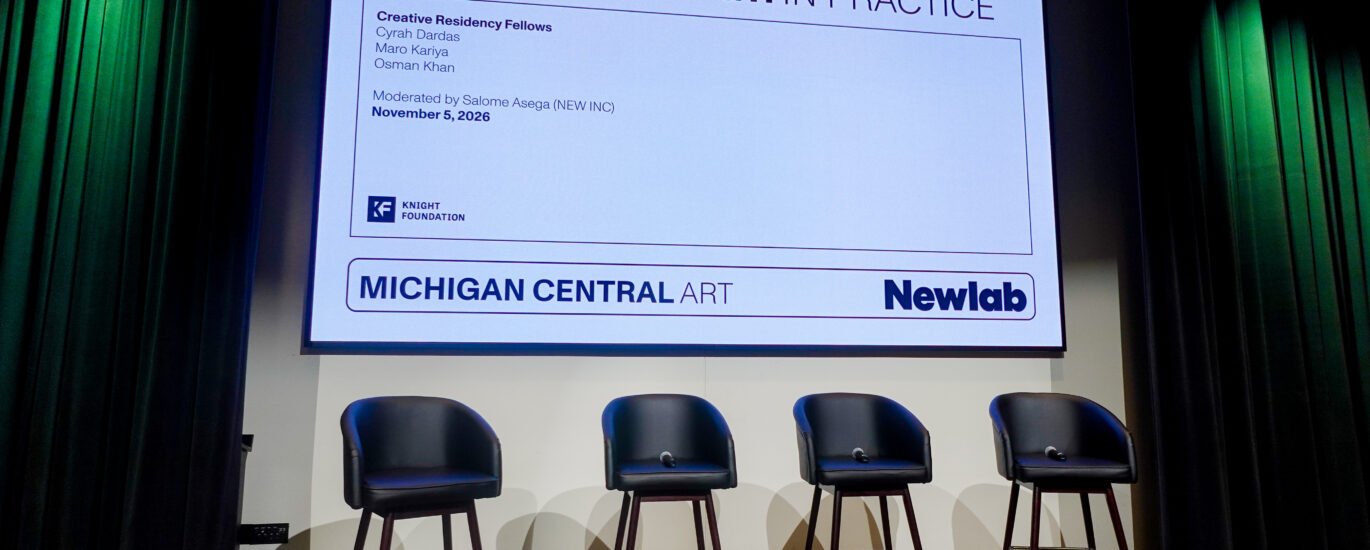
Cyrah Dardas took us back in history, On the 5th of November, 2026. It was a night for Art + Technology: In Practice, a conversation hosted by Michigan Central Art and Newlab Detroit.
The evening brought together three artists participating in the 2026 Art + Technology Fellowship—Maro, Cyrah, and Osman—in a conversation moderated by Salome Asega, Director of NEW INC and Deputy Director of Strategy and Innovation at the New Museum.
I had gone primarily out of curiosity, wanting to meet the people behind the creative residency, learn about the work being undertaken by the artists, and better understand how art was being integrated into an ecosystem I had come to know primarily through entrepreneurship and technology. I have spent much of the past year getting acquainted with Detroit, and I am increasingly interested in understanding the city through the people, institutions, and ideas that have shaped it.
During the conversation, Cyrah said something that has stuck with me: make the stone stonier. I found the expression rather peculiar at first, and perhaps that is part of its appeal. A stone is already a stone, after all. What would it mean to make it more of what it already is? As the conversation continued, I found myself thinking about how much of our experience of the world depends on the assumptions we carry into it, and how rarely we have the time or inclination to examine those assumptions.
I spend a considerable amount of my professional life asking questions about the future, particularly what emerging technologies might enable us to do differently. Yet I have come to appreciate that imagining different futures requires us to develop a more deliberate relationship with the world as it presently exists.
I find this argument particularly fascinating when considered alongside the way modern economies are organized.
Much of our technological and institutional development has been directed toward improving efficiency, reducing friction, accelerating processes, and minimizing the time required to accomplish particular tasks. As an economist, I understand the importance of these objectives. As an entrepreneur, I depend on them.
As a technologist, I am increasingly involved in developing systems intended to perform complex tasks more efficiently. Yet the pursuit of efficiency can also create an intellectual habit of treating existing arrangements as settled. Once we understand how something works, our attention shifts toward making it work better, sometimes before we have adequately considered whether its underlying purpose or structure deserves reconsideration.
I have spent approximately thirteen years of my life building businesses and developing initiatives across education, media, technology, and economic development. My professional journey has taken me through government, the United Nations Development Programme, Microsoft, and several entrepreneurial ventures.
Across these environments, I have become accustomed to thinking about systems: how they emerge, how different institutions interact, what incentives shape their behavior, and how interventions in one part of a system produce consequences elsewhere. Increasingly, I have become interested in how far technological advancement might allow us to redesign some of those systems.
My thinking has in recent times moved toward artificial intelligence, immersive simulation, robotics, and the relationship between intelligence and physical production. I spend considerable time looking at what is becoming technically possible and imagining the societies in which those capabilities might eventually become commonplace.
However, the conversation at Michigan Central prompted me to consider something that I had been gradually discovering through my own experience in Detroit. Perhaps the ability to imagine different futures depends as much on our willingness to examine the present as it does on our understanding of emerging technologies. Perhaps some of the most consequential questions we can ask are those that require us to revisit things we have become accustomed to seeing in only one way.
I left the event thinking about the artists, certainly, but also about the rather complicated relationship I have developed with my own creative identity, and the unexpected role Detroit has begun playing in helping me understand it.
Delve into Business and International Development with Nthanda Manduwi
Systems Don’t Have to Be Broken to Produce Bad Outcomes
I contemplated not publishing an episode this week [I explain why in the podcast], and then ended up recording my longest episode yet.
And to make up for publishing a little late the past two weeks, I am publishing this a day early. You’re welcome, or I am sorry?
I woke up to a message from a friend sharing a video of President William Ruto demanding Veto power for African nations at the 80th United Nations General Assembly [I happened to be in attendance], and I jumped out of bed and got to writing about my favorite beverage: tea! I also got to pen about slave trade, and colonization, and war [I know, what does any of this have to do with Hibiscus tea??!]
This week’s episode explores one of the central ideas behind the third book in the Lessons Book series – Systemic Nonsense: what if many of the frustrations we experience in institutions are not accidents or failures, but predictable outcomes of how those systems were designed?
It often feels like bureaucracy feels so resistant to change, and that reforms often produce more process than progress. It also seems that good intentions so rarely translate into meaningful outcomes. If you’ve pondered on these thoughts before, then these conversations are for you.
This Week’s Book
📖 Systemic Nonsense [Book 3]
This week only, from 27–31 July, the Kindle edition of Systemic Nonsense is available free as part of its Founders Edition launch.
Systemic Nonsense explores several ideas on international development in much greater depth. It asks a simple question:
What if the system isn’t failing? What if it’s doing exactly what it was designed to do?
Whether you listen, read, or dive into the book, I hope it leaves you asking better questions about the systems we inherit—and the ones we choose to build next.
How to Read
To receive your free Kindle copy:
* Click the Amazon link below.
* Select the Kindle edition while the promotion is active.
* Add it to your Kindle library.
You do not need a Kindle device. The free Kindle app works on iPhone, Android, tablets, Macs, and PCs, allowing you to build your digital library wherever you read.
Helpful Links
📚 Read this week’s book for free [search on Amazon or in Kindle for the book that is free for the week, and feel free to purchase the others]:http://amazon.com/dp/B0FQNJ61SB
📰 Subscribe to The Lessons Conversation:
Africa paperback pre-orders:https://forms.office.com/r/RMRMKTNd1M
Enjoyed listening to the Lessons Conversation? This post is public so feel free to share it.
This is a public episode. If you would like to discuss this with other subscribers or get access to bonus episodes, visit podcast.lessonsconversation.com

I have always understood myself as existing in a certain duality. I am deeply creative, and much of what I love most about life comes from artistic expression. I write extensively, and I have a profound appreciation for music, cinema, storytelling, and the worlds that artists are able to construct through their work. Writing, in particular, has been one of the ways in which I process my experiences and develop my understanding of the world. I often begin writing with an idea that I have not yet fully formed, and through the process of examining it, researching its implications, and finding the language through which to communicate it, I arrive at an understanding that would have been considerably more difficult to reach otherwise.
At the same time, my academic and professional development has followed an increasingly analytical and technological trajectory. I studied economics and demography at the University of Malawi, later pursued a master’s degree in entrepreneurship with a focus on digital transformation, and subsequently completed a STEM-designated MBA at Michigan State University, concentrating on marketing management and business analytics. These disciplines have shaped how I approach problems. I am interested in understanding the structural conditions that produce particular outcomes, and I tend to become considerably more interested in the systems underlying a problem than in its immediate manifestation. Over the years, this disposition has led me toward questions of technological infrastructure, industrial development, education, and the institutional conditions required for societies to become more productive.
I have found that the further I venture into technology, the more important my creative instincts become.
Robotics, for example, requires enormous technical precision. A machine must operate within the constraints of mechanics, electronics, computing, material properties, and the environment in which it is expected to function. Yet before any of those engineering decisions can be made, somebody must develop a sufficiently compelling conception of what the machine should accomplish and why its existence might be useful. Similarly, immersive simulations require sophisticated software, visual design, computational systems, and extensive testing, but their effectiveness also depends on the experiences they create and the assumptions about human behavior that inform their design.
These are questions that draw upon different forms of intelligence, and I have become increasingly interested in understanding how they relate to one another. Technical expertise provides the ability to investigate and implement possibilities within established physical and computational constraints. Artistic practice expands the ways in which we might perceive, interpret, and engage with those possibilities. Neither guarantees the quality of the other, and both require discipline developed through years of practice. My interest lies in the opportunities created when people with different forms of expertise are able to challenge and inform one another’s thinking.
For some time, I had begun organizing my ambitions around different periods of my life. I imagined that the coming decade would be predominantly technological, allowing me to concentrate on developing the infrastructure, businesses, and engineering capabilities required to pursue some of the ideas I have been carrying. Perhaps the decade after that would offer greater freedom to return more visibly to my artistic interests, including writing, film, publishing, and creative production. It seemed a reasonable way of organizing a rather extensive collection of ambitions, particularly given the considerable demands associated with building technology companies.
I have started questioning that arrangement. There is an assumption within it that the artist and the technologist must take turns, and that one aspect of my identity needs to recede for the other to develop. Yet the more I reflect on the work I am undertaking, the more I recognize that my interest in technology is itself deeply connected to my creative imagination. I am fascinated by the possibilities emerging from artificial intelligence because they allow us to reconsider activities that have long been organized around particular human limitations. I am interested in robotics because it introduces the possibility of intelligent systems interacting with the physical world in ways we are only beginning to understand. I am drawn to simulations and games because they create environments in which people can experiment with different realities and learn through experience.
There is something rather artistic about that disposition. The process begins with the ability to imagine an arrangement of the world that does not yet exist, followed by a prolonged engagement with the practical constraints of bringing some part of that imagined world into reality. I am learning that my creativity does not need to wait until I have finished building technology. In many respects, it is already embedded in the questions that have led me toward technology in the first place.
The conversation at Michigan Central gave me an opportunity to consider this relationship outside the immediate demands of my businesses. I found myself thinking about what it means to be an artist in an increasingly technological society, and what it means to be a technologist who remains deeply interested in cultural expression, history, and human experience. These questions are particularly interesting in Detroit, because few cities offer such a compelling history of the relationship between industrial technology and artistic imagination.
Detroit occupies a distinctive place in the economic history of the United States. Founded as a French settlement in 1701, the city developed through its strategic position along the Detroit River, its connection to regional trade networks, and its eventual integration into America’s expanding industrial economy. By the beginning of the twentieth century, Detroit had become an important manufacturing center, supported by transportation infrastructure, access to materials, an expanding labor force, and a concentration of industrial enterprises. The emergence of the automobile industry transformed these advantages into a period of extraordinary economic and demographic growth (Brookings Institution, 2024).
The scale of that transformation is remarkable. Detroit’s population increased from approximately 285,704 residents in 1900 to 1,849,568 in 1950, representing an increase of more than sixfold within half a century (Southeast Michigan Council of Governments, 2001; U.S. Census Bureau, 2022). Such growth required an enormous expansion of housing, infrastructure, commercial activity, public services, and employment. The city became a destination for people seeking industrial work, including migrants from Europe, African Americans relocating from the southern United States during the Great Migration, and workers from other parts of the country. Its manufacturing economy shaped the development of entire communities and contributed to the emergence of a substantial industrial working class.
Central to this transformation was Henry Ford, whose contribution to industrial production extended considerably beyond the automobile itself. The Ford Model T, introduced in 1908, initially sold for approximately $850. By 1914, its price had fallen to $490, and by 1924 it had declined to approximately $260, reflecting substantial improvements in manufacturing efficiency and production scale (Library of Congress, n.d.). These changes helped bring automobile ownership within reach of a much broader market, contributing to the transformation of transportation and the spatial organization of American life.
Ford’s most consequential innovation was the development and refinement of the moving assembly line. Introduced at the Highland Park plant in 1913, the system combined interchangeable components, specialized labor, and the coordinated movement of materials through production. By early 1914, improvements in the manufacturing process had reduced the time required to assemble a Model T from approximately twelve and a half hours to ninety-three minutes (The Henry Ford, n.d.). The implications were considerable. Lower production costs enabled lower prices, which expanded demand and created incentives for further improvements in manufacturing. The resulting increases in output supported employment, supplier networks, transportation infrastructure, and the development of related industries.
What I find particularly interesting is that the technological transformation of the automobile industry depended on the organization of production as much as it depended on advances in mechanical engineering. Ford and his contemporaries were developing systems through which technical capabilities could be translated into products at a scale that fundamentally changed their accessibility. Economists and business scholars have subsequently used the term Fordism to describe aspects of the industrial model associated with large-scale standardized production, organized labor processes, and the relationship between productivity and mass consumption.
The model also exposed important tensions between productivity and human experience. Assembly-line work could be repetitive and physically demanding, contributing to substantial employee turnover. In January 1914, Ford announced the five-dollar working day, increasing compensation for qualifying employees from a previous basic rate of $2.34 for nine hours of work to five dollars for eight hours. The policy helped address labor retention challenges while attracting considerable public attention (The Henry Ford, 2013). The broader relationship between wages, working conditions, productivity, and purchasing power subsequently became central to debates about industrial capitalism.
I find these historical developments particularly relevant to contemporary conversations about automation and intelligent machines. Technological progress has often involved reorganizing the relationship between human labor, machinery, and production. The resulting economic benefits have depended on considerably more than technical performance. They have been shaped by institutions, labor relations, markets, regulation, and decisions about how productivity gains are distributed. The same questions are emerging today as artificial intelligence and robotics begin affecting a broader range of economic activities.
There is also an important geographical dimension to this history. The automobile helped reshape the physical organization of American cities through changing patterns of mobility, suburbanization, road construction, and land use. It contributed to the growth of industries that extended far beyond vehicle manufacturing, including petroleum, construction, logistics, tourism, and consumer services. The economic impact of automobile production therefore cannot be understood solely through the number of vehicles manufactured or the revenues generated by individual companies. Its significance lies partly in the extensive systems that developed around it.
This is one of the reasons I have become increasingly interested in the relationship between technology and infrastructure. When I think about emerging technologies, I am interested in understanding the broader changes that might follow their adoption. A sophisticated technical capability may initially appear relevant to a narrow application, yet its eventual significance can depend on the industries, institutions, and behaviors that develop around it. Detroit’s industrial history demonstrates how profoundly a technology can shape the organization of society when the conditions exist for it to become widely accessible.
However, the history of industrialization also reveals the limitations of evaluating progress primarily through output and productivity. The enormous wealth created by Detroit’s automobile industry coexisted with racial discrimination, unequal access to employment, housing segregation, and disparities in the distribution of economic opportunity. The development of the modern city involved decisions whose consequences were experienced very differently by different communities. Any serious examination of Detroit’s industrial legacy must therefore consider both its technological achievements and the social structures through which those achievements were realized.
Detroit’s cultural history introduces another dimension to its industrial identity. While the automobile industry was transforming the physical infrastructure of modern life, the city was also developing an extraordinary capacity to produce cultural innovations that would eventually influence audiences around the world. Motown and Detroit techno offer particularly compelling examples of how technological environments, entrepreneurial organization, and artistic imagination can intersect.
In 1959, Berry Gordy Jr. founded the enterprise that would become Motown Records, supported by an $800 loan from his family’s Ber-Berry Cooperative. Gordy had previously worked in automobile manufacturing, and he drew upon aspects of the industry’s organizational practices in developing his approach to music production. Motown brought together songwriting, performance, recording, artist development, and marketing within a coordinated production system that helped transform the careers of numerous artists and establish a globally influential musical institution (Motown Museum, n.d.).
The relationship between Motown and Detroit’s manufacturing culture is particularly interesting from a business perspective. The label’s development reflected an understanding that creative talent required an institutional environment capable of nurturing, producing, distributing, and commercializing artistic work. Its success depended on the abilities of individual artists and musicians, alongside the organizational processes through which their work could reach audiences. The record label became an economic and cultural enterprise whose influence extended far beyond the city in which it was established.
I find Motown’s history fascinating because it complicates the conventional separation between artistic creativity and business organization. Creative production is often discussed as though it exists primarily through the inspiration of exceptional individuals. Yet the development of a sustainable creative industry also depends on producers, technicians, managers, infrastructure, distribution networks, and institutions capable of supporting artistic work over time. These arrangements shape the opportunities available to artists and influence the ways in which cultural value is created and distributed.
There are, of course, important differences between manufacturing automobiles and producing music. Artistic value cannot be reduced to the standardization of output, and creative organizations must contend with the tension between commercial expectations and individual expression. Nevertheless, Motown’s history illustrates the importance of the economic and institutional environments surrounding creativity. A city with established expertise in organizing industrial production became home to a company that developed a remarkably effective system for bringing music to the world.
Detroit techno offers another extraordinary example of the relationship between technological change and cultural imagination. During the late 1970s and early 1980s, artists including Juan Atkins, Derrick May, and Kevin Saunderson began experimenting with electronic instruments and musical influences that would contribute to the emergence of a distinct sound. Known collectively as the Belleville Three, these musicians were influenced by funk, European electronic music, disco, and the changing technological environment in which they lived. Their experiments with synthesizers, drum machines, and electronic production techniques helped establish Detroit as one of the principal centers of techno music (Detroit Historical Society, n.d.).
The development of techno occurred during a particularly complicated period in Detroit’s economic history. Industrial restructuring, population loss, suburbanization, and changing employment patterns had begun to transform the city’s social and economic landscape. Within that environment, a generation of musicians developed a sound deeply engaged with technology and the imagination of the future. The musical instruments available to them made it possible to construct increasingly sophisticated electronic compositions outside the traditional institutional structures of the recording industry.
I find the timing of this reflection particularly poignant because Juan Atkins, widely recognized as one of the founding figures of Detroit techno, died on October 31, 2026, only days before the conversation at Michigan Central (Beaumont-Thomas, 2026). His career offers a particularly compelling illustration of the relationship between technological possibility and artistic experimentation. Atkins was fascinated by science fiction, electronic instruments, and the transition from industrial society toward a more technologically mediated future. These interests informed a musical practice that would eventually shape an internationally recognized genre.
Detroit techno also raises questions about the geography of cultural production and the distribution of economic value. The music emerged from a particular social, cultural, and technological environment, yet its influence expanded across international markets, with especially important developments in European electronic music scenes. The movement demonstrates how artistic ideas can travel beyond the places in which they originate, acquiring new audiences, interpretations, and commercial structures along the way.
This is a dynamic I find especially interesting as an African entrepreneur and creative. Cultural influence and economic participation do not always develop at the same pace. Communities can generate extraordinary artistic innovations without necessarily controlling the institutions through which those innovations are eventually commercialized. The history of global music, including the influence of African and African diasporic cultural traditions, provides numerous examples of this relationship.
There is a broader economic argument here. The cultural industries represent substantial productive activity, although their contributions are sometimes overlooked when development discussions concentrate on more conventional sectors. According to the U.S. Bureau of Economic Analysis (2025), arts and cultural production contributed approximately $1.17 trillion to the American economy in 2023, representing 4.2% of gross domestic product. In real terms, the sector grew by 6.6% that year, compared with 2.9% growth in the broader economy.
Internationally, the United Nations Conference on Trade and Development estimated that global exports of creative services reached approximately $1.4 trillion in 2022, while creative-goods exports amounted to approximately $713 billion. Creative-services exports had increased by 29% since 2017, reflecting the growing economic importance of activities including audiovisual production, design, information services, research, and other knowledge-intensive creative activities (UNCTAD, 2024).
These figures require careful interpretation because the statistical definition of creative industries extends beyond the activities commonly associated with individual artists. Nevertheless, they establish the substantial economic significance of cultural and creative production. They also suggest that discussions about technological innovation and economic development would benefit from a more integrated understanding of the relationship between cultural expression, intellectual property, digital infrastructure, and international trade.
For Detroit, this relationship has been present for generations. The city helped establish modern systems of industrial production while also generating musical innovations that transformed cultural experiences across the world. Its history provides a compelling reminder that technological capability and artistic imagination can develop within the same social environment, sometimes influencing one another in ways that become fully apparent only retrospectively.
There is a tendency to present Detroit’s contemporary transformation through a familiar narrative of industrial decline followed by renewed investment and technological opportunity. While aspects of that narrative are supported by economic developments, it risks simplifying a much more complicated history. Detroit’s challenges emerged through decades of industrial restructuring, racial inequality, demographic change, public policy decisions, and institutional failures. Its future cannot be adequately understood without examining the consequences of those processes.
During the Great Migration, African Americans moved to Detroit in substantial numbers, seeking employment and improved opportunities beyond the discriminatory social and economic conditions prevalent in the southern United States. Yet racial discrimination remained embedded in many of the institutions governing housing, employment, and access to wealth. Black Bottom and Paradise Valley developed into important centers of African American residential, commercial, and cultural activity, supported by networks of businesses, professional services, entertainment venues, and community institutions (Detroit Historical Society, n.d.-a).
By 1942, more than 300 Black-owned businesses operated across Black Bottom and Paradise Valley, including restaurants, medical practices, shops, hotels, and entertainment establishments (National Endowment for the Humanities, n.d.). These businesses formed part of a substantial local economy developed under conditions in which Black residents faced significant restrictions on where they could live, work, and access services.
The subsequent destruction of these neighborhoods illustrates the complicated relationship between infrastructure development and social welfare. Beginning in the mid-twentieth century, urban renewal and highway construction programs contributed to the demolition of significant portions of Black Bottom and Paradise Valley. Federal housing and highway policies helped finance redevelopment projects that displaced residents and businesses while fundamentally altering established patterns of community life (Detroit Historical Society, n.d.-a).
For me, this history raises questions that extend far beyond Detroit. Infrastructure is often presented within economic development as a necessary foundation for growth, and in many circumstances it is. Roads, electricity, transport systems, housing, and communications networks support economic activity and expand access to opportunities. Yet the effects of infrastructure investment depend considerably on how projects are designed, where they are located, and whose interests are reflected in the decisions surrounding them.
A major redevelopment project can generate substantial economic activity while simultaneously disrupting established communities. A new transport corridor can improve connectivity for some populations while imposing considerable costs on others. The economic evaluation of such investments therefore requires attention to distributional effects, institutional processes, and the long-term consequences experienced by affected communities.
These issues became increasingly visible as Detroit confronted the consequences of industrial restructuring. Manufacturing employment declined, economic activity shifted across the metropolitan region, and the city’s population fell substantially from its mid-twentieth-century peak. The reduction in economic activity and population weakened the municipal tax base, contributing to difficulties maintaining public infrastructure and services. These challenges were exacerbated by successive economic downturns, including the financial crisis of 2008, and culminated in Detroit’s municipal bankruptcy filing in 2013 (Brookings Institution, 2024).
The city’s emergence from bankruptcy in December 2014 involved extensive negotiations among public institutions, creditors, pension beneficiaries, philanthropic organizations, and cultural institutions. One of the most significant elements of the resolution was the Grand Bargain, through which approximately $816 million in commitments from foundations, donors, and the State of Michigan helped support pension obligations while protecting the collection of the Detroit Institute of Arts (Detroit Historical Society, n.d.-b).
I find this particularly interesting because it demonstrates the institutional significance of art during a period of severe economic crisis. The future of a major cultural collection became part of the negotiation surrounding the city’s financial recovery. Decisions about the preservation of cultural assets were therefore directly connected to questions of public finance, institutional responsibility, and the distribution of limited resources.
Detroit’s economic circumstances have improved in some respects since bankruptcy, although substantial challenges remain. The U.S. Census Bureau estimated the city’s population at 649,095 in July 2025, representing modest growth relative to its 2020 population. Yet the 2020–2024 estimates also reported a median household income of $39,938 and a poverty rate of 32.7% (U.S. Census Bureau, n.d.). These indicators illustrate the importance of distinguishing between improvements in particular economic measures and the broader distribution of opportunity across the city’s population.
This distinction is especially relevant when evaluating contemporary innovation districts and urban redevelopment strategies. New businesses, research facilities, restored buildings, and technology investments can contribute meaningfully to economic activity. Their broader developmental significance depends on the relationships they establish with surrounding communities, the accessibility of resulting opportunities, and the extent to which benefits extend beyond the institutions directly participating in the investment.
The scholarly literature on creative cities has explored these tensions extensively. Landry (2000), for example, examined the potential of creative approaches to urban development and the importance of cultivating environments that encourage experimentation and institutional innovation. Other scholars have questioned the assumption that attracting creative professionals necessarily produces broadly shared economic prosperity. Peck (2005) argued that creative-city strategies can reproduce existing inequalities when they become closely associated with property-led development, interurban competition, and the exclusion of lower-income communities. Markusen (2006) similarly emphasized that artists have distinct economic and social roles that should not be reduced to a generalized category of highly educated creative workers.
These arguments are relevant to Detroit because they invite a more rigorous examination of how creativity becomes integrated into urban development. Cultural institutions can contribute to economic activity, strengthen community identity, preserve collective memory, and support experimentation. Yet the conditions under which these benefits are realized vary considerably.
I am interested in Detroit’s future partly because its history makes these questions difficult to overlook. The city has demonstrated an extraordinary capacity for industrial and cultural innovation, while also experiencing the consequences of unequal economic and institutional arrangements. Any meaningful discussion of its ongoing transformation must engage with both histories.
The physical transformation of Michigan Central provides a particularly compelling setting for these reflections. Michigan Central Station opened in December 1913, during a period when railway transport was an important component of the country’s industrial infrastructure. Designed by the architectural firms Warren & Wetmore and Reed & Stem, the station became one of Detroit’s most recognizable buildings, accommodating thousands of passengers and workers during its busiest years (Ford Motor Company, 2024).
The building’s history subsequently reflected the changing organization of American transportation. As automobile ownership and air travel expanded, passenger rail services declined, and the station eventually closed in January 1988. For approximately three decades, the abandoned building became an increasingly prominent symbol of urban disinvestment, its monumental architecture attracting attention even as the surrounding economic environment continued to change.
In 2018, Ford Motor Company acquired the property and began a six-year restoration, culminating in the reopening of Michigan Central Station in June 2024. The restoration formed part of a broader effort to establish a technology and cultural district in Corktown, bringing together established companies, startups, researchers, creative practitioners, and community organizations (Ford Motor Company, 2024).
Nearby, the former Detroit Public Schools Book Depository, an Albert Kahn-designed building dating to 1936, was restored and opened in April 2023 as Newlab’s Detroit headquarters. The facility provides space and infrastructure for entrepreneurs and researchers working across advanced manufacturing, robotics, mobility, energy, and other technological fields (Michigan Central, 2023).
There is considerable symbolism in this transformation. A railway station constructed during the expansion of America’s industrial economy now forms the center of a district exploring emerging technologies and the future of mobility. The physical infrastructure of one technological era has been preserved and adapted to support experimentation associated with another.
Such transformations are occurring in other former industrial centers. In Essen, Germany, the Zollverein Coal Mine Industrial Complex operated as an important component of the Ruhr region’s industrial economy until mining activities ended in 1986. The complex was inscribed on UNESCO’s World Heritage List in 2001 and has subsequently developed into a center for cultural activity, design, heritage, and creative enterprise (UNESCO World Heritage Centre, n.d.). Pittsburgh offers another example, having developed significant robotics research capabilities through institutions such as Carnegie Mellon University, whose Robotics Institute was established in 1979. The region has increasingly incorporated former industrial sites into research and advanced manufacturing activities.
The historical circumstances of these cities differ, and their experiences should not be treated as interchangeable models of economic transformation. Nevertheless, they offer useful examples of how existing industrial infrastructure can acquire new purposes as economic structures evolve. The preservation of buildings and the development of new institutions can help maintain connections between a place’s historical identity and its emerging economic activities.
Michigan Central’s contemporary economic significance is increasingly measurable. An economic impact analysis prepared by BJH Advisors estimated that the district’s ongoing operations supported approximately $2.95 billion in total economic activity across Michigan during 2025, including direct, indirect, and induced effects. The same report indicated that the ecosystem had grown to include more than 240 companies across over 60 industries, alongside workforce development programs serving more than 3,000 participants since 2023 (Michigan Central, 2026c).
As with any economic impact study, these figures require careful interpretation. Estimates of direct, indirect, and induced effects measure economic activity associated with particular operations under specified assumptions. They do not represent the district’s revenue, nor do they establish that the resulting benefits have been evenly distributed across Detroit’s communities.
Still, the scale of activity provides evidence of the institutional and economic investment being directed toward the district. What interests me personally is the way Michigan Central has chosen to incorporate cultural and artistic practice into an environment that is also strongly associated with technological experimentation.
The inclusion of artists in this ecosystem reflects an understanding that innovation involves questions extending beyond technical feasibility. The development of new technologies changes the environments in which people live, the forms of interaction available to them, and the relationships they develop with institutions and physical spaces. Artists have the capacity to investigate these questions through approaches that differ considerably from conventional engineering and commercial research.
I think there is a particular value in allowing creative practitioners to work within these environments while preserving the independence of artistic inquiry. The productive relationship between art and technology depends on the ability of each discipline to contribute its distinctive forms of knowledge and practice. An artist working alongside engineers may encounter new materials, tools, or methods of production. An engineer engaging with an artist may discover different ways of interpreting the meaning and consequences of a technological system.
This is one of the reasons the creative residency at Michigan Central interests me.
The Michigan Central Art and Newlab Creative Residency supports practitioners working at the intersection of art, technology, health, and society. In 2026, the program included Art + Technology and Art + Health fellowships, with fellows receiving unrestricted awards of $30,000, access to fabrication facilities, mentorship, and opportunities to engage with researchers, entrepreneurs, and other practitioners within the district (Michigan Central, 2026b).
I find the structure of this program significant because it recognizes the material conditions required for creative work. Artists need time, facilities, opportunities for experimentation, and access to people whose expertise can inform the development of their ideas. The creation of an environment in which artistic inquiry can proceed without being immediately subordinated to conventional commercial requirements is an important institutional decision.
The three artists who participated in the November 5 conversation approach their work from different disciplinary and experiential perspectives. Maro Kariya is an audiovisual artist, scientist, and educator whose practice uses sound, environmental data, field recordings, and multimedia experiences to explore ecological change and systems requiring transformation. Osman Khan, a multidisciplinary artist and professor at the University of Michigan, examines questions of identity, homeland, and diasporic community through installations and site-specific interventions. Cyrah Dardas works across sculpture, textiles, natural pigments, and social practice, exploring relationships between ecological systems, collective care, grief, repair, and community (Michigan Central, n.d.).
I have become particularly interested in Cyrah’s work since attending the conversation. In an interview with Michigan Central Art, she discussed Conversations with the Wind, a project combining sculpture and renewable energy to develop an irrigation system intended for use in neighborhood gardens throughout Detroit. Her approach draws upon questions of ecological stewardship, collective responsibility, and the relationships between people and the natural environments they inhabit.
There is something especially compelling about this project in the context of an innovation district. The work brings together material experimentation, renewable energy, public space, environmental relationships, and community participation. It demonstrates how an artist might engage with technological capabilities while retaining a fundamentally different orientation toward their purpose and meaning.
I find the relationship between this type of artistic inquiry and my own technological interests fascinating. Much of my recent work involves thinking about the possibilities created when intelligent systems interact with physical environments, including agricultural and ecological settings. My questions frequently concern sensing, information processing, automation, and the technical systems required to make particular activities possible.
Cyrah’s practice approaches related environments through questions of care, ecological relationships, memory, and collective experience. These perspectives can reveal dimensions of a problem that remain less visible when it is examined primarily through technical performance. Her work has encouraged me to reconsider how much of our understanding of technological systems depends on the disciplinary frameworks through which we approach them.
The same is true of Maro Kariya’s work with environmental information and sound. Scientific data are generally encountered through measurements, visualizations, reports, and analytical models. Translating aspects of that information into audiovisual experiences introduces a different relationship between observation and understanding. The artistic interpretation does not replace scientific analysis; it creates another way of engaging with environmental phenomena.
Osman Khan’s work introduces further questions about identity, migration, belonging, and the social significance of technological environments. These concerns are especially relevant in societies undergoing rapid technological and demographic change, where the development of new systems can affect how people understand their relationship with place and community.
What I appreciated about the conversation was the opportunity to encounter these different approaches within a space I had largely come to associate with technological entrepreneurship. It reminded me that the questions surrounding innovation are much larger than the immediate objectives of the companies working within an ecosystem.
There is also an important distinction between supporting artists as independent practitioners and treating artistic work primarily as an instrument for improving commercial innovation. The economic and social value of art includes contributions that may never result in a marketable product or measurable efficiency gain. Artistic practice can preserve cultural memory, challenge prevailing assumptions, create shared experiences, and expand the ways in which individuals and communities understand themselves.
Markusen (2006) makes an important contribution to this discussion by challenging the tendency to group artists together with other highly educated professionals under an undifferentiated concept of the creative class. Artists often operate through distinctive employment arrangements, social networks, institutional relationships, and economic motivations. Their contributions to urban life therefore require analysis that takes seriously the specific conditions under which artistic work is produced.
I think this is an important consideration for institutions seeking to support interdisciplinary collaboration. The objective should include creating opportunities for artists to develop their own practices, pursue questions that matter to them, and participate meaningfully in the environments in which they work. The resulting interactions may produce technological, cultural, or social innovations, although their significance should not be evaluated exclusively through conventional commercial indicators.
The November 5 conversation provided a rather useful demonstration of the intellectual value of this kind of environment. I attended expecting to learn about the projects being developed by artists in residence. I left thinking more deeply about my own work, my creative identity, and the assumptions through which I have been approaching entrepreneurship and technology.
There is another reason why these reflections have become particularly significant to me. I have spent much of the past several years operating within the demands of entrepreneurship, and I have become increasingly conscious of how profoundly the pressure of keeping a business operational can influence the way one thinks.
Entrepreneurship is frequently celebrated through narratives of vision, persistence, resilience, and execution. These qualities are important, particularly for founders working under conditions of substantial uncertainty. Yet the everyday experience of entrepreneurship also involves financial obligations, personnel decisions, operational difficulties, and a continuous need to respond to immediate demands. For entrepreneurs without substantial financial reserves, these pressures can become a defining feature of professional life.
I have experienced this extensively. There have been periods when much of my attention has been directed toward ensuring that the work could continue. The immediate questions concerned revenue, staffing, deadlines, resources, and the numerous practical decisions required to maintain an organization. Over time, one becomes remarkably efficient at responding to these demands. It is possible to develop an entire professional identity around the ability to keep things moving, sometimes under extraordinarily difficult circumstances.
That ability has served me well. I have learned to execute, adapt, and make decisions under pressure. But I have also begun questioning what happens when a founder spends so much time responding to immediate circumstances that there is insufficient opportunity to reconsider the larger direction of the work.
This is particularly important for businesses operating in technologically complex fields, where product development often requires extended experimentation and substantial learning. The decisions being made cannot always be reduced to familiar commercial frameworks, because the underlying technical possibilities, user requirements, and appropriate applications may still be uncertain.
Research into organizational creativity provides useful insight into this problem. Amabile et al. (2002) examined the relationship between time pressure and creative performance through extensive workplace diary research. Their findings suggested that intense time pressure can undermine creative thinking when individuals experience their work as a continuous sequence of urgent demands, particularly where opportunities for sustained concentration and meaningful engagement are limited. Under certain conditions, time pressure may support focused effort, but its effects depend on the organizational environment and the nature of the work being undertaken.
I find this distinction useful because it helps explain something I have been experiencing in my own professional life. There are tasks for which deadlines and operational urgency are appropriate. When a problem is sufficiently understood, execution requires discipline, coordination, and the ability to complete defined activities within available constraints. But when the underlying problem remains uncertain, the process of exploration itself becomes essential.
A founder working on an established consumer product may have access to familiar production methods, established market categories, and relatively clear measures of commercial performance. The development of complex technologies frequently involves a different set of uncertainties. Technical feasibility, system integration, reliability, user requirements, and practical applications may all require prolonged investigation before they can be adequately understood.
I have encountered these realities through my work in robotics and immersive simulation. I am not a mechanical or robotics engineer, and much of the technical work I am pursuing requires collaboration with people whose expertise differs considerably from my own. Over the past several months, I have worked closely with engineers and researchers to understand the practical requirements of developing physical robotic systems. Our conversations have involved the relationship between mechanical design, electronics, sensing, control systems, materials, mobility, and the environments in which these technologies might eventually operate.
The learning process has been considerable. Ideas that initially appeared relatively straightforward became substantially more complicated once we began examining the requirements of implementation. Decisions about physical dimensions, components, power systems, movement, and environmental performance introduced constraints that were difficult to appreciate fully at the conceptual stage. I have spent a great deal of time learning from my engineering colleagues, questioning assumptions, reviewing designs, and developing a more realistic understanding of what the work requires.
A similar experience has shaped my interest in immersive simulation and game development. I have spent substantial time investigating the technical infrastructure involved in developing interactive environments, including the relationship between software engineering, visual production, user experience, simulation, and testing. At one point, I expressed frustration to my team that we were approaching two years of work on some of our gaming ambitions and I remained dissatisfied with what we had accomplished.
My colleagues reminded me that sophisticated game development can take many years, and that the apparent simplicity of a finished experience often conceals substantial technical and creative complexity. I found the conversation useful because it forced me to reconsider the assumptions underlying my expectations. The relevant question became whether our development processes were appropriate to the complexity of the work, and how we might improve them while acknowledging the practical realities of production.
These experiences have been important in shaping the way I now think about my technological ambitions. I remain deeply interested in what emerging technologies might make possible, but I am becoming more attentive to the processes through which complex ideas are developed, tested, and refined. I am also learning to distinguish between the urgency of operational management and the intellectual work required to understand what should be built in the first place.
The Detroit Tech Residency has played an important role in this process. Moving to Detroit following my MBA created an opportunity to concentrate more deliberately on the technological work I had been developing, while becoming part of an ecosystem in which I could engage with engineers, entrepreneurs, researchers, and other practitioners. The residency has given me access to a different professional environment, but perhaps equally importantly, it has encouraged me to reconsider how I allocate my attention.
For the first time in a considerable period, I have had more room to sit with some of the ideas I have been carrying and examine them without immediately reducing every question to the next operational requirement. I have been able to investigate different technological possibilities, reconsider the relationships between my interests, and spend time understanding the technical and institutional environments in which I hope to work over the coming decades.
I think this has been one of the most valuable aspects of the experience. As entrepreneurs, we often measure opportunity through access to customers, financing, infrastructure, and networks. These are important resources, and their availability can materially influence the development of a business. Yet there is another resource that is equally consequential for work involving substantial uncertainty: the ability to devote sustained intellectual attention to a problem.
I had underestimated how much I needed that.
The more time I spend investigating emerging technologies, the more interested I become in the relationship between human imagination and the systems through which societies organize knowledge, production, and experience.
My current interests extend across several fields, including artificial intelligence, robotics, simulation, and education. At first glance, these may appear to represent different areas of activity. Yet I have increasingly come to understand them through their shared capacity to change how people interact with information, environments, and the possibilities available to them.
One of the areas I am particularly interested in is experiential learning. Advances in artificial intelligence and interactive technology have expanded the range of tools available for creating educational experiences, but the underlying questions about how people learn remain important. Learning involves understanding, experimentation, feedback, repetition, and the ability to apply knowledge in meaningful contexts. Technology can support these processes, although the educational value of a particular system depends on how effectively it is designed and implemented.
I have become fascinated by the possibility of developing learning environments that incorporate some of the qualities that make games engaging. Games can create opportunities for exploration, decision-making, progression, collaboration, and learning through repeated attempts. These characteristics have considerable relevance to education when thoughtfully integrated with appropriate learning objectives.
Within our work, we have begun exploring what I sometimes describe as disguised learning: experiences designed to be genuinely enjoyable while supporting the development of meaningful knowledge and skills. I am interested in making educational experiences as engaging as games, and in understanding whether some of the design principles that make games compelling can help improve the way people experience education.
This is a rather interesting challenge because it requires technical, pedagogical, and artistic expertise. The development of an effective learning environment requires an understanding of the subject being taught, the needs and capabilities of the learner, the design of meaningful activities, the systems through which progress is evaluated, and the overall experience through which the learner engages with the material.
There are important differences between entertainment and education, and the fact that an experience is engaging does not necessarily mean that meaningful learning has occurred. Nevertheless, I believe the intersection deserves considerably more experimentation, particularly as new technologies expand the possibilities for creating interactive experiences.
My interest in robotics and physical systems emerges from a related curiosity about how technological intelligence might interact with the environments in which people live and work. The increasing availability of sensing technologies, computing capabilities, and artificial intelligence creates opportunities to investigate systems capable of observing physical conditions, interpreting information, and supporting decisions or actions within particular environments.
The technical and commercial applications of these capabilities remain subjects of extensive research and experimentation. Their eventual significance will depend on factors including reliability, affordability, infrastructure, regulation, and the needs of the people and institutions using them. Nevertheless, I find the possibilities intellectually compelling, particularly when considering how technological systems might evolve over the next several decades.
What has become clearer to me is that these interests are connected by a broader concern with the design of experiences and environments. I want to understand how the world might function differently as technologies become more capable, but I am equally interested in how those changes might affect human behavior, social relationships, and the ways people understand their surroundings.
This is where my creative interests become particularly relevant. A simulation may be technically sophisticated while failing to communicate the dynamics it is intended to represent. A robotic system may perform an engineering task successfully while remaining poorly suited to the lived conditions of its users. An educational experience may incorporate advanced artificial intelligence while providing little meaningful improvement in learning.
These possibilities reinforce the importance of considering the human dimensions of technological design. Technical capability establishes what a system can do under defined conditions. Its broader significance depends on the purposes it serves, the experiences it creates, and the environment in which it operates.
I think artists have an important role in these conversations because their work frequently explores dimensions of experience that are difficult to capture through conventional technical analysis. Artistic practice can examine memory, emotion, identity, cultural meaning, and the relationship between people and their environments. These perspectives can contribute to the development of more thoughtful technological systems, while remaining valuable independently of their applications.
The November 5 conversation gave me a useful opportunity to revisit these questions. Encountering artists whose practices engage with ecological systems, scientific information, collective experience, and questions of belonging reminded me that technological possibilities can be understood through a wider range of intellectual and creative approaches than those typically represented within entrepreneurship.
I have come to appreciate that my own development as a technologist will benefit from maintaining an active relationship with artistic inquiry. I want to understand the scientific and engineering principles governing the systems I hope to develop. I also want to remain attentive to the social, cultural, and experiential questions surrounding their use.
There is considerable value in allowing these different forms of inquiry to coexist, particularly during periods when the technologies being developed may have consequences that are difficult to anticipate fully.
I arrived in Detroit in February 2026, following a period of substantial professional transition. I had spent the preceding years completing graduate studies, developing entrepreneurial ventures, and moving between institutional environments that had shaped my understanding of development and technological change. My decision to establish myself in Detroit was closely connected to the technological work I wanted to pursue, and to the opportunities offered by the city’s emerging innovation ecosystem.
I had visited and learned about Detroit before moving here, but living in a place creates a different relationship with it. Over the past several months, I have been gradually developing a more personal understanding of the city through its neighborhoods, people, institutions, and histories. I have become increasingly curious about the economic and cultural forces that shaped its development, and about the different communities now participating in its transformation.
I grew up in Mangochi, a lakeside town in Malawi, and much of my professional experience has involved moving between very different social and economic environments. I have worked within African institutions, international development organizations, and now the American business and technology ecosystem. These experiences have given me an enduring interest in how knowledge, ideas, and institutions develop across geographical boundaries.
I tend to look at places through the relationships they reveal. An industrial district raises questions about the history of production and the communities whose labor sustained it. A cultural institution raises questions about the preservation of memory and the relationship between artistic expression and public life. A technology hub raises questions about the concentration of expertise, the organization of experimentation, and the conditions through which new industries develop.
Detroit has provided an extraordinary collection of these questions.
The city has a long history of industrial production, but its identity cannot be understood exclusively through manufacturing. Its contributions to music, design, architecture, labor organization, political movements, and cultural life are equally important to understanding its development. Its history also contains difficult lessons about inequality, displacement, industrial dependence, and the consequences of decisions made by public and private institutions.
I think the complexity is part of what makes the city interesting to me. I have become increasingly drawn to places where historical experience and contemporary experimentation exist in close proximity, and where different communities are actively engaged in shaping what the future might look like.
Detroit’s recognition as a UNESCO City of Design in 2015 reflects some of this history. The designation acknowledges the city’s contributions to design and its potential to use creative practice as part of broader urban development (Design Core Detroit, n.d.). Yet the significance of a creative city ultimately depends on the everyday conditions through which people are able to participate in its cultural and economic life.
The presence of institutions such as Michigan Central, Newlab, cultural organizations, universities, and community-based initiatives creates opportunities for collaboration across disciplines. These institutions operate within a city whose existing communities possess considerable knowledge, experience, and creative capacity. The relationship between emerging innovation ecosystems and the people who have sustained Detroit through decades of change will remain important to the city’s future.
As I have become more involved in Detroit’s technology community, I have also become interested in the possibilities for building relationships between the city and the places that have shaped my own journey. I increasingly see opportunities for collaboration across institutions, disciplines, and geographical contexts, particularly where different communities can contribute complementary experiences and capabilities.
For me, the value of these relationships lies partly in the opportunity to encounter different ways of understanding familiar problems. My experiences in Malawi and across African institutions have shaped how I think about infrastructure, education, economic development, and the relationship between technological capability and everyday life. My time in the United States has introduced me to different institutional arrangements, research environments, and approaches to technological experimentation. Moving between these contexts encourages me to question assumptions that might otherwise appear natural within either environment.
I am becoming increasingly comfortable thinking of myself as a bridge between different worlds, although I recognize that meaningful institutional relationships require sustained work and reciprocal engagement. There are opportunities for knowledge exchange, research collaboration, creative partnerships, and the development of shared initiatives that can benefit communities across geographical boundaries.
These possibilities are especially meaningful to me because I have come to understand my professional journey through the relationships it has allowed me to build. My experiences have rarely fitted neatly into one discipline, industry, or institutional environment. I have often found myself working at the intersection of different fields, attempting to understand how their capabilities might inform one another.
Detroit is beginning to offer an environment in which that way of thinking feels increasingly natural.
I am also discovering a personal relationship with the city that extends beyond professional opportunity. I enjoy learning its history, encountering its creative communities, and gradually developing a sense of belonging. I am interested in the ways people have experienced the city across different generations, and in how contemporary Detroiters understand the changes taking place around them.
The more I learn, the more I appreciate how much remains to be discovered.
I have been thinking quite extensively about the next twenty or thirty years of my life. Perhaps this is a natural consequence of reaching a point in one’s career where the accumulated experiences of the preceding decade begin to influence a more deliberate understanding of what one wants to pursue next.
I am thirty-one years old, and I have already spent a substantial portion of my adult life building businesses, developing initiatives, and working across different institutional environments. There are ideas I have carried for many years, some of which have developed into organizations and programs, while others remain subjects of research and experimentation.
I have become increasingly interested in approaching the next stage of my career with greater clarity about the work I want to undertake and the contribution I hope to make. That clarity requires an understanding of my capabilities, the limitations of my knowledge, the environments in which I can learn most effectively, and the kinds of people with whom I want to collaborate.
I am also becoming more conscious of the importance of preserving the intellectual and creative interests that have shaped me. There is always a risk that professional ambition becomes so closely associated with operational achievement that other aspects of one’s identity receive progressively less attention. I have experienced periods when the demands of entrepreneurship left relatively little time for sustained writing, artistic exploration, or the kind of unstructured intellectual curiosity that has always been important to me.
I want the coming decades to be different in that respect. I remain deeply ambitious about the technologies and institutions I hope to help develop, and I understand that substantial achievements require sustained effort, discipline, and an ability to work through difficult periods. At the same time, I want to be deliberate about creating space for learning, reflection, writing, and creative experimentation.
The relationship between these activities is becoming clearer to me. My writing benefits from the analytical training I have acquired through economics and business. My technological interests are informed by years of thinking about development systems and institutional change. My creative imagination influences the questions I ask about the future, while my professional experience has made me more attentive to the practical realities involved in translating ideas into functioning systems.
I suspect that different aspects of this work will become more prominent at different stages of my life. There may be periods when technological development occupies most of my professional attention, and others when writing, publishing, or other creative pursuits become more central. I am becoming less concerned with assigning rigid boundaries to those periods and more interested in allowing the different parts of my work to develop alongside one another.
There is also something important about remaining a learner. Over the past several months, I have repeatedly encountered situations in which my understanding of a subject proved considerably less complete than I had initially assumed. Working with engineers has introduced me to the practical complexity of physical technologies. Researching game development has expanded my appreciation of the relationship between creative production and technical infrastructure. Engaging with artists has encouraged me to reconsider the assumptions underlying my understanding of technology and human experience.
I find these experiences encouraging. They remind me that expertise is necessarily incomplete, and that meaningful work often requires entering environments in which other people possess knowledge that we do not yet have.
There are times when entrepreneurship encourages a rather performative certainty. Founders are expected to articulate compelling visions, communicate confidence, and persuade others that their ideas deserve attention. These activities are part of the work, but they can create an uncomfortable relationship with uncertainty if the founder begins to believe that every question must already have an answer.
I have become more interested in developing the confidence to acknowledge what I do not know, particularly when pursuing work that depends on scientific and technological capabilities outside my original field of training. The ability to ask good questions, identify appropriate expertise, and revise one’s assumptions is becoming increasingly important to how I understand my responsibilities.
Perhaps this is another reason why artistic practice interests me so deeply. Artists often work through processes of exploration in which the final form of a work emerges through prolonged engagement with materials, ideas, experiences, and constraints. There is discipline involved, certainly, but also a willingness to discover something through the act of making.
I recognize that the same principle applies to much of the technological work I am pursuing. The original idea establishes a direction, while the process of investigating it reveals possibilities and limitations that could not have been fully understood in advance.
I want to retain that openness throughout the coming decades. I want to remain capable of imagining possibilities that currently appear distant, while developing the technical and analytical discipline required to evaluate them seriously. I want to work with people who challenge my thinking, and I want to be willing to change direction when experience or evidence suggests that my assumptions require reconsideration.
Most importantly, I want to continue finding meaning in the process itself. I have spent enough time building things to understand that the work can become consuming. I would like the next phase of my career to reflect a more deliberate integration of intellectual curiosity, creative expression, technological development, and the personal experiences that make the undertaking worthwhile.
Detroit has become an important part of that journey.
I returned from the November 5 conversation thinking about how much of my understanding of Detroit had changed since I first arrived. The city that initially represented an opportunity to concentrate on building a technology company had gradually become an environment through which I was reconsidering my relationship with entrepreneurship, creativity, and the future.
I have learned more about its industrial history, the development of its cultural institutions, the extraordinary influence of its music, and the difficult economic and social transformations that have shaped its communities. I have encountered entrepreneurs, engineers, researchers, artists, and other practitioners whose work has introduced me to questions I might otherwise never have considered.
The conversation at Michigan Central was particularly meaningful because it occurred within that broader process of discovery. Meeting the artists and learning about their practices gave me an opportunity to consider how differently people can engage with the same world. A scientist may encounter an environmental system through measurements and models. An engineer may investigate the technological capabilities required to interact with it. An artist may explore its meaning through materials, experience, memory, and relationships. Each perspective can reveal something important, and the relationships between them can become intellectually productive.
Shklovsky’s argument about defamiliarization provides a useful way of understanding why these encounters matter. Familiarity allows us to navigate the world efficiently, but it can also limit our willingness to reconsider the arrangements through which we understand it. Artistic practice can interrupt that familiarity, encouraging us to attend more carefully to objects, environments, and experiences that we might otherwise overlook.
I think there is a broader lesson here for anyone engaged in building institutions, technologies, or communities. The way we define a problem influences the possibilities we are able to imagine in response to it. Our assumptions shape the questions we ask, the evidence we consider relevant, and the solutions we regard as feasible. Developing the capacity to examine those assumptions is therefore an important part of meaningful innovation.
For me, the process has become increasingly personal. I arrived in Detroit with a collection of technological ambitions and a determination to make progress on work that I had spent years developing. Those ambitions remain important. What has changed is my understanding of the kind of intellectual environment I need in order to pursue them well.
I have begun appreciating the value of being surrounded by people whose interests and expertise differ substantially from my own. I am learning to make more time for reflection, to examine the histories of the places and systems around me, and to remain attentive to the creative instincts that have always influenced how I understand the world.
I am also discovering that falling in love with a city can be a gradual intellectual experience. The more I learn about Detroit, the more interested I become in its contradictions, its achievements, its cultural life, and the possibilities emerging from its contemporary transformation. I have developed an increasing sense of affection for the place and curiosity about the people who continue to shape it.
There is a great deal about Detroit that I am still learning. There is also a great deal about my own work that remains uncertain. I do not know exactly what every technological idea I am exploring today will become, or how the different aspects of my creative and professional life will evolve over the next twenty years.
I am becoming more comfortable with that uncertainty, particularly when it creates an opportunity to investigate questions that genuinely interest me. I have spent much of my entrepreneurial life feeling the pressure to move quickly, and I am beginning to appreciate the importance of knowing when a question deserves more time.
Perhaps that is the greatest gift this period in Detroit has given me: the opportunity to approach familiar ambitions with a renewed sense of curiosity, and to develop a more deliberate understanding of what I want my work to mean.
I came to Detroit to build technology, and I am grateful for the opportunities I am finding to do so. Along the way, I have encountered a city whose history and creative communities are helping me rediscover the artist who has always been part of that journey.
Cyrah’s words have stayed with me because they articulate something that I have been gradually learning through experience. We can become so accustomed to the world around us that we stop recognizing how extraordinary, complicated, and open to interpretation it remains. The work of seeing it differently requires attention, curiosity, and a willingness to question what we think we already understand.
I suspect that this will remain an important part of how I approach the coming decades, both as a creative and as a technologist.
And perhaps that is why I am falling in love with Detroit.
It is giving me room to imagine again.
If you’d like to go deeper into my journey — from Malawi, through the United Nations and Microsoft to now building my own companies in Detroit, you can find it in my books.
Amabile, T. M., Hadley, C. N., & Kramer, S. J. (2002). Creativity under the gun. Harvard Business Review, 80(8), 52–61. https://hbr.org/2002/08/creativity-under-the-gun
Beaumont-Thomas, B. (2026, November 1). Juan Atkins, pioneer of Detroit techno sound, dies aged 64. The Guardian. https://www.theguardian.com/music/2026/nov/01/juan-atkins-pioneer-of-detroit-techno-sound-dies-aged-64
Brookings Institution. (2024). Advancing future-forward mobility in Detroit’s legacy automotive cluster. https://www.brookings.edu/articles/advancing-future-forward-mobility-in-detroits-legacy-automotive-cluster/
Design Core Detroit. (n.d.). About Design Core. https://designcore.org/about
Detroit Historical Society. (n.d.-a). Black Bottom neighborhood. https://www.detroithistorical.org/learn/online-research/encyclopedia-of-detroit/black-bottom-neighborhood
Detroit Historical Society. (n.d.-b). Grand Bargain. https://www.detroithistorical.org/learn/online-research/encyclopedia-of-detroit/grand-bargain
Detroit Historical Society. (n.d.-c). Atkins, Juan. https://www.detroithistorical.org/learn/online-research/encyclopedia-of-detroit/atkins-juan
Ford Motor Company. (2024). New Michigan Central Station reopens as heart of a culture and tech hub. https://www.fromtheroad.ford.com/us/en/articles/2024/new-michigan-central-station-reopens-as-heart-of-a-culture-and-t
Landry, C. (2000). The creative city: A toolkit for urban innovators. Earthscan.
Library of Congress. (n.d.). Ford implements the moving assembly line. https://guides.loc.gov/this-month-in-business-history/October/Ford
Markusen, A. (2006). Urban development and the politics of a creative class: Evidence from a study of artists. Environment and Planning A: Economy and Space, 38(10), 1921–1940. https://doi.org/10.1068/a38179
Michigan Central. (2023, April 24). Michigan Central launches with Newlab opening in reimagined Book Depository. https://michigancentral.com/michigan-central-launches-with-newlab-opening-in-reimagined-book-depository/
Michigan Central. (2026a). Art + Technology: In Practice [Event]. https://michigancentral.com/event/art-technology-in-practice/
Michigan Central. (2026b, April 13). Michigan Central Art and Newlab Detroit opens applications for its expanded 2026 Creative Residency Program. https://michigancentral.com/michigan-central-art-and-newlab-detroit-opens-applications-for-its-expanded-2026-creative-residency-program/
Michigan Central. (2026c, July 30). Inaugural report shows Michigan Central supported nearly $3 billion in statewide economic impact in 2025. https://michigancentral.com/inaugural-report-shows-michigan-central-supported-nearly-3-billion-in-statewide-economic-impact-in-2025/
Michigan Central. (n.d.). Michigan Central Art x Newlab Creative Residency. https://michigancentral.com/michigan-central-x-newlab-art-technology-residency/
Michigan Central Art. (2026, August 19). The potential of art, health and tech: Conversations with artists in residency—Cyrah Dardas. https://michigancentral.substack.com/p/the-potential-of-art-health-and-tech
Motown Museum. (n.d.). Berry Gordy. https://www.motownmuseum.org/legacy/berry-gordy/
National Endowment for the Humanities. (n.d.). The people and places of Black Bottom, Detroit. https://www.neh.gov/article/people-and-places-black-bottom-detroit
Peck, J. (2005). Struggling with the creative class. International Journal of Urban and Regional Research, 29(4), 740–770. https://doi.org/10.1111/j.1468-2427.2005.00620.x
Shklovsky, V. (1965). Art as technique (L. T. Lemon & M. J. Reis, Trans.). In L. T. Lemon & M. J. Reis (Eds. & Trans.), Russian formalist criticism: Four essays (pp. 3–24). University of Nebraska Press. (Original work published 1917).
Southeast Michigan Council of Governments. (2001). Detroit and 300 years of metropolitan growth. https://www.semcog.org/desktopmodules/SEMCOG.Publications/GetFile.ashx?filename=DetroitAnd300YearsOfMetropolitanGrowthJune2001.pdf
The Henry Ford. (2013). Ford’s Five Dollar Day revolution. https://www.thehenryford.org/collections/explore/articles/fords-five-dollar-day
The Henry Ford. (n.d.). Assembly line. https://www.thehenryford.org/collections/explore/sets/detail/henry-ford-assembly-line
UNESCO World Heritage Centre. (n.d.). Zollverein Coal Mine Industrial Complex in Essen. https://whc.unesco.org/en/list/975/
United Nations Conference on Trade and Development. (2024). Creative economy outlook 2024. United Nations. https://unctad.org/publication/creative-economy-outlook-2024
U.S. Bureau of Economic Analysis. (2025, April 2). Arts and cultural production satellite account, U.S. and states, 2023. https://www.bea.gov/news/2025/arts-and-cultural-production-satellite-account-us-and-states-2023
U.S. Census Bureau. (2022). 1950 census records. https://www.census.gov/programs-surveys/decennial-census/decade/1950/census-records.html
U.S. Census Bureau. (n.d.). QuickFacts: Detroit city, Michigan. Retrieved November 17, 2026, from https://www.census.gov/quickfacts/fact/table/detroitcitymichigan/



Nthanda Manduwi is a Malawian storyteller, entrepreneur, digital transformation advocate, and community builder driven by the mission to empower Africa’s economic landscape through innovation and technology.