By Nthanda Manduwi
21 November 2026 | New York City
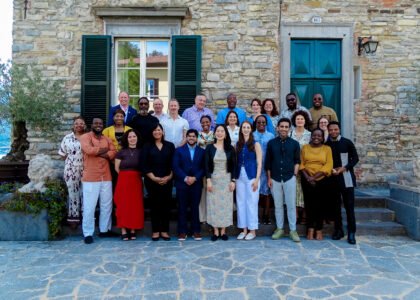
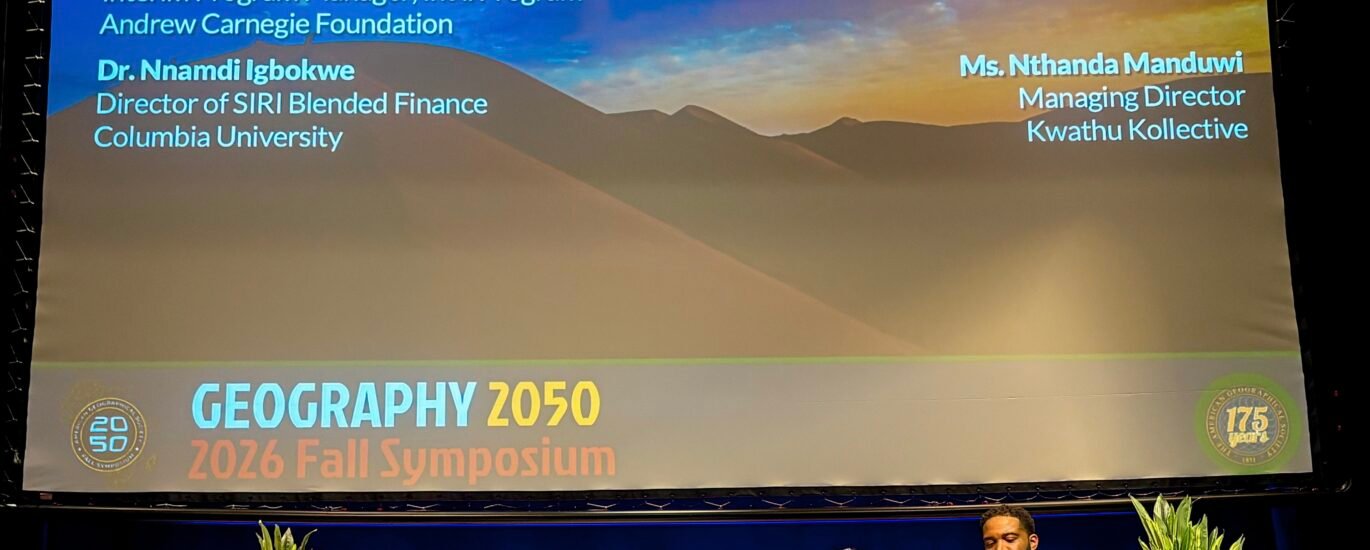
On November 19 and 20, 2026, I had the pleasure of participating in the American Geographical Society’s annual Geography 2050 symposium, held at the Schomburg Center for Research in Black Culture in Harlem, New York.
This year’s gathering, Africa Shaping Tomorrow, brought together scholars, entrepreneurs, researchers, policymakers, and institutional leaders to examine the forces that will shape the African continent over the next quarter-century. The conversations extended across food systems, public health, demography, environmental sustainability, geospatial intelligence, political leadership, and investment. I had been invited to participate in a discussion on financing Africa’s future, and I arrived carrying questions that have become increasingly important to me through my work in entrepreneurship, technology, and international development.

There was something particularly meaningful about holding these conversations at the Schomburg Center, an institution within the New York Public Library that has spent the past century preserving and advancing knowledge about the histories and contributions of people of African descent. I have always had a great appreciation for libraries. There is something extraordinary about institutions that preserve the intellectual work of generations, allowing ideas to remain accessible long after the lives and circumstances that produced them have changed. I was delighted to be participating in an event at the New York Public Library, and the more I learned about the history of the Schomburg, the more appropriate the setting became for a discussion about Africa’s future.
The institution traces its origins to the Division of Negro Literature, History and Prints, established at the 135th Street Branch of the New York Public Library in 1925. Its development was closely associated with the work of librarian Ernestine Rose and historian, writer, and collector Arturo Alfonso Schomburg, whose lifelong efforts to document African and diasporic intellectual history contributed to one of the world’s most important research collections in Black history and culture. In 1926, supported by a $10,000 grant from the Carnegie Corporation, the New York Public Library acquired Schomburg’s collection of 2,932 volumes, 1,124 pamphlets, and numerous prints and manuscripts. The materials arrived in 104 crates and became the foundation of the institution that would eventually bear his name.
I find this history fascinating, particularly because the acquisition took place exactly a century before our gathering.
Schomburg was working at a time when dominant accounts of world history routinely marginalized or disregarded the intellectual and cultural contributions of African societies and their descendants. His 1925 essay, The Negro Digs Up His Past, examined the importance of recovering historical knowledge and establishing a more complete understanding of Black contributions to civilization. He approached historical collection as an intellectual and institutional responsibility, recognizing that the ability of a people to understand their place in the world was shaped partly by the records available to them.
There is an important relationship between the preservation of knowledge and the development of economic and political agency. Historical narratives influence how societies understand their capabilities, the institutions they consider legitimate, and the possibilities they believe are available to them. When the contributions of particular communities are systematically excluded from the historical record, the consequences extend beyond academic representation. They influence education, public discourse, institutional priorities, and the assumptions through which future opportunities are evaluated.
The Schomburg Center has grown considerably since the acquisition of its original collection, becoming an internationally recognized institution for research, education, and public engagement. Its history is also part of Harlem’s broader intellectual and cultural development, including the Harlem Renaissance and the movement of African and diasporic ideas across the Atlantic. Schomburg himself was born in Puerto Rico and spent much of his life tracing connections among African-descended communities across different countries, languages, and historical periods. His work reflected an understanding that the African experience could not be adequately confined within a single national or geographical narrative.
A century later, we gathered at the institution he helped establish to discuss the Africa that might exist in 2050. The American Geographical Society, founded in 1851 and celebrating its 175th anniversary, had chosen to dedicate its annual symposium to the continent’s future. Its programme emphasized the implications of demographic growth, urbanization, environmental change, technological advancement, and the increasing importance of African countries within global economic and political systems.
The historical continuity was striking. In 1926, an institution invested in preserving evidence of what African people had contributed to the world. In 2026, African and American scholars, entrepreneurs, and institutional leaders were gathered within that same intellectual tradition to consider what the continent might become capable of producing over the next twenty-five years.
I found myself thinking about the responsibilities that come with participating in such a conversation. We have inherited an extraordinary body of knowledge, alongside institutions, economic structures, and political arrangements that continue to influence the opportunities available to African societies. The decisions made during our lifetimes will shape what subsequent generations inherit. There is therefore considerable value in asking what we want the continent to look like in 2050, and how the choices we make today might contribute to that future.
For me, the question has become increasingly practical.

Delve into Business and International Development with Nthanda Manduwi
Systems Don’t Have to Be Broken to Produce Bad Outcomes
I contemplated not publishing an episode this week [I explain why in the podcast], and then ended up recording my longest episode yet.
And to make up for publishing a little late the past two weeks, I am publishing this a day early. You’re welcome, or I am sorry?
I woke up to a message from a friend sharing a video of President William Ruto demanding Veto power for African nations at the 80th United Nations General Assembly [I happened to be in attendance], and I jumped out of bed and got to writing about my favorite beverage: tea! I also got to pen about slave trade, and colonization, and war [I know, what does any of this have to do with Hibiscus tea??!]
This week’s episode explores one of the central ideas behind the third book in the Lessons Book series – Systemic Nonsense: what if many of the frustrations we experience in institutions are not accidents or failures, but predictable outcomes of how those systems were designed?
It often feels like bureaucracy feels so resistant to change, and that reforms often produce more process than progress. It also seems that good intentions so rarely translate into meaningful outcomes. If you’ve pondered on these thoughts before, then these conversations are for you.
This Week’s Book
📖 Systemic Nonsense [Book 3]
This week only, from 27–31 July, the Kindle edition of Systemic Nonsense is available free as part of its Founders Edition launch.
Systemic Nonsense explores several ideas on international development in much greater depth. It asks a simple question:
What if the system isn’t failing? What if it’s doing exactly what it was designed to do?
Whether you listen, read, or dive into the book, I hope it leaves you asking better questions about the systems we inherit—and the ones we choose to build next.
How to Read
To receive your free Kindle copy:
* Click the Amazon link below.
* Select the Kindle edition while the promotion is active.
* Add it to your Kindle library.
You do not need a Kindle device. The free Kindle app works on iPhone, Android, tablets, Macs, and PCs, allowing you to build your digital library wherever you read.
Helpful Links
📚 Read this week’s book for free [search on Amazon or in Kindle for the book that is free for the week, and feel free to purchase the others]:http://amazon.com/dp/B0FQNJ61SB
📰 Subscribe to The Lessons Conversation:
Africa paperback pre-orders:https://forms.office.com/r/RMRMKTNd1M
Enjoyed listening to the Lessons Conversation? This post is public so feel free to share it.
This is a public episode. If you would like to discuss this with other subscribers or get access to bonus episodes, visit podcast.lessonsconversation.com

The programme for Geography 2050 was exceptionally broad, and I appreciated the way the organizers approached the continent through several interconnected disciplines. Thursday’s discussions examined socioecological systems, agricultural production, food leadership, environmental knowledge, and biodiversity conservation. Friday’s programme moved through demographic change, migration, investment, public health, geospatial innovation, political leadership, and the institutions through which African science might develop over the coming decades.
The breadth reflected the reality that development challenges rarely exist within the boundaries of individual disciplines. The future of agriculture is connected to the availability of water, energy, transport infrastructure, financing, and markets. Public-health outcomes are shaped by environmental conditions, settlement patterns, household income, and access to services. Technological innovation depends on education, research institutions, infrastructure, and the ability of organizations to transform knowledge into practical applications. These relationships have become particularly important to how I approach development questions, having spent much of my professional life working across economics, international institutions, education, and entrepreneurship.
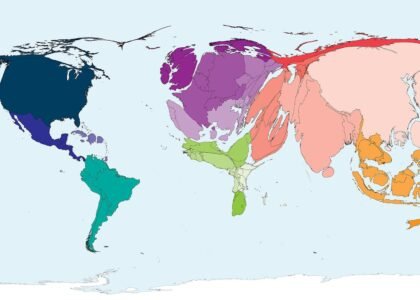
The demographic horizon provided an important foundation for the conversations. The American Geographical Society’s symposium materials projected that Africa’s population could reach approximately 2.5 billion by 2050, with substantial increases in the working-age population and continued urbanization. These changes will influence global labor markets, demand for infrastructure, patterns of consumption, food production, public services, and the distribution of economic activity.
Demographic growth creates considerable possibilities, although the economic outcomes depend on how societies organize education, employment, infrastructure, and productive investment. A rapidly expanding working-age population can support growth when opportunities exist for people to participate productively in the economy. Where those opportunities remain limited, demographic pressures can intensify existing challenges involving unemployment, public services, housing, and migration.
My training in economics and demography has made me particularly attentive to the relationship between population structures and the productive capacity of economies. When discussing Africa’s demographic future, I am interested in the industries that will employ future generations, the institutions that will support their development, and the technologies that might influence the organization of their work. The continent’s population growth will occur alongside technological changes that are already affecting the demand for different kinds of labor, the structure of production, and the capabilities required to participate competitively in international markets.
These considerations lead to a question that became central to my own contribution at the symposium: what do we want African economies to become capable of producing by 2050?
Much of the development discourse surrounding the continent focuses on the resources required to address existing needs. Those needs are substantial, and financing essential services remains important. Yet I think there is considerable value in examining the productive systems that could change the underlying economic conditions generating those needs. This includes agriculture, manufacturing, energy, technology, scientific research, and the institutions through which knowledge and capital become economically productive.
I increasingly approach this question through the relationship between learning, technological intelligence, and production. Over the past decade, I have worked extensively on educational initiatives, digital transformation, and programs supporting young people’s participation in emerging economic opportunities. More recently, my entrepreneurial interests have extended toward artificial intelligence, immersive simulation, and robotics. These experiences have made me interested in how societies develop the capacity to understand complex environments, make better decisions, and translate knowledge into productive activity.
Several conversations during Geography 2050 provided compelling examples of these relationships in practice.
One of Thursday’s central discussions, The Stakes of 2050: What Africa’s Food Leaders Know That Others Don’t, brought together Dr. Agnes Kalibata and Ndidi Okonkwo Nwuneli, moderated by Dr. Catherine Nakalembe. I was particularly interested in the combination of experiences represented on that panel. The participants have worked across agricultural policy, scientific research, entrepreneurship, and the development of institutions concerned with transforming African food systems.
Africa’s agricultural future presents an enormous development challenge. The 2026 edition of The State of Food Security and Nutrition in the World estimated that approximately 309 million people in Africa experienced hunger in 2025, representing around one-fifth of the continent’s population. The same report estimated that 66.6% of Africans could not afford a healthy diet, highlighting the economic dimensions of food insecurity alongside the challenges associated with agricultural production (FAO et al., 2026).
These figures are particularly important because food security is often discussed primarily through the quantity of food produced. Agricultural output matters, but food systems also depend on processing, storage, logistics, market access, purchasing power, dietary quality, and the institutions through which producers and consumers interact. Increasing production in an environment with inadequate storage or weak market access may not generate the economic benefits farmers require. Similarly, improvements in food availability do not necessarily resolve nutritional challenges when household incomes remain insufficient to support healthy consumption.
I have long been interested in the relationship between agricultural productivity and broader economic development, particularly in Malawi, where agriculture remains central to employment, livelihoods, and export earnings. The country’s dependence on a limited range of agricultural commodities exposes its economy to climatic variability and external market conditions, while weaknesses in infrastructure and productive diversification constrain opportunities for value addition. The World Bank’s 2026 Malawi Economic Monitor identified persistent foreign-exchange shortages, weak supply chains, infrastructure constraints, and limited private investment among the factors affecting the country’s economic performance (World Bank, 2026).
The relevance of Ndidi’s work lies partly in her understanding of agriculture as an economic system involving enterprises, institutions, and value chains. Through Sahel Consulting, where she serves as Executive Chair and co-founder, and through her work establishing organizations including AACE Foods and African Food Changemakers, she has contributed to initiatives concerned with agricultural enterprise development, market systems, nutrition, and the participation of African businesses in food value chains.
Her book, Food Entrepreneurs in Africa: Scaling Resilient Agriculture Businesses, examines the operational and strategic conditions required for food enterprises to develop sustainable business models and expand their activities (Nwuneli, 2021). I have been reading a book Ndidi gifted me earlier this year at AfricaXchange, and I have appreciated the opportunity to engage with her work alongside conversations about the practical realities of building African businesses.
Ndidi is also a member of The Rockefeller Foundation’s Board of Trustees, a relationship that connects her entrepreneurial work with broader questions about institutional investment, philanthropy, and the financing of development. Her experience demonstrates the importance of understanding food systems through the interactions between entrepreneurs, public institutions, financing organizations, and the communities whose livelihoods depend on those systems.
I have become increasingly interested in how technological innovation might contribute to these productive relationships. Advances in sensing technologies, robotics, and computational intelligence create opportunities to investigate different approaches to agricultural monitoring and production. However, the usefulness of any particular technology depends on its ability to address a meaningful operational problem within an economically viable system.
The development of agricultural technology therefore requires attention to the conditions facing producers, including the scale of their operations, access to energy and technical support, availability of financing, and ability to connect with markets. The economic environment in which a technology is introduced influences its adoption and the benefits it may eventually generate.
I found the pairing of Ndidi with Dr. Agnes Kalibata particularly appropriate in this context. Kalibata’s career has included service as Rwanda’s Minister of Agriculture, leadership of AGRA, and her appointment as the United Nations Secretary-General’s Special Envoy for the 2021 Food Systems Summit. Her experience connects national agricultural policy with international food-system initiatives and institutional coordination.
The relationship between entrepreneurial capability and public policy is central to agricultural transformation. Private enterprises can develop products, services, and business models that improve the functioning of food systems, while public institutions influence the infrastructure, regulatory environment, research capacity, and market conditions under which those enterprises operate.
I left this part of the programme thinking about the importance of financing the different activities that make agricultural production economically meaningful. Africa’s food future will require farmers, researchers, businesses, financial institutions, governments, and communities to develop more effective relationships around production and distribution. The experience of food entrepreneurs provides an important foundation for understanding how those relationships function in practice.
My connection to Geography 2050 developed through a series of conversations made possible by people whose work I have increasingly come to appreciate. Nathalia Arcencio de Marchi dos Santos, whom I met through The Rockefeller Foundation’s Africa Big Bets Fellowship, connected me to the symposium through Dr. Catherine Nakalembe. Earlier in November, Catherine moderated a Locus Charter discussion featuring Nathalia and me on the future of African food systems and the importance of investing in African-led innovation.
That conversation became the basis of an earlier reflection published through Kwathu Kollective, Geography 2050: Why Bet on African Food Systems?. We examined the role of technological development, financing, public institutions, and entrepreneurship in supporting more productive and resilient food systems. The conversation also reinforced my interest in understanding how scientific knowledge becomes useful when it is integrated into the practical decisions of institutions and producers.
Catherine’s research offers a particularly compelling example of this relationship.
At the University of Maryland, she works at the intersection of geospatial science, artificial intelligence, agricultural monitoring, and food security. Through her work with NASA Harvest and other research initiatives, she has contributed to efforts to improve the availability and application of satellite-derived agricultural information across African countries.
I have been particularly interested in a study she published in January 2026 examining Uganda’s Disaster Risk Financing Program, which operated between 2016 and 2020. The program incorporated satellite-derived vegetation indicators into a mechanism intended to support responses to drought conditions. According to Nakalembe (2026), the $14 million program reached more than 452,000 people and generated estimated total benefits of $40.7 million, including approximately $11.1 million in immediate emergency-assistance savings.
The study illustrates the economic value that can emerge when scientific information is connected to institutional systems capable of acting upon it. Satellite observations made it possible to identify conditions associated with drought risk. The financing mechanism created a process through which those observations could inform the release of resources. Government institutions and implementing partners were then responsible for translating those resources into assistance for affected communities.
The implications extend beyond agricultural monitoring. Modern technological systems can generate enormous quantities of information, and advances in artificial intelligence are expanding the capabilities available for interpreting that information. Yet the availability of intelligence does not automatically create the institutional or financial capacity required to respond to it.
This is particularly relevant in environments where public institutions face limitations involving data, infrastructure, technical expertise, and operational resources. An increasingly sophisticated model may identify a developing problem, but its practical value depends on whether the relevant institutions can interpret the results, make decisions, and mobilize an appropriate response.
Catherine’s more recent work reflects an interest in addressing some of these institutional challenges. In March 2026, a regional workshop organized by NASA Harvest Africa, AGRA, and COMESA brought together technical representatives from nine African countries, including Malawi, to develop capabilities in satellite-based crop monitoring and AI-supported yield forecasting. The initiative emphasized the transfer of technical skills and the development of forecasting processes that could eventually be managed within national institutions (University of Maryland, 2026).
I find this approach particularly meaningful because it connects the development of technology with the development of local capacity to use and maintain it. The ability to generate information becomes more valuable when the institutions responsible for making decisions possess sufficient knowledge and operational authority to apply it.
These questions also inform my own technological interests. Through Q2 Systems, I have been researching the possibilities created by combining physical sensing, computational intelligence, and increasingly autonomous systems. I am interested in how these capabilities might eventually contribute to more informed decisions within agricultural and other production environments.
The challenges are substantial, particularly where data are incomplete, communications infrastructure is unreliable, and the technical systems required to maintain advanced technologies remain limited. These conditions influence both the design of technologies and the institutions necessary to support their use.
Catherine’s work demonstrates the importance of approaching these challenges through partnerships that connect research, government capacity, and practical applications. I have come to appreciate that the development of sophisticated technological capabilities must be accompanied by an equally serious investment in the people and institutions that will determine how those capabilities are used.
Thursday’s discussion on Capacity, Complexity, and Community: Building Africa’s Food Systems at Scale brought together Nathalia dos Santos of The Rockefeller Foundation and Dr. Nadait Gebremedhen, founder and CEO of Hagush, in a conversation moderated by Dr. Niwaeli Kimambo of Middlebury College.
I was particularly interested in this session because Nathalia and Nadait approach development through different but closely related concerns. Nathalia’s work focuses on leadership development, networks, institutional collaboration, and the conditions through which emerging leaders can develop their ideas. Nadait’s work examines questions of digital access, organizational capacity, and the financial and institutional arrangements that influence the ability of social enterprises to operate effectively.
Through the Rockefeller Foundation’s Connected Leaders Platform, Nathalia has worked on initiatives bringing together people whose activities address complex social and economic challenges. My own participation in the Africa Big Bets Fellowship has made me particularly appreciative of the value of these relationships. The fellowship introduced me to practitioners working across food systems, energy, healthcare, technology, and other areas of development, creating opportunities to learn from people whose approaches differ considerably from my own.
I have come to appreciate the importance of institutional networks in supporting entrepreneurs, particularly those working on problems requiring expertise and resources that cannot be developed within a single organization. Access to researchers, experienced practitioners, potential partners, and institutions capable of supporting experimentation can influence what an entrepreneur is able to accomplish.
Nathalia’s role in connecting me with Catherine and Geography 2050 provides a very personal example of how these relationships develop. An introduction created an opportunity to participate in the Locus Charter discussion, which subsequently became part of a wider conversation about the continent’s future. That process expanded my engagement with people working on questions that have become increasingly relevant to my own professional interests.
Nadait’s work brings another important dimension to this discussion. Our paths had crossed previously through conversations concerning women’s participation in Africa’s digital transformation, including the broader community surrounding Bants2Business and digital-skills initiatives. I have appreciated the opportunity to encounter her work again in a different institutional setting.
Through Hagush, Nadait has been developing approaches to improving digital access and connecting communities with services and economic opportunities. Her work recognizes the relationship between access to technological tools and the institutions through which those tools become useful.
I have become especially interested in her research on the costs associated with accessing funding. Alongside collaborators working through the Shifting the Funding Paradigm initiative, she has contributed to the development of the Funding Footprint Calculator, which estimates the collective resources expended by organizations competing for grants. The tool measures the total cost of application processes and compares that expenditure with the funding eventually distributed (Proximate, 2025).
The idea has important implications for the economics of development financing.
Organizations seeking grants invest staff time, technical expertise, professional services, and other resources in preparing applications. These expenditures are necessary to some extent because funders need information through which they can evaluate proposals and allocate resources responsibly. However, the total cost imposed upon unsuccessful applicants is rarely considered when assessing the efficiency of a funding program.
An individual application may require a relatively manageable amount of work, but the aggregate cost across hundreds or thousands of applicants can become substantial. For smaller organizations operating with limited resources, repeated applications can divert attention and capacity away from program delivery, technical development, and other activities directly associated with their missions.
Nadait’s research encourages a more comprehensive understanding of the economic costs of financing systems. It invites institutions to examine how application requirements, eligibility criteria, evaluation processes, and funding cycles influence the organizations seeking support.
I find this particularly relevant because I have spent much of my entrepreneurial career applying for grants, seeking partnerships, and developing proposals intended to finance new initiatives. I understand why funders need rigorous processes, and I also understand the organizational effort required to participate in them.
The relationship between the two can be improved through thoughtful institutional design. Clear eligibility requirements, appropriately staged applications, proportionate reporting obligations, and more predictable funding arrangements can help reduce unnecessary costs while preserving accountability.
These considerations reinforce a broader conclusion I have been developing through my own experience: the effectiveness of development financing depends on the systems through which resources are mobilized, allocated, accessed, and ultimately used.
The presence of capital within an economy or institution does not guarantee that it will reach the organizations capable of using it productively. The financing architecture matters enormously.
On Friday morning, I joined Dr. Nnamdi Igbokwe of Columbia University for a panel titled Investing in Africa’s Tomorrow: Capital, Innovation and African Ambition, moderated by Hiba Said of the Andrew Carnegie Foundation.
Our preparation had involved a deliberate effort to center the discussion around African institutional capital and the question of how African societies might assume greater influence over the financing of their own development. I appreciated Hiba’s approach to framing the conversation, particularly her recognition that the continent’s 54 countries have significantly different economic structures, financial systems, and institutional capabilities.
I approached the panel from several perspectives developed through my professional journey. I have worked in economics and international development, participated in the development of educational initiatives, and spent approximately thirteen years building businesses. I am currently developing Q2 Systems, a technology company based in Detroit, with interests in robotics, simulation, and intelligent production systems. I also hope to become increasingly involved in financing other entrepreneurs as my own enterprises develop.
These experiences have made me interested in the relationship between the forms of capital available to entrepreneurs and the types of economic activity that those financing arrangements encourage.
One of the central questions I brought to the discussion concerned what African economies should become capable of producing by 2050. Conversations about investment frequently begin with the amount of capital that must be mobilized, although the eventual developmental significance of that capital depends on the productive activities it supports.
For an economy seeking to expand manufacturing, develop technological industries, or improve the sophistication of its exports, the financing requirements may include investments whose returns emerge over considerably longer periods than those associated with established commercial businesses.
This becomes particularly important when considering the development of technological capabilities.
A company operating within an established market may be able to demonstrate relatively familiar indicators of commercial performance, including revenue, margins, customer acquisition, and demand. A company developing a complex technology may first need to establish technical feasibility, validate performance, identify appropriate applications, and develop the infrastructure required for commercial production.
The financing instruments appropriate to these activities can differ substantially.
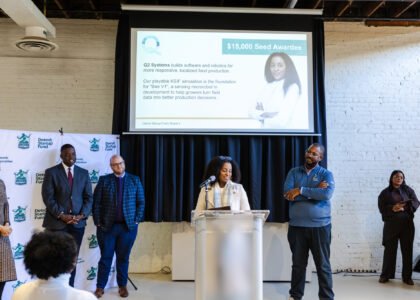
I spoke about the importance of blended capital and the role of governments and other institutions in helping entrepreneurs undertake risks that conventional private financing may be poorly positioned to support at the earliest stages. In my own experience, the City of Detroit and its economic-development institutions have provided early support for the development of Q2 Systems, including a $15,000 Detroit Startup Fund grant intended to help finance the prototyping of our first agricultural sensing microrobot.
I also shared that I have been reading Mariana Mazzucato’s The Entrepreneurial State, which has been influencing how I think about the relationship between governments, technological innovation, and the financing of long-term economic transformation. Mazzucato (2013) examines the role public institutions have played in financing foundational technologies, including research underlying the internet, GPS, and several capabilities subsequently commercialized by private technology companies. Her work has encouraged me to think more deliberately about the institutional arrangements through which societies develop technological capabilities, particularly where the uncertainty and time horizons involved make conventional commercial financing difficult to secure.
I find this particularly relevant to African economies seeking to participate in increasingly sophisticated industries. If we want to develop capabilities in robotics, artificial intelligence, advanced manufacturing, and agricultural technology, we must consider who finances the research, experimentation, infrastructure, and early technical development required before these activities become commercially viable. I raised the importance of blended capital during our panel because my own entrepreneurial experience has demonstrated the value of institutions willing to support that process. The City of Detroit’s early investment in Q2 Systems has given us an opportunity to develop and test aspects of our robotics work. I am increasingly interested in how African governments, development-finance institutions, philanthropies, and private investors might develop complementary financing arrangements that support similarly ambitious technological enterprises, with appropriate accountability and a sustained commitment to building productive capabilities.
This type of public support can create a foundation for generating technical evidence and demonstrating progress. Where such support is subsequently combined with appropriately structured private investment, development finance, or other instruments, it may contribute to a broader blended-finance strategy.
I am particularly interested in the relationship between these financing stages and the development of productive capabilities that might otherwise remain difficult to establish.
The distinction matters because many of the industries likely to influence the global economy in 2050 depend on research, technical experimentation, infrastructure, and the accumulation of specialized skills. Their development requires institutions willing and able to finance different types of risk over different time horizons.
The structure of African financial markets adds another dimension to this challenge.
The OECD’s Africa Capital Markets Report 2026 found that nearly 85% of the continent’s pension assets and more than 90% of its insurance assets are concentrated in four countries, with South Africa accounting for the largest share. The report also identified constraints involving the depth of domestic capital markets, the availability of suitable investment instruments, and the concentration of institutional portfolios in particular asset classes (OECD, 2026).
These findings complicate proposals that assume large pools of African institutional savings can be readily redirected toward new enterprises.
Pension funds and insurance institutions have obligations to beneficiaries and policyholders. Their investment decisions must reflect liquidity needs, risk-management requirements, regulatory conditions, and the characteristics of the assets available to them.
The challenge involves developing financing instruments and investable opportunities that can connect long-term savings with productive economic activity under appropriate institutional safeguards.
I also spoke about the importance of being careful with how we frame risk when discussing African investment opportunities.
Risk assessment plays an essential role in responsible capital allocation. Currency volatility, infrastructure constraints, regulatory uncertainty, and macroeconomic instability can materially affect commercial outcomes. These conditions must be evaluated seriously.
At the same time, the way investment risks are understood and communicated can influence which enterprises receive financing, which countries are considered commercially attractive, and what financing terms are available.
I am interested in how African institutions can strengthen their own capacity to evaluate technological and industrial opportunities, develop credible financing structures, and create the conditions through which more productive investments become possible.
The discussion has particular significance for countries such as Malawi, where persistent macroeconomic constraints and limited productive diversification create substantial difficulties for entrepreneurs seeking to develop capital-intensive enterprises.
It is also relevant to the broader African technology ecosystem. Partech Africa’s 2025 report recorded approximately $4.1 billion in technology financing across the continent, including both equity and debt. Four markets—Kenya, South Africa, Egypt, and Nigeria—accounted for 72% of the total (Partech Africa, 2026). These figures illustrate both the progress made in developing venture-financing ecosystems and the continuing concentration of investment within a relatively small number of countries.
The development of financial markets, research institutions, technical capabilities, and viable enterprises must therefore be considered together. Financing more businesses can contribute to economic development, but the longer-term transformation of productive structures requires attention to the industries those businesses participate in and the capabilities their activities help establish.
This is the question I hope we continue examining as the conversation about Africa’s economic future develops.
One of the most meaningful conversations I had during the symposium took place after my panel, when I had an opportunity to speak with Ndidi.
She asked me why I was not thinking about building in Africa.
I appreciated the question because it required me to consider the relationship between my commitments to African development and the geographical decisions I have made in pursuing my entrepreneurial ambitions.
I explained that Africa remains central to my thinking, and that I have spent considerable time exploring different possibilities for developing my technological work on the continent. I had considered South Africa as a potential location for some of these activities, undertaken research, developed relationships, and made efforts to identify opportunities through which the work might progress. Those efforts have not yet materialized into the arrangements I had hoped for.
Ndidi suggested Rwanda, introducing another possibility that I intend to continue considering as my work evolves.
The conversation was particularly interesting because it touched upon a question that African entrepreneurs living and working internationally encounter quite frequently. There is an expectation that commitment to African development should eventually translate into a decision to return home and build.
I understand the importance of that expectation. African countries need entrepreneurs, engineers, researchers, investors, and institutions willing to develop productive capabilities within their economies. The location of businesses influences where employment opportunities emerge, where technical expertise accumulates, and where commercial value is generated.
These considerations matter enormously when thinking about industrial development and the future of African economies.
At the same time, the circumstances under which individual entrepreneurs make decisions about where to operate can be considerably more complicated.
I explained to Ndidi that I have financial responsibilities that must be met regardless of the geographical aspirations I carry. I have bills to pay and student debt associated with my education in the United States. My businesses require resources, and I have to make decisions that allow me to remain financially responsible while developing the capabilities necessary to pursue my longer-term ambitions.
There is a practical reality to entrepreneurship that becomes particularly apparent when one has limited personal financial reserves.
The decision to establish a business in a particular location is influenced by market access, infrastructure, engineering expertise, financing opportunities, commercial relationships, and the ability of the founder to sustain themselves through the process.
For now, Detroit offers an environment in which I can concentrate on developing the technological capabilities I am interested in, while working toward the financial stability required to undertake more ambitious activities over time.
I do not consider that decision a departure from my commitment to African development.
My professional work continues to involve institutions and initiatives serving African communities. Through the Ntha Foundation and Digital Skills for Africa, we have developed educational opportunities for learners across the continent, and our current scholarship initiative has attracted applications from more than fifty African countries. The Foundation’s commitment of $27 million in educational access represents 5,400 scholarship opportunities valued at $5,000 each, with the intention of expanding access to digital and emerging-technology education.
The value represents committed educational access rather than cash expenditure, but the scale illustrates what can become possible when learning infrastructure is designed to reach people across geographical boundaries.
Our platform has also exceeded 5,000 registered learners, and I remain deeply involved in the development of the systems through which these educational opportunities are delivered.
I have become increasingly interested in how international professional and institutional relationships can contribute to African development through knowledge exchange, technical collaboration, education, investment, and eventually commercial activity.
There is considerable historical precedent for the movement of skills, capital, and knowledge across national boundaries. Migration can create economic costs for countries that lose skilled professionals, but diaspora relationships can also facilitate trade, investment, research collaboration, and the circulation of ideas.
The economic consequences depend on the institutional arrangements through which those relationships develop and the opportunities available to participate in productive activities.
I am interested in contributing to the development of such relationships, particularly between Detroit and institutions in Malawi and elsewhere on the continent.
I have also become increasingly conscious of the importance of designing technologies for the environments in which they may eventually operate.
My work in robotics has led me toward questions about how intelligent systems can function in places where electricity, communications infrastructure, technical maintenance, and access to replacement components are constrained.
These are practical engineering considerations that can influence the architecture of a technological product. I believe there is considerable opportunity in treating such constraints as foundational design requirements, particularly when developing technologies intended for international markets.
The ability to operate reliably under difficult environmental and infrastructure conditions may also create benefits for customers in other regions.
This is one of the ways I hope to connect the technological capabilities developed through Q2 Systems with the needs of emerging markets.
My conversation with Ndidi stayed with me because it required me to articulate these relationships more carefully. I appreciate the importance of building within African economies, and I recognize the contribution that entrepreneurs can make through the establishment of locally rooted enterprises. I am also conscious of the financial and technical conditions that determine what I can responsibly undertake at this stage of my career.
I intend to continue exploring opportunities across the continent, including those that might eventually allow different aspects of my technological work to develop through African institutions and partnerships.
For now, I am building where I have an opportunity to develop the capabilities I need, while continuing to invest my time and resources in initiatives serving African communities.
I think that is an important part of the conversation about African economic agency. The geographical organization of a business, the ownership of its capabilities, the markets it serves, and the communities benefiting from its activities are related questions that deserve to be examined carefully.
Ndidi’s question has given me even more reason to think about how those relationships might develop over the coming years.
The symposium also gave me an opportunity to spend a brief moment with Dr. Demetrice “Dee” Jordan, who chaired the Geography 2050 planning committee.
Dee met with us as we prepared for the event, and we continued our conversations afterward. I particularly appreciated her interest in the longer-term questions emerging from our panel, especially the need to examine the history of development financing, identify approaches that have produced meaningful results, and understand what institutions might improve as they develop future investment strategies.
Dee’s professional work provides an interesting intellectual foundation for these conversations. At Harvard Medical School, her research examines the spatial and ecological determinants of disease risk, including vector-borne and neglected tropical diseases, alongside questions of environmental change, public health, and health equity. Her academic training includes a dual PhD in Health Geography and Environmental Science and Policy from Michigan State University, creating an additional connection to an institution that has played an important role in my own academic and professional journey (Harvard Medical School, n.d.).
I have become increasingly interested in geography as a discipline because of the extent to which economic and development questions are shaped by spatial conditions.
The location of infrastructure influences access to markets. Environmental conditions affect agricultural production and public health. The geographical distribution of educational and research institutions shapes opportunities for developing expertise. Urbanization changes the organization of housing, transport, employment, and services.
These relationships become particularly important when technological systems depend on reliable information about physical environments.
Geospatial research provides capabilities for observing and analyzing many of these conditions, allowing institutions to develop more informed approaches to planning and resource allocation.
Dee’s research demonstrates the importance of connecting such analysis with public-health outcomes, while her broader professional work has also addressed questions concerning access to geographical education and representation within the discipline.
She has contributed to initiatives intended to expand opportunities for underrepresented scholars and to document the work of Black geographers, including the Celebrating Black Geographers anthology developed through the American Geographical Society.
I appreciated the opportunity to learn more about these contributions, particularly in the context of an event held at the Schomburg Center.
There was also a rather wonderful moment of humor.
I met Brian during the gathering, and he recounted a conversation with Dee about how she preferred to be introduced. He explained, with warmth and considerable amusement, that Dee had asked him to dispense with the familiar distinctions of being the first Black person or the first woman in a particular position. She wanted to be recognized simply as the first geographer at Harvard Medical School, period.
I enjoyed that enormously.
The anecdote stayed with me because it reflected something important about the way professional contributions are recognized. Representation matters, particularly in institutions where certain communities have historically had limited access to opportunities. At the same time, people develop expertise and make substantive contributions that deserve recognition in their own right.
I understood the humor in Dee’s preference, and I appreciated the confidence with which it asserted the significance of geographical expertise within a medical institution.
The exchange also reminded me of something I have experienced throughout my own career. Moving between disciplines and institutional environments can involve considerable effort to explain why a particular perspective belongs in a space where it has not traditionally been represented.
My training in economics and entrepreneurship has increasingly led me toward technological systems, including robotics and simulation. I have spent time working with engineers, learning the practical requirements of technologies outside my original field of expertise, and developing an understanding of how these capabilities might contribute to broader economic systems.
These experiences have reinforced my appreciation for interdisciplinary work and the institutional environments that make it possible.
Dee’s interest in continuing the conversation about investment was particularly encouraging. It suggested an opportunity to move beyond the questions raised during the symposium and engage more seriously with the evidence surrounding different financing approaches.
I would be interested in examining which development-financing arrangements have successfully supported the accumulation of productive capabilities, how institutional relationships contributed to those outcomes, and what lessons might inform future investment decisions.
These are questions that require sustained research and collaboration across disciplines.
They are also questions that I believe will become increasingly important as African economies confront the changing technological and demographic conditions of the coming decades.
As I reflected on the different conversations across the symposium, I became increasingly interested in the relationship between knowledge, financing, and economic agency.
Africa’s development has been shaped by domestic institutions and international relationships whose histories extend across colonialism, independence, structural adjustment, regional integration, and the expansion of global markets. These experiences have influenced the productive structures of different African economies, the financial institutions available to them, and the policy choices through which development priorities are pursued.
The continent’s economies have followed different trajectories, and there is substantial variation in industrial capabilities, financial markets, institutional capacity, and economic opportunities. Treating Africa as a single investment environment obscures differences that are important for making responsible decisions about development.
Nevertheless, several questions recur across countries.
Who determines which economic activities deserve priority? Which institutions possess the resources required to support their development? How are technological capabilities acquired, adapted, and maintained? Who participates in the ownership of productive assets, and how are the benefits of economic growth distributed?
These questions relate directly to the organization of capital.
The OECD’s latest research on African capital markets emphasizes the importance of deepening domestic financial systems, improving the availability of suitable investment instruments, and strengthening institutions capable of mobilizing long-term savings (OECD, 2026). The report also highlights the geographical concentration of institutional assets and the challenges associated with expanding access to market-based financing.
I find these issues particularly important because the development of more sophisticated productive economies requires a combination of capabilities that must be accumulated over time.
Entrepreneurs need education, technical expertise, infrastructure, financing, and access to markets. Researchers need institutions capable of supporting scientific inquiry and translating discoveries into practical applications. Governments need analytical and administrative capacity to identify priorities, implement policies, and evaluate outcomes.
The relationships between these capabilities influence whether economies are able to diversify and participate in more technologically sophisticated industries.
I am interested in how African institutions can develop a greater capacity to determine their own technological and industrial priorities, supported by financing arrangements that reflect the economic conditions under which those ambitions must be pursued.
This also requires a serious discussion about the meaning of ownership.
African-owned businesses can participate in international markets and develop technologies through research and production networks that extend across national borders. Their contribution to African development depends partly on the relationships they establish with African economies, including employment, investment, knowledge transfer, procurement, and the development of local productive capacity.
Similarly, international financing can support African-led initiatives when the institutions receiving support possess meaningful authority over the design, implementation, and evaluation of their activities.
The organization of these relationships matters more than the labels through which they are described.
I have become increasingly interested in what it would take for African entrepreneurs to develop globally competitive technologies while maintaining a deliberate commitment to markets and communities across the continent.
That ambition requires a sustained effort to develop commercially viable enterprises, establish appropriate institutional relationships, and contribute to the technical capabilities available within different economic environments.
I also believe it requires greater investment in people.
Through my work with the Ntha Foundation, I have spent years developing initiatives intended to expand access to education, digital skills, and entrepreneurial opportunities. Those experiences have given me a strong appreciation for the capabilities of young Africans and the challenges they face in accessing opportunities through which their skills can become economically productive.
The relationship between human-capital development and the expansion of productive industries deserves particular attention.
Educational access is essential, but the economic value of skills depends on the opportunities available to apply them. A generation of increasingly educated young people will require businesses, institutions, and industries capable of creating meaningful economic activity.
This is one of the reasons I hope to spend the coming decades working across both education and technological enterprise.
I am interested in the development of systems that allow people to learn through meaningful experiences, technologies that expand productive capabilities, and institutions that can finance the application of those capabilities.
The symposium reinforced my belief that these objectives need to be considered together.
I have spent much of my entrepreneurial career thinking about what it takes to build organizations capable of sustaining themselves while contributing to broader social and economic objectives. My experiences across education, international development, and technology have introduced me to different approaches to financing, institutional management, and the evaluation of impact.
Over time, I have become increasingly interested in the responsibilities associated with allocating capital.
I currently approach these questions as an entrepreneur who continues to seek resources for the development of ambitious ideas. I understand how difficult it can be to communicate a long-term technological vision, particularly when the commercial applications are still being investigated and the resources required for technical development are substantial.
I also recognize that investors and institutions have responsibilities to evaluate proposals rigorously and allocate resources in ways that reflect their mandates, risk tolerance, and accountability obligations.
These perspectives have influenced my growing interest in eventually financing other entrepreneurs.
I hope to develop businesses capable of generating meaningful economic value and to use some of the resources and experience accumulated through that work to support ideas and institutions beyond my own companies.
I have substantial interests in experiential learning, artificial intelligence, sensing, robotics, and increasingly autonomous production systems. Some of these interests may develop into commercial activities within Q2 Systems. Others may be more appropriately pursued by independent founders, research institutions, or organizations whose expertise and operating models differ from ours.
I am beginning to think about how an eventual investment thesis might support a broader collection of enterprises working toward the development of more accessible and productive technological systems.
The experience of Geography 2050 has contributed to that thinking.
Ndidi’s work demonstrates the importance of entrepreneurial institutions capable of creating value across agricultural systems. Catherine’s research illustrates the significance of connecting technological intelligence with institutional action. Nadait’s work encourages scrutiny of the economic costs embedded within financing processes. Nathalia’s work shows how relationships and institutional networks can contribute to the development of leadership and collaboration. Dee’s research and professional initiatives remind me of the importance of developing and recognizing expertise across disciplinary boundaries.
Together, these perspectives offer a useful foundation for thinking about the responsibilities of institutions involved in shaping economic development.
I am particularly interested in the possibility of developing financing approaches that recognize the different requirements of research, technical experimentation, enterprise formation, and commercial expansion.
The eventual objective would be to support entrepreneurs and institutions capable of developing lasting productive capabilities, while ensuring that capital is allocated through processes that are financially responsible and attentive to broader social and economic outcomes.
I also recognize that building such institutions requires considerable experience, resources, and credibility.
For now, much of my attention remains directed toward developing the enterprises and educational initiatives I am already responsible for. The work is demanding, and there are substantial technical and commercial questions that must be addressed before some of our longer-term ambitions can become viable.
Nevertheless, I appreciate the opportunity to participate in conversations that expand my understanding of how different institutions approach these problems.
There is considerable value in learning from people who have spent years building organizations, financing enterprises, conducting research, and developing policies intended to improve economic outcomes.
I hope to continue developing those relationships, including the conversations begun through Geography 2050.
As I left the Schomburg Center, I found myself reflecting on the remarkable range of experiences and perspectives that had informed the preceding two days. The conversations moved across agriculture, health, technology, environmental systems, financing, and the changing role of African countries in the global economy. I appreciated the intellectual ambition of the symposium, particularly its willingness to approach Africa’s future through the relationships between different systems.
I was also grateful for the people who made my participation possible.
Nathalia’s introduction through Catherine created an opportunity that expanded into several meaningful conversations. I appreciated the chance to engage with Ndidi’s thinking, reconnect with Nadait, learn more about Catherine’s research, and spend time with Dee before and after the symposium. I was glad to share the investment panel with Nnamdi and appreciated Hiba’s thoughtful moderation and her efforts to frame the discussion around African institutional capital.
These relationships have become an important part of how I understand my professional development. Much of my work involves bringing together ideas and capabilities that emerge from different institutions, disciplines, and geographical environments. I have learned that these connections can create opportunities for collaboration and learning that are difficult to anticipate in advance.
The history of the Schomburg Center provided an especially meaningful setting for the experience.
In 1926, the New York Public Library made a consequential investment in the preservation of Black intellectual and cultural history. That investment supported an institution whose resources would eventually become important to scholars, artists, students, and communities around the world.
A century later, we gathered within that intellectual legacy to discuss the capabilities African societies might develop over the next twenty-five years.
I find the historical relationship compelling because it reminds me of how institutions can influence the opportunities available to generations they may never encounter directly.
The work of preserving knowledge, developing research capabilities, financing enterprises, and building public institutions often produces consequences that extend well beyond the immediate period in which resources are committed.
I have become increasingly interested in evaluating development through that longer historical perspective.
The economic challenges facing African countries are substantial, and many require urgent action. Households need affordable food, reliable energy, healthcare, education, and opportunities to earn sustainable livelihoods. Governments and institutions must respond to these needs within the constraints of available resources.
At the same time, the choices being made today will influence the productive structures and technological capabilities available to future generations.
By 2050, the African continent will have experienced profound demographic, environmental, and economic changes. The nature of employment will continue evolving, technological systems will become more capable, and the relationships between countries and markets will be shaped by developments that remain difficult to anticipate fully.
The continent’s ability to participate meaningfully in these changes will depend partly on the institutions, industries, and capabilities developed during the intervening decades.
This is the central question I brought to Geography 2050, and it remains the question I want to spend the coming years investigating.
I want to understand how African societies can develop greater productive capacity, how technological advancement can be made relevant to different economic environments, and how financing systems can support the entrepreneurs and institutions required to pursue those ambitions.
I am interested in the responsibilities of governments, investors, researchers, and businesses in developing an environment where ambitious ideas can be tested, refined, and translated into commercially and socially meaningful activities.
I also hope to contribute directly to that work through the organizations I am building, the partnerships I develop, and eventually the entrepreneurs I may have an opportunity to finance.
There is considerable uncertainty in the future we are discussing. Many of the technologies, industries, and institutional arrangements that will shape 2050 are still developing, and some of the assumptions guiding our present decisions will inevitably require reconsideration.
That uncertainty makes the quality of our institutions and the discipline of our investments particularly important.
I believe the most consequential decisions we make will involve which capabilities we choose to develop, how we organize the resources required to support them, and whether we create institutions capable of sustaining those capabilities over time.
I am grateful to the American Geographical Society, the organizing committee, the speakers, and everyone who contributed to making Geography 2050 such an intellectually engaging experience. I am particularly appreciative of the opportunity to participate in these conversations at the Schomburg Center, an institution whose history reminds us of the enduring importance of preserving knowledge and creating space for African intellectual contributions.
I left New York with a deeper appreciation for the people working across different parts of the continent’s development, and with an even stronger interest in the relationships between education, technological innovation, productive capacity, and investment.
As I continue building Q2 Systems in Detroit and expanding the educational initiatives supported through the Ntha Foundation, I expect these questions to remain central to my work.
I hope that the next twenty-five years will see more African entrepreneurs developing technologies with international relevance, more institutions capable of financing long-term productive investments, and greater opportunities for young people to participate in shaping the economies they will inherit.
I also hope to spend a meaningful part of those years contributing to that future, initially through the businesses and institutions I am building, and eventually through the ideas and ambitions of other entrepreneurs.
The conversations at Geography 2050 have given me a great deal to carry forward.
I look forward to continuing them.
If you’d like to go deeper into my journey — from Malawi, through the United Nations and Microsoft to now building my own companies in Detroit, you can find it in my books.
American Geographical Society. (2026). Geography 2050: Africa shaping tomorrow [Symposium programme]. https://www.geography2050.org/program-2026
Food and Agriculture Organization of the United Nations, International Fund for Agricultural Development, United Nations Children’s Fund, World Food Programme, & World Health Organization. (2026). The state of food security and nutrition in the world 2026. Food and Agriculture Organization of the United Nations. https://www.fao.org/publications/fao-flagship-publications/the-state-of-food-security-and-nutrition-in-the-world
Harvard Medical School. (n.d.). Demetrice ‘Dee’ Jordan. Department of Global Health and Social Medicine. https://ghsm.hms.harvard.edu/faculty-staff/demetrice-dee-jordan
Mazzucato, M. (2013). The entrepreneurial state: Debunking public vs. private sector myths. Anthem Press. https://www.amazon.com/dp/0141986107
Nakalembe, C. (2026). Lessons from Uganda’s Earth observation-based disaster risk financing program. AGU Advances, 7(1), e2025AV002224. https://doi.org/10.1029/2025AV002224
New York Public Library. (n.d.). Schomburg’s library. https://libguides.nypl.org/arturoschomburg/library
Nwuneli, N. O. (2021). Food entrepreneurs in Africa: Scaling resilient agriculture businesses. Routledge.
Organisation for Economic Co-operation and Development. (2026). Africa capital markets report 2026. OECD Publishing. https://doi.org/10.1787/aced796a-en
Partech Africa. (2026). 2025 Africa tech venture capital report. https://partechpartners.com/africa-reports/2025-africa-tech-venture-capital-report
Proximate. (2025, December). This calculator knows what it costs to get funded. https://www.proximate.press/latest-stories/this-calculator-knows-what-it-costs-to-get-funded
University of Maryland, Department of Geographical Sciences. (2026, April 8). Regional workshop empowers nine African nations with AI-driven crop yield forecasting. https://geog.umd.edu/featured-content/regional-workshop-empowers-nine-african-nations-ai-driven-crop-yield-forecasting
World Bank. (2026). Malawi economic monitor: Building stability to unlock growth. https://www.worldbank.org/en/brief/2026/09/23/malawi-economic-monitor-building-stability-to-unlock-growth



Nthanda Manduwi is a Malawian storyteller, entrepreneur, digital transformation advocate, and community builder driven by the mission to empower Africa’s economic landscape through innovation and technology.