
When people talk about “women’s empowerment,” I sometimes pause. The phrase sounds noble, but too often, it assumes that women are powerless — waiting to be lifted, helped, or given permission.
In truth, women aren’t disempowered. I believe that the systems women exist within are misdesigned.
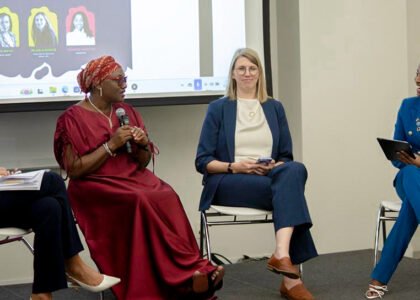
That’s one of the first things I said in my most recent conversation with the United Nations Capital Development Fund (UNCDF) and the Digital Frontiers Institute. The episode — Women in Inclusive Finance and Policy Regulation — dives into how digital finance, ecosystem design, and intentional policy can open doors for women entrepreneurs across Africa and beyond.
For me, this was was a moment to connect the dots — between my academic research, my entrepreneurial journey, and the work we’ve been doing at Ntha Foundation, Kwathu Kollective, and Q2 Corporation to redesign the systems that shape opportunity.
🎧 Listen here: UNCDF & DFI Podcast – Women in Inclusive Finance and Policy Regulation
I learned early in my career that capability isn’t what holds women back — architecture does.
During my undergraduate research on gender participation in Malawi’s economy, I discovered that the gap wasn’t about women lacking skill; it was about the way systems were structured — policies, access to finance, leadership norms, procurement rules.
When I later ran youth innovation programs funded by the World Bank and the European Union, we hard-coded inclusion into the system: 60% of participants had to be women. But we didn’t have to fight to reach that quota — over 70% joined organically because leadership was visibly female.
That experience taught me something profound: when women see themselves represented, participation follows naturally. We don’t need “programmes for women.” We need systems that include women by design — where diversity isn’t an afterthought but a metric built into the architecture.
Capacity building has always been at the heart of development work, but I’ve learned that capacity without connectivity doesn’t scale.
After years of training young people, I realized workshops alone don’t change lives. Systems do. Ecosystems do.
That’s why we shifted our model at Kwathu Kollective from short-term trainings to long-term pathways — connecting women entrepreneurs to investors, procurement opportunities, and platforms where their work can be seen, valued, and funded.
It’s a principle I also carry into my work with Microsoft: when platforms are designed inclusively, they become equalizers. They don’t just teach people to build businesses — they connect those businesses to capital, customers, and opportunity.
Workshops issue certificates.
Ecosystems issue purchase orders.
At the last UN General Assembly, a short video I posted went viral. It began, “I’m not a feminist, I can cook,” and flipped to, “I am a feminist — watch me cook.” It was playful, but it carried something deeper.
Feminism, for me, isn’t theory. It’s lived experience.
I was raised by a woman who was fire and force — Malawi’s first female inland marine captain. My mother never called herself a feminist, but her life was a manifesto of possibility. She taught me that empowerment starts at home, long before a woman walks into a bank or boardroom.
As Graça Machel said, “The chains of poverty and inequality are forged in childhood.”
If we want more women entrepreneurs, we must start with early interventions — at home, in schools, and in culture. Girls must grow up knowing that entrepreneurship, technology, and leadership are gender-neutral spaces.
And when I design programs today, I always return to my “3 Cs”: Capability, Confidence, and Connectivity. Before we talk about finance, we must talk about belief, skills, and networks. Because without those, capital has nowhere to land.
Intentionality is a word I use often. It’s what transforms mentorship into real impact.
During my time at Microsoft, I met Sarah Bond — President of Xbox — and she reminded me what leadership looks like when it’s both human and deliberate. She remembered names. She gave visibility. She created space. That 15-minute conversation with her expanded how I think about sponsorship, visibility, and what it means to be seen.
Intentionality, however, shouldn’t rely on individual goodwill — it should be built into institutions. Governments must enforce gender-responsive procurement policies. Donors should fund longitudinal support, not one-off projects. Leaders must open doors and walk others through them.
Mentorship opens doors.
Sponsorship walks you through.
One of the most powerful lessons from my MBA at Michigan State University has been about structure. I used to think entrepreneurship could be taught in a bootcamp. Now I know it’s a lifelong curriculum.
Across Africa, 58% of self-employed people are women — yet fewer than 3% scale beyond micro-enterprise. That’s not a talent problem; it’s a systems problem.
At Kwathu Kollective, we now design for scale. We map value chains, host investor demo days, and help women build ventures that speak the language of investment and policy. The goal is to move from capability to capital, with confidence and connectivity in between.
Africa isn’t poor — it’s poorly managed. And the way we fix that is through education reform and ecosystem design — not charity, but structure.
When people ask why I plan to return to Africa after my MBA, I smile. They say, “Why not stay in the U.S. where things work?”
But my answer is always the same: because home deserves systems that work too.
Talent doesn’t flee the continent. It flees dysfunction.
That’s why I’m building Q2 Corporation — an ecosystem where we Play. Learn. Build. Earn. Through Q2, we’re designing simulations and pilots — from smart farms to creative supply chains — where young Africans can learn, prototype, and build within functioning systems.
Women don’t need pink programs. They need neutral systems that work for everyone.
Over the next five years, my focus is to help redesign Africa’s systems — in finance, education, and innovation — so exclusion becomes impossible. So that a girl in rural Malawi doesn’t have to fight her way into the digital economy — she’s already part of it.
This conversation on the UNCDF x Digital Frontiers podcast reminded me of why I do this work: because inclusion isn’t a favor — it’s good design.
If you haven’t already, take just a little bit less than an hour to listen to the episode. It’s a conversation about women, but also about systems, power, and what it really means to build.
🎧 Listen on Spotify: UNCDF and Digital Frontiers Institute: Women in Inclusive Finance and Policy Regulation with Nthanda Manduwi
If you’d like to go deeper into my journey — from Malawi, through the United Nations to Microsoft, you can find it in my books:



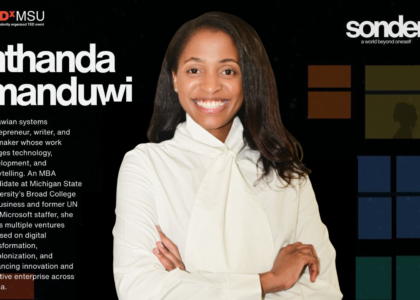
Nthanda Manduwi is a Malawian storyteller, entrepreneur, digital transformation advocate, and community builder driven by the mission to empower Africa’s economic landscape through innovation and technology.