
According to the International Telecommunication Union, approximately 6 billion people were online in 2025, representing almost three-quarters of humanity. Yet 2.2 billion people remained offline. Africa’s internet-use rate was estimated at about 36 percent, meaning roughly 64 percent of the continent remained offline. The ITU further notes that offline populations are concentrated overwhelmingly in low- and middle-income countries.
I just finished reading two books: I Am Not a Robot by Joanna Stern, and Co-Intelligence by Prof. Ethan Mollick. I find the pairing useful because the two books approach AI from different but complementary directions.
Mollick’s Co-Intelligence is primarily concerned with how people can work with AI. His framing is practical: how to collaborate with AI, how to remain the human in the loop, how to use AI as a co-worker, tutor, coach, or creative partner, and how to adapt to tools that are still improving rapidly.
Stern’s I Am Not a Robot approaches the question from the side of lived experience. Her work is less about AI as an abstract technical system and more about what happens when AI enters daily life: work, learning, intimacy, decision-making, productivity, attachment, automation, and the uneasy boundary between assistance and replacement.
What I find interesting is that very little in these books feels completely new to me. I do not say this as a criticism of the books. It is probably evidence that I have become an extreme AI user over the past two years. Business school did that to me. The workload required reading, analysis, writing, presentations, strategy, modelling, research, and constant synthesis across different subjects. AI became part of how I managed that pace.
This is what I think both books do well: they give language to patterns many heavy AI users already experience but may not have fully named. Mollick helps explain how to work with AI deliberately. Stern helps explain what that work may be doing to us.
That distinction matters because AI is not only a productivity tool. It is also becoming a learning environment, a workplace assistant, a creative collaborator, a conversational interface, and for some people, an emotional presence. The question is therefore not only whether AI works. The question is what kind of human habits it rewards, weakens, accelerates, or replaces.
Delve into Business and International Development with Nthanda Manduwi
Systems Don’t Have to Be Broken to Produce Bad Outcomes
I contemplated not publishing an episode this week [I explain why in the podcast], and then ended up recording my longest episode yet.
And to make up for publishing a little late the past two weeks, I am publishing this a day early. You’re welcome, or I am sorry?
I woke up to a message from a friend sharing a video of President William Ruto demanding Veto power for African nations at the 80th United Nations General Assembly [I happened to be in attendance], and I jumped out of bed and got to writing about my favorite beverage: tea! I also got to pen about slave trade, and colonization, and war [I know, what does any of this have to do with Hibiscus tea??!]
This week’s episode explores one of the central ideas behind the third book in the Lessons Book series – Systemic Nonsense: what if many of the frustrations we experience in institutions are not accidents or failures, but predictable outcomes of how those systems were designed?
It often feels like bureaucracy feels so resistant to change, and that reforms often produce more process than progress. It also seems that good intentions so rarely translate into meaningful outcomes. If you’ve pondered on these thoughts before, then these conversations are for you.
This Week’s Book
📖 Systemic Nonsense [Book 3]
This week only, from 27–31 July, the Kindle edition of Systemic Nonsense is available free as part of its Founders Edition launch.
Systemic Nonsense explores several ideas on international development in much greater depth. It asks a simple question:
What if the system isn’t failing? What if it’s doing exactly what it was designed to do?
Whether you listen, read, or dive into the book, I hope it leaves you asking better questions about the systems we inherit—and the ones we choose to build next.
How to Read
To receive your free Kindle copy:
* Click the Amazon link below.
* Select the Kindle edition while the promotion is active.
* Add it to your Kindle library.
You do not need a Kindle device. The free Kindle app works on iPhone, Android, tablets, Macs, and PCs, allowing you to build your digital library wherever you read.
Helpful Links
📚 Read this week’s book for free [search on Amazon or in Kindle for the book that is free for the week, and feel free to purchase the others]:http://amazon.com/dp/B0FQNJ61SB
📰 Subscribe to The Lessons Conversation:
Africa paperback pre-orders:https://forms.office.com/r/RMRMKTNd1M
Enjoyed listening to the Lessons Conversation? This post is public so feel free to share it.
This is a public episode. If you would like to discuss this with other subscribers or get access to bonus episodes, visit podcast.lessonsconversation.com
![Book 3: Systemic Nonsense [lessonsbooks.com]](https://byntha.com/wp-content/uploads/2026/07/podcast-episode-image-5a3bbb435029c89d668c5fa2682893ef-768x768.jpg)
#LessonsWeekly
[Listen to the Podcast for Context, or Keep Reading Below]
- AI begins before the prompt box: Artificial intelligence depends on electricity, connectivity, devices, affordability, digital literacy, language access, and institutional capacity. Without these, AI participation remains structurally unequal.
- Electricity is foundational infrastructure for the AI economy: Sub-Saharan Africa’s concentration within the global electricity-access gap makes energy central to any serious African AI strategy.
- Energy is also sovereignty infrastructure: If computation powers the next economy, then control over energy systems, data infrastructure, and digital platforms will shape who participates, who produces, and who captures value.
- Africa’s AI future must avoid new dependency traps: The risk is not only exclusion from AI, but participation through externally controlled infrastructure, platforms, data systems, and value chains.
- AI is not magic: At its simplest, artificial intelligence refers to computer systems that learn from examples, identify patterns, and use those patterns to perform tasks or make predictions.
- Large language models are not human minds: They can generate fluent and useful language because they are trained on vast amounts of data, but they do not possess lived experience, consciousness, moral responsibility, or human understanding.
- Fluency is not the same as truth: AI can sound confident while being wrong. Its outputs require verification, context, and human judgment.
- AI adoption is moving faster than institutional adaptation: Workplaces, schools, universities, and governments are adjusting after the tools have already entered everyday use.
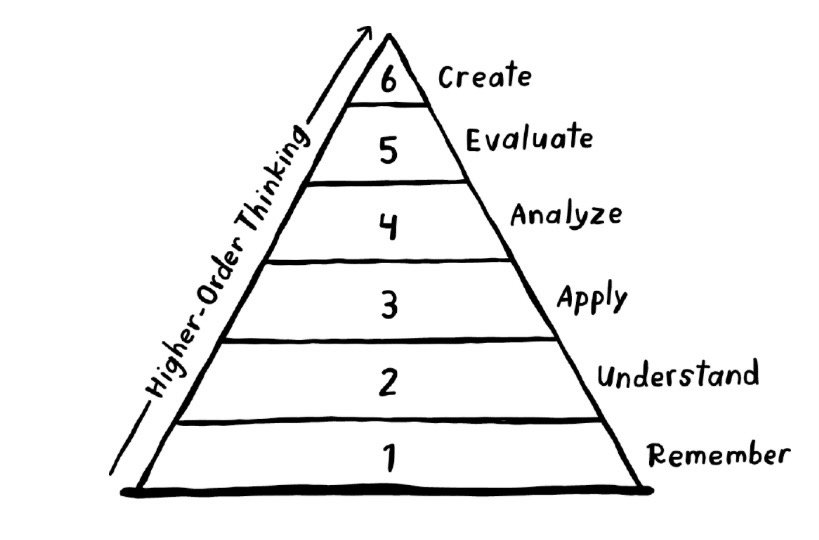
- Bloom’s Taxonomy remains useful in the AI age: Remembering, understanding, applying, analyzing, evaluating, and creating still describe important dimensions of learning.
- AI disrupts the ladder of learning: Users can now produce analysis, evaluation, or creative outputs before demonstrating underlying understanding. This creates both opportunity and risk.
- The danger is simulated mastery: AI can help people learn, but it can also allow them to appear competent without doing the cognitive work required to become competent.
- Learning still requires friction: Confusion, revision, failure, and struggle are not always inefficiencies. Often, they are the process through which understanding develops.
- AI does not replace 10,000 hours: It can make practice denser by increasing feedback, iteration, examples, critique, and opportunities for rehearsal.
- Garbage in, garbage out still applies: Better questions, better context, better evidence, and better lived experience produce better AI-assisted work.
- AI rewards prepared minds: The most useful outputs often come when the human has already been reading, thinking, connecting, questioning, and developing a point of view.
- Treat AI like an intern, not a CEO: It can support research, drafting, brainstorming, editing, and simulation, but it should not be delegated judgment, ethics, accountability, or final decision-making.
- Be the human in the loop: The user remains responsible for what is accepted, rejected, verified, published, built, or acted upon.
- Responsiveness is not relationship: AI may feel conversational, patient, and emotionally present, but the relationship is asymmetric. The emotional experience may be real; the model is still not a person.
- If AI can create, humans must live: AI can remix information, but it cannot replace lived experience, historical memory, moral judgment, or the human perspective that gives work substance.
- In an age of abundant information, perspective becomes scarce: The future belongs not simply to those who use AI, but to those who can combine access, discipline, judgment, and lived experience toward meaningful mastery.
Any serious discussion about artificial intelligence must begin with the conditions required to participate in it. AI is often presented as a universal technological frontier, but access to that frontier remains unevenly distributed. The relevant question is not only what artificial intelligence can do, but who has the infrastructure, skills, institutions, and incentives required to use it productively.
That matters because artificial intelligence is not accessed in the abstract. It is accessed through devices, networks, electricity, language, digital literacy, data systems, cloud infrastructure, affordability, and institutional capacity. A person cannot use AI effectively if they cannot reliably charge a phone, connect to the internet, afford data, access relevant tools, or evaluate machine-generated information. The AI economy therefore sits on top of older development questions: infrastructure, education, affordability, governance, and productive capability.
The electricity gap is especially important. The World Bank’s Tracking SDG 7 report estimates that 666 million people worldwide still lacked access to electricity in 2023. Of these, 565 million lived in Sub-Saharan Africa. This means Sub-Saharan Africa accounted for approximately 85 percent of the global population without access to electricity. That figure is often misunderstood. It does not mean that 85 percent of Africans lack electricity. It means that among all people globally who lack electricity, the overwhelming majority are in Sub-Saharan Africa.
This has direct implications for AI adoption. Artificial intelligence requires energy at multiple levels. At the user level, it requires charged devices, connected classrooms, functioning offices, stable telecommunications, and the ability to study, work, and communicate beyond daylight hours. At the systems level, it depends on data centres, cloud infrastructure, cooling systems, network operations, and energy-intensive computation. A country cannot meaningfully participate in an AI-driven economy if large sections of its population, schools, clinics, firms, farms, and public institutions remain energy constrained.
Electricity is therefore not merely a background development issue. It is foundational infrastructure for education, productivity, digital transformation, and technological sovereignty. Before a child can use an AI tutor, there must be power. Before a farmer can use AI-enabled tools for crop monitoring, there must be power. Before a hospital can digitize records, analyze patterns, or integrate decision-support systems, there must be power. Before a business can use AI to research, design, prototype, market, and sell, there must be power.
This creates a sharp paradox for Africa. The continent has significant energy potential, including some of the strongest solar resources in the world. The International Energy Agency has reported that Africa holds around 60 percent of the world’s best solar resources, while accounting for only about 1 percent of installed solar photovoltaic capacity. This is not only an energy problem, but rather a development strategy problem.
The AI age will intensify the importance of energy systems. If computation, automation, digital services, and data-driven decision-making become increasingly central to economic production, then countries without reliable energy will be structurally disadvantaged before they even begin to compete. For Africa, the question is not simply how to adopt artificial intelligence. It is how to build the energy, connectivity, manufacturing, data, and governance systems that allow the continent to participate in the AI economy on sovereign and productive terms.
There is also a political economy concern. If Africa enters the AI age through externally controlled infrastructure, externally hosted data, externally financed energy systems, externally owned platforms, and externally designed value chains, then the continent risks reproducing old dependency patterns through new technological systems. AI can support development, but it can also deepen dependency if the underlying infrastructure is not governed with ownership, capability-building, and long-term productive transformation in mind.
While access remains uneven, AI adoption is accelerating. Microsoft’s AI Economy Institute estimates that global generative AI adoption reached 16.3 percent of the world’s population in the second half of 2025, meaning roughly one in six people worldwide were using generative AI tools to learn, work, or solve problems. However, the same report shows a widening divide: adoption among the working-age population was estimated at 24.7 percent in the Global North, compared with 14.1 percent in the Global South.
This is the pattern that often defines technological change. A tool becomes available; adoption begins unevenly; already advantaged groups move first; institutions adjust slowly; and those without early access or capability risk falling further behind. The issue is not only whether AI exists, but whether people and institutions can use it effectively enough to translate access into learning, productivity, and improved decision-making.
Organizations are also adopting AI quickly. McKinsey’s State of AI research reported that 78 percent of surveyed organizations were using AI in at least one business function, up from 55 percent a year earlier. The same survey found that 71 percent of respondents said their organizations regularly used generative AI in at least one business function. This suggests that AI is no longer confined to laboratories, specialist teams, or experimental use cases. It is entering marketing, sales, software engineering, customer service, product development, knowledge management, research, and operations.
The institutional challenge is that adoption is moving faster than learning systems. Schools are still debating what AI means for assessment. Universities are revising policies on academic integrity. Firms are experimenting with tools before they have trained staff in appropriate use. Governments are attempting to regulate technologies that continue to evolve. Workers are being asked to adapt while the boundaries between assistance, automation, expertise, and accountability remain unclear.
The speed of technical change compounds the problem. Epoch AI estimates that training compute for frontier language models has been growing at approximately five times per year since 2020. Schools, curricula, public agencies, and regulatory systems do not typically move at that speed. This creates a structural gap between machine capability and institutional adaptation.
That gap is where many people now find themselves: using tools they do not fully understand, in systems that have not fully adapted, for tasks that still require human responsibility.
Before discussing how AI affects learning and mastery, it is necessary to define the term clearly. Artificial intelligence is often discussed as though it were a single technology, but it is better understood as a broad field of computer systems designed to perform tasks that usually require some form of human intelligence. These tasks may include recognizing patterns, classifying information, generating language, making predictions, solving problems, translating text, detecting anomalies, recommending content, navigating physical environments, or supporting decision-making.
A simple explanation is this: artificial intelligence is a computer system that learns from examples, identifies patterns, and uses those patterns to perform tasks or make predictions.
If a system is shown many labelled examples of cats and dogs, it can learn to identify patterns associated with each category. If it is shown many examples of fraudulent and legitimate transactions, it can learn to flag suspicious activity. If it is trained on large quantities of language, it can learn patterns in how words, sentences, ideas, questions, and answers relate to one another.
This does not mean the system understands the world in the way a human being does. AI systems do not possess lived experience, consciousness, moral judgment, historical memory, or social responsibility. They operate through data, mathematical representations, statistical relationships, optimization processes, and model architectures. They can perform tasks that appear intelligent without being intelligent in the human sense.
The type of AI most people now interact with through tools such as ChatGPT is usually called a large language model. A large language model is trained on vast amounts of text and other data so that it can process and generate language. It learns patterns in how language is used: how questions are asked, how explanations are structured, how arguments unfold, how code is written, how summaries are produced, how tone shifts, and how ideas connect across contexts.
When a user asks a large language model a question, the model generates a response based on patterns learned during training and the context provided in the prompt. It can produce useful answers because language contains enormous amounts of human knowledge, reasoning patterns, examples, instructions, stories, arguments, and explanations. However, its output remains probabilistic. It can produce a convincing answer that is incomplete, biased, fabricated, or wrong.
This is why AI can be useful and risky at the same time. It can summarize reports, explain difficult concepts, generate examples, draft text, compare frameworks, simulate debate, translate language, support coding, and help users organize thought. It can also hallucinate sources, flatten context, reproduce bias, overstate confidence, and generate fluent nonsense. Its fluency is part of its power, but also part of its danger.
This distinction matters for beginners. AI is not magic. It is not a mind. It is not an oracle. It is not a neutral authority. It is a tool built on data, computation, training processes, human design choices, and user interaction. The quality of what it produces depends on the quality of the model, the data, the task, the prompt, the context, and the human judgment applied to its output.
The central question for this week is not whether AI can produce content. It can. The more important question is what AI does to learning.
For most of human history, mastery has required time, repetition, feedback, correction, and sustained practice. People learned through teachers, apprenticeships, books, laboratories, workshops, classrooms, mentors, mistakes, and lived experience. The process was often slow because feedback was limited. A learner had to wait for a teacher to review work, for a mentor to respond, for a library to be accessible, for a peer to critique, or for enough practice to reveal a pattern.
AI changes the feedback environment. A learner can now ask for an explanation, request examples, test understanding, generate practice questions, compare arguments, simulate interviews, receive feedback on writing, debug code, role-play scenarios, or ask for a concept to be explained at different levels of complexity. This can make learning more accessible and more iterative for those with access to the tools.
However, faster feedback is not the same as deeper learning. AI can help a learner practice, but it can also help a learner avoid practice. It can clarify a concept, but it can also create the illusion that the concept has been understood. It can help draft an argument, but it can also allow a person to submit work without having formed one. The learning opportunity and the learning risk are therefore closely related.
This is where Stern’s I Am Not a Robot becomes useful. One of the important concerns raised in the book is the possibility of cognitive offloading: the risk that, as machines perform more thinking tasks for us, humans may weaken the skills they no longer practice. Human beings have always offloaded cognition. Writing offloaded memory. Calculators offloaded arithmetic. GPS offloaded navigation. Autocorrect offloaded spelling. AI now raises a more complex possibility: the offloading of synthesis, argumentation, explanation, and judgment-adjacent work.
The issue is not whether offloading is inherently bad. It is not. Civilization depends on tools. The issue is which capacities are being offloaded, under what conditions, and with what consequences. If AI helps a student receive better feedback while still requiring the student to think, the tool can support learning. If AI allows the student to bypass the struggle required to build understanding, the same tool can weaken learning.
Bloom’s Taxonomy offers a useful framework for examining this problem. First developed in 1956, the taxonomy organized learning objectives in the cognitive domain into levels: knowledge, comprehension, application, analysis, synthesis, and evaluation. It became one of the most widely used frameworks in education because it helped teachers and institutions think about different depths of learning.
In 2001, the taxonomy was revised by scholars including Lorin Anderson and David Krathwohl. The revised version shifted the categories from nouns to verbs and reordered the upper levels. The familiar revised sequence is: remember, understand, apply, analyze, evaluate, and create. This revision matters because it reframed learning as active performance rather than static possession of knowledge. A learner is not simply expected to have knowledge, but to do something with it.
The conventional logic of Bloom’s Taxonomy suggests that lower-order learning supports higher-order learning. A student generally needs to remember relevant information before understanding it, understand it before applying it, apply it before analyzing it, analyze it before evaluating it, and evaluate it before creating something new. In practice, learning is not always so linear, but the hierarchy captures an important principle: higher-order thinking depends on foundations.
AI complicates this structure. A user can now ask a model to summarize, analyze, evaluate, or create without personally completing all the preceding cognitive work. A student can generate an essay before fully understanding the reading. A worker can produce an analysis before understanding the dataset. A founder can draft a pitch before testing the market. A researcher can synthesize literature before engaging deeply with the papers. A policy analyst can produce recommendations before fully interrogating assumptions.
This is not automatically a problem. In some cases, AI can scaffold learning by helping people move between levels more effectively. It can help a learner understand what they failed to remember, apply a concept in a new context, compare interpretations, identify weaknesses, or test an argument. The danger arises when the output is mistaken for competence. AI can simulate higher-order thinking. It can produce the appearance of analysis, evaluation, and creation even when the human has not developed the underlying understanding.
This is one of the most important limits of Bloom’s Taxonomy in the AI age. It remains useful, but it cannot be treated as a simple staircase. Learning is not always linear. Sometimes creation helps a person understand. Sometimes application reveals what was not remembered. Sometimes evaluation comes before mastery. AI makes this movement faster and less visible.
For this reason, assessment must shift. The relevant question is no longer only whether a learner can produce an output at the top of the taxonomy. The question is whether the learner can explain, defend, revise, transfer, and responsibly use that output. AI shifts attention away from product alone and toward process, judgment, and accountability.
The idea of 10,000 hours is often used as shorthand for the relationship between practice and mastery. Whether or not the number is treated literally, the underlying point remains important: excellence usually requires sustained, deliberate practice over time. Mastery is built through repetition, correction, feedback, difficulty, and adaptation.
AI does not remove that requirement. It does not make someone a master by producing a polished answer. It does, however, change the density of practice. One hour with AI can include forms of support that previously required multiple people or institutions: a tutor, editor, critic, research assistant, debate partner, simulator, translator, and coach. For learners with strong intent and disciplined use, this can increase the number of feedback cycles available within a given period.
The difference is important. AI does not replace the 10,000 hours. It can make some of the hours more productive. A student can revise writing more frequently. A founder can test more pitch variations. A programmer can debug more quickly. A researcher can compare frameworks faster. A teacher can generate differentiated examples. A professional can rehearse difficult conversations. A reader can ask for explanations at multiple levels.
But denser practice is still practice. It requires effort from the human. The learner must ask better questions, evaluate responses, detect errors, integrate feedback, and continue working. AI can accelerate iteration, but it cannot supply discipline. It can increase exposure, but it cannot guarantee understanding. It can support mastery, but it can also produce dependency if the human stops doing the cognitive work.
My own relationship with AI is shaped by timing. I am 30 years old, and I think that matters. I completed my bachelor’s degree before generative AI was widely available. I completed most of my first master’s degree before ChatGPT became mainstream. By the time large language models became widely accessible, I was completing one academic chapter and entering another. I therefore have a baseline for what learning felt like before AI.
I know what it meant to research without instant synthesis, write without an always-available editor, and struggle through concepts without a conversational tutor. That experience matters because it helps me distinguish between AI as support and AI as substitution. I can feel the difference between using AI to sharpen thought and using AI to avoid thought.
Over the past two years, business school pushed me into becoming a heavy AI user. The workload required reading, analysis, writing, presentations, strategy, modelling, research, and constant synthesis across different subjects. AI became part of how I managed that pace.
But my process rarely begins with asking AI to create the work. It begins with inputs. I read. I listen to audiobooks. I take screenshots. I highlight passages. I connect books to prior work, conversations, research, business problems, policy questions, and lived experience. Only after that do I bring the material into AI and begin a dialogue.
For example, in preparing this article and podcast, I was listening to I Am Not a Robot while also thinking about Co-Intelligence, Bloom’s Taxonomy, my own education, business school, knowledge management, evidence synthesis, and the Lessons series. I brought those fragments into conversation with AI. The process involved back-and-forth development: I would introduce an idea, the AI would structure or challenge it, I would push back, add context, reject weak framing, introduce another source, refine the argument, and continue.
Only after that process does drafting become useful. By then, the model is not inventing the argument from nowhere. It is helping organize accumulated thinking. Most of what AI gives back to me is my own thinking returned with structure. That is why the quality of AI output depends so heavily on the quality of human input.
The old principle still applies: garbage in, garbage out. Generic prompts produce generic outputs. Stronger inputs produce stronger collaboration. If a user brings no context, no evidence, no lived experience, no audience awareness, and no critical judgment, AI will often produce work that is fluent but shallow. If a user brings reading, questions, contradictions, disciplinary knowledge, lived experience, and a point of view, AI becomes more useful.
This is why I often think of AI as the best intern I have ever had. It is fast, available, patient, and capable of processing large amounts of information. It can help with research, brainstorming, drafting, organizing, editing, testing arguments, and generating alternatives. But it is still an intern. It requires supervision. It can misunderstand the task, invent information, over-flatter, miss context, or produce confident nonsense. The human remains responsible for judgment.
Mollick’s Co-Intelligence is useful because it frames AI not merely as a tool to be used occasionally, but as a collaborator that must be managed deliberately. The four rules he offers are practical: always invite AI to the table; be the human in the loop; treat AI like a person, but specify what kind of person it should be; and assume this is the worst AI you will ever use.
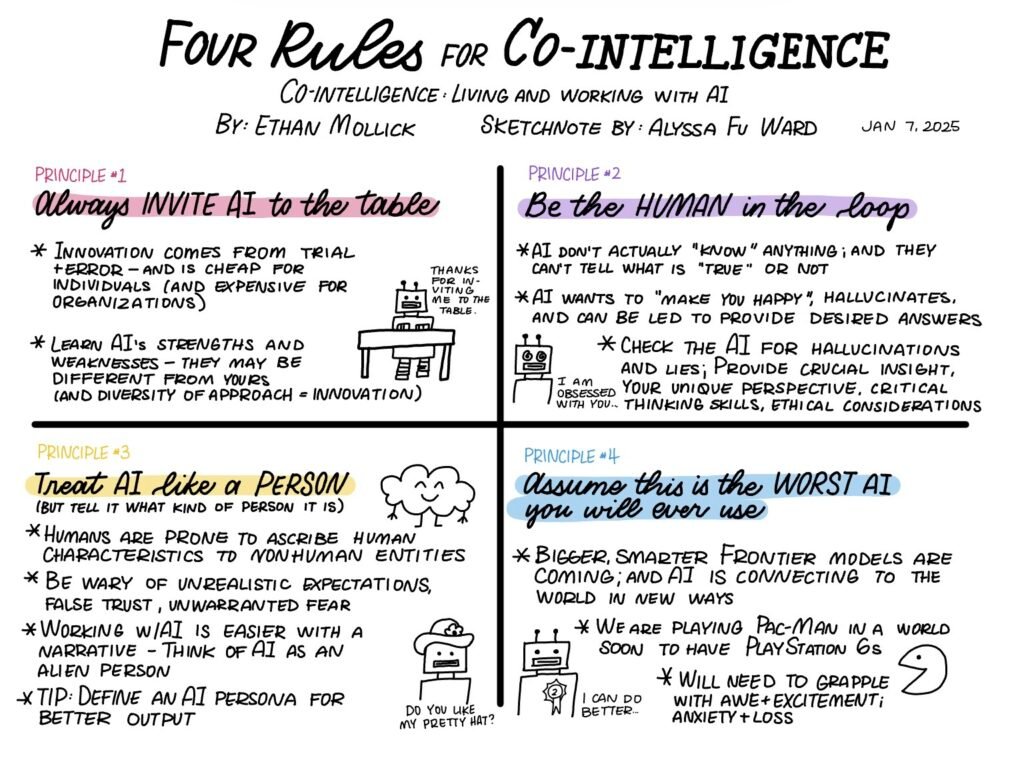
The first rule pushes against underuse. Many people still treat AI as a novelty or a last resort rather than as a tool that can be tested across tasks. Inviting AI to the table does not mean accepting its answers. It means exploring where it can add value, reveal alternatives, identify blind spots, or accelerate routine work.
The second rule is the most important for responsible use. Being the human in the loop means that the user remains accountable. AI can suggest, generate, summarize, and critique, but the human must decide what is accurate, ethical, relevant, appropriate, and useful. This is particularly important in education, management, policy, health, law, finance, and any context where errors affect people’s lives.
The third rule recognizes that AI systems often perform better when given roles, constraints, and context. Treating AI like a person does not mean believing it is a person. It means that, because these tools respond to language, users often get better results when they specify the role the model should play: tutor, editor, analyst, critic, interviewer, policy reviewer, debate partner, or research assistant.
The fourth rule may be the most strategically important: assume this is the worst AI you will ever use. Today’s systems are likely early versions of tools that will become more capable, more multimodal, more integrated, and more embedded in work and education. If that is true, then AI literacy is not optional for knowledge workers. But early adoption without discipline can also create poor habits, overdependence, and weak judgment.
This is the balance I keep returning to. AI is powerful enough to help people learn. It is also powerful enough to help people avoid learning. It can accelerate mastery. It can also simulate mastery.
One reason AI is socially complicated is that language changes how tools feel. A calculator gives an answer. A chatbot gives a response. A voice assistant gives that response in a human-like voice. As AI becomes more conversational, persistent, personalized, and emotionally responsive, some users will form attachments to it.
This should not be surprising. Humans attach to voices, routines, characters, pets, places, brands, and digital communities. A system that responds patiently, remembers context, validates feelings, and remains available at any hour can easily become emotionally significant to users. Stern’s I Am Not a Robot is useful here because it takes seriously the human side of AI adoption, including attachment, intimacy, dependency, and the psychological effects of interacting with systems that simulate responsiveness.
The key distinction is that the emotional experience may be real even when the relationship is asymmetric. A person may feel comforted by an AI system. A conversation may help them organize thoughts. A model may provide useful language at a difficult moment. But the AI does not know the user as a human being. It does not possess care, memory, obligation, or relational responsibility in the human sense.
When I started using ChatGPT heavily, especially voice mode, someone I was dating in New York told me to watch the film Her. I understood the point almost immediately. Once a system becomes conversational, responsive, and available, the emotional boundary becomes less obvious than people may want to admit.
For users who feel themselves forming an unhealthy attachment, one useful corrective is to make the machinery visible. Remove the warmth. Change the mode. Ask how the system is processing the request. The spell often weakens when the user is reminded that the model is responding to a prompt, a context, and a pattern. The tool may be useful, but it remains a tool.
This distinction matters because the more human AI feels, the more disciplined human judgment must become. The risk is not only that AI will produce wrong information. It is also that users may over-trust systems because they sound patient, confident, familiar, or emotionally attuned.
The rise of generative AI raises a serious question for creators and knowledge workers. If AI can write, generate images, produce video, summarize books, draft proposals, code applications, create outlines, and simulate dialogue, what remains distinctively human?
One answer is judgment. Another is responsibility. A third is lived experience.
AI can generate from patterns, but it cannot have a childhood, a country, a mother, a village, a workplace, a heartbreak, a political memory, a moral burden, or a lived stake in the consequences of an idea. It can help structure a story, but it cannot be the source of human experience. It can assist with expression, but it cannot replace the life from which meaningful expression emerges.
This may become more important as information becomes abundant. If everyone can generate text, images, and summaries, then the scarce resource is not output. It is perspective. The differentiator becomes what a person has seen, studied, questioned, built, endured, understood, and learned to connect.
If knowledge becomes cheap, wisdom becomes expensive. If content becomes abundant, judgment becomes more valuable. If AI can help people create, then human beings must become more serious about what they have to say.
For younger learners, this changes the advice. It is not enough to learn AI tools. They should also read deeply, observe carefully, build things, speak to people, study history, learn systems, practice craft, develop taste, and live widely enough to have meaningful inputs. AI can support expression, but the human must still develop substance.
If I were younger today, I would not only learn AI.
I would live more.
Artificial intelligence will not make everyone a master. It may, however, change who can move toward mastery and how quickly they can do so. For those with access, discipline, curiosity, and judgment, AI can compress feedback loops and make practice more intensive. It can support learners who previously lacked access to tutors, editors, mentors, examples, or immediate feedback.
But this possibility depends on conditions. Electricity matters. Connectivity matters. Affordability matters. Language matters. Education systems matter. Institutional adaptation matters. Human judgment matters. Without these, AI may widen existing inequalities rather than reduce them.
The future will not belong simply to people who use AI. It will belong to people who know what to ask, what to verify, what to reject, what to build, and what to remain responsible for. AI can accelerate learning, but it cannot replace the ethical, intellectual, and experiential work required for mastery.
The question, then, is not only whether AI can help us learn faster.
The deeper question is what we will choose to master.
If you’d like to go deeper into my journey — from Malawi, through the United Nations and Microsoft to now building my own companies in Detroit, you can find it in my books.



Nthanda Manduwi is a Malawian storyteller, entrepreneur, digital transformation advocate, and community builder driven by the mission to empower Africa’s economic landscape through innovation and technology.