I woke up in conversation with one of my good friends: Zaithwa Gwaza.
I met Zai when I lived in New York, as he worked in finance on Wall Street. Our conversation was on ‘giving up on Malawi’. I called us ‘stupid’, for failing to turn our countries around over decades and centuries, as every man sets out to look out for themselves. Zai pushed back, insisting calling us stupid is unneccessarily blunt, as most are simply trying to survive, and emerging economies do not offer enough incentive for one to do more.
I have been reading The African Dream while moving across contexts—Malawi, Kenya, Turkey, the United States—and the text lands differently depending on where I am.
In Malawi—what one is to call the book’s home, it reads as proximity. Institutions, ambitions, and gaps are visible in ways that are difficult to abstract away. After spending time with my interns and reflecting on the systems around them, I found myself returning to a more difficult question.
Africa has not lacked vision. It has produced plans, frameworks, and long-term strategies at both national and continental levels. From institutional designs like the Malawi University of Science and Technology to continental blueprints such as Agenda 2063, the intent to transform has been articulated repeatedly.
So the question is not whether vision exists.
The question is what allows vision to translate into sustained outcomes—and what prevents it from doing so.
I write never in conclusion. Always as an attempt to think through the questions more carefully.
Delve into Business and International Development with Nthanda Manduwi
Systems Don’t Have to Be Broken to Produce Bad Outcomes
I contemplated not publishing an episode this week [I explain why in the podcast], and then ended up recording my longest episode yet.
And to make up for publishing a little late the past two weeks, I am publishing this a day early. You’re welcome, or I am sorry?
I woke up to a message from a friend sharing a video of President William Ruto demanding Veto power for African nations at the 80th United Nations General Assembly [I happened to be in attendance], and I jumped out of bed and got to writing about my favorite beverage: tea! I also got to pen about slave trade, and colonization, and war [I know, what does any of this have to do with Hibiscus tea??!]
This week’s episode explores one of the central ideas behind the third book in the Lessons Book series – Systemic Nonsense: what if many of the frustrations we experience in institutions are not accidents or failures, but predictable outcomes of how those systems were designed?
It often feels like bureaucracy feels so resistant to change, and that reforms often produce more process than progress. It also seems that good intentions so rarely translate into meaningful outcomes. If you’ve pondered on these thoughts before, then these conversations are for you.
This Week’s Book
📖 Systemic Nonsense [Book 3]
This week only, from 27–31 July, the Kindle edition of Systemic Nonsense is available free as part of its Founders Edition launch.
Systemic Nonsense explores several ideas on international development in much greater depth. It asks a simple question:
What if the system isn’t failing? What if it’s doing exactly what it was designed to do?
Whether you listen, read, or dive into the book, I hope it leaves you asking better questions about the systems we inherit—and the ones we choose to build next.
How to Read
To receive your free Kindle copy:
* Click the Amazon link below.
* Select the Kindle edition while the promotion is active.
* Add it to your Kindle library.
You do not need a Kindle device. The free Kindle app works on iPhone, Android, tablets, Macs, and PCs, allowing you to build your digital library wherever you read.
Helpful Links
📚 Read this week’s book for free [search on Amazon or in Kindle for the book that is free for the week, and feel free to purchase the others]:http://amazon.com/dp/B0FQNJ61SB
📰 Subscribe to The Lessons Conversation:
Africa paperback pre-orders:https://forms.office.com/r/RMRMKTNd1M
Enjoyed listening to the Lessons Conversation? This post is public so feel free to share it.
This is a public episode. If you would like to discuss this with other subscribers or get access to bonus episodes, visit podcast.lessonsconversation.com
![Book 3: Systemic Nonsense [lessonsbooks.com]](https://byntha.com/wp-content/uploads/2026/07/podcast-episode-image-5a3bbb435029c89d668c5fa2682893ef-768x768.jpg)
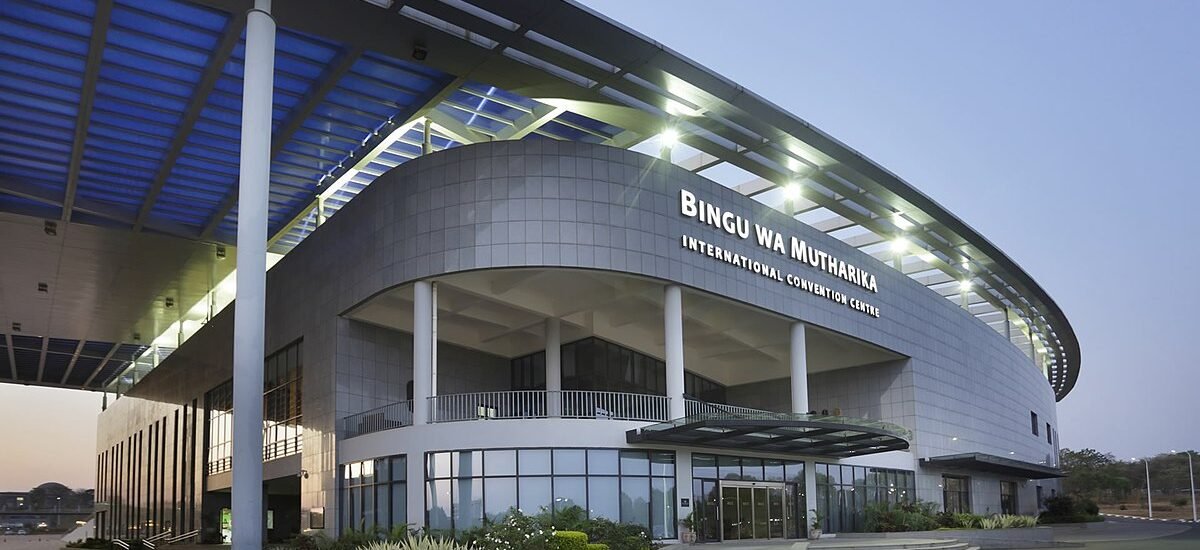
Bingu wa Mutharika was a Malawian economist, diplomat, and head of state who served as President of Malawi from 2004 until his death in 2012. Before entering politics, he spent decades working in international development, including roles at the World Bank and regional economic institutions, where he focused on trade, finance, and structural transformation. That background shaped his approach to governance—he saw development as something that could be designed through policy, institutions, and economic strategy. His presidency was marked by an emphasis on agricultural productivity, macroeconomic stability, and attempts to reposition Malawi toward greater self-sufficiency.
He is also notable for articulating a clear, if ambitious, philosophy of development in his book The African Dream.
In his book, Bingu argues that African countries must move away from dependency and externally driven models, and instead define their own priorities, build productive capacity, and invest deliberately in science, technology, and human capital. Whether one agrees with his conclusions or not, his work stands out because it represents one of the more explicit efforts by an African head of state to think systematically about how a country might move from poverty to sustained economic growth—and what role institutions, leadership, and long-term planning must play in that process.
At its core, The African Dream is an attempt to articulate a development philosophy from within the African context.
Bingu wa Mutharika rejects passive models of development. He argues for sovereignty in defining priorities, for deliberate economic transformation, and for the use of institutions as instruments of that transformation. Development, in his framing, is not something that emerges organically. It must be designed.
This logic is visible in the institutions established during his administration. The Malawi University of Science and Technology, created by Act of Parliament No. 31 of 2012 and opened in 2014, was mandated to promote the development, adaptation, and application of science, technology, and innovation for economic transformation. That mandate is precise. It positions education not as an isolated activity, but as part of a broader system linking human capital to national development.
There is intellectual weight to this position.
Across multiple development trajectories, particularly in parts of East Asia, education systems were not expanded independently of economic strategy. They were aligned with it. Human capital was developed in response to industries that either existed or were being intentionally built. Infrastructure, policy, and production moved together.
In that sense, Bingu’s instinct is neither unusual nor misplaced. He is arguing that Africa must define its own pathway and build the institutional architecture required to support it.
It is not difficult to see why this framework holds appeal.
It offers an alternative to passive development, where outcomes are expected to emerge from markets, aid, or external intervention. It restores agency. It places responsibility for direction within the state. It insists that transformation is a matter of design, not chance.
The reference points often invoked—Singapore, South Korea, and other Asian economies—reinforce this appeal. These are cases where states played an active role in shaping industrial policy, aligning education with production, and maintaining long-term strategic direction. Research on Singapore, for example, highlights the deliberate integration of human capital development with industrial strategy, supported by disciplined institutions and sustained policy continuity.
From this perspective, the lesson appears straightforward.
Development requires vision, institutions, and coordination.
The difficulty emerges in the translation.
Vision can define direction. Institutions can be created to support that direction. But the system must sustain alignment over time, under pressure, and across transitions.
This is where the model encounters its limits.
Institutions such as MUST continue to operate. Students enroll, study, and graduate. On paper, the system appears intact. Yet the connection between what is being produced and what the economy can absorb begins to weaken.
This is visible in current labor-market dynamics. Recent data indicates that a substantial share of young Malawians remain outside employment, education, or training, while employers report increasing costs associated with retraining graduates whose skills do not align with immediate needs. At the same time, hundreds of thousands of young people enter the labor market each year, while job creation remains far below that level.
The implication is not that education is absent. It is that education is not consistently translating into economic participation. This is a coordination problem.
One of the underlying challenges is continuity.
A development vision articulated at a particular moment does not automatically persist. If it is closely tied to a specific leadership context, its transmission into long-term institutional behavior is uncertain. Institutions may retain their form, but lose their function.
This produces a specific kind of outcome.
Degrees continue to be offered, but without a clear mapping to a live economic trajectory. Students move through technical programs—engineering, computer science, cybersecurity—yet struggle to situate themselves within industries that are evolving rapidly at the global level.
In this environment, individuals adapt rationally.
When the broader system does not provide clear pathways, ambition narrows to what is immediately achievable. Financial independence becomes the primary goal. Small-scale enterprise becomes the most visible route. The horizon contracts, not because aspiration is absent, but because direction is unclear.
This is not a failure of individuals.
It is what systems produce when alignment weakens.
The reference to development models such as Singapore introduces a second layer of complexity.
Singapore’s trajectory was not solely a function of vision. It was supported by a set of conditions that are not easily replicated: a highly disciplined bureaucracy, sustained policy continuity, strong integration into global markets, and a scale that allowed for tight coordination.
Research on the Singapore model emphasizes both its effectiveness and its specificity. It demonstrates that state-led development can work, but also that it depends on execution capacity, institutional discipline, and context.
This raises a more difficult question.
Even if the model is conceptually sound, under what conditions can it be implemented?
If those conditions are absent or only partially present, what modifications are required?
This is where I find myself moving beyond the original framing.
The challenge is not to reject the idea of deliberate development. The evidence suggests that intentionality, coordination, and institutional design remain necessary.
The challenge is to understand what must accompany vision for it to translate into outcomes.
From my own work, I approach this through a different starting point.
Not vision first, but constraint.
Energy systems. Infrastructure. Production capacity. The ability of firms to operate, learn, and scale. These are not downstream considerations. They define what is feasible.
Development, in this framing, is not simply the implementation of a plan. It is the construction of systems that enforce learning, efficiency, and output over time.
This shifts the emphasis.
Institutions must not only exist. They must be connected to production systems that require what they produce. Human capital must not only be developed. It must be absorbed and utilized within functioning economic structures.
Without that, expansion of education does not produce transformation. It produces accumulation without deployment.
Seen through this lens, The African Dream remains a serious and necessary contribution. It is one of the best books produced by an African Economist, in my humble opinion.
It insists on agency. It recognizes the need for structure. It rejects passive approaches to development.
Where it encounters difficulty is in the gap between design and sustained execution.
Vision is necessary. It is not sufficient.
Institutions are necessary. They are not sufficient.
The system must also be able to carry that vision through time, across leadership changes, and under real-world constraints.
That requires more than planning. It requires enforcement mechanisms, continuity structures, and alignment between education, infrastructure, and production.
A development vision can move a country forward. What determines whether that movement lasts is how that vision is carried once it leaves the mind of the person who defined it.
In this case, the early years of Bingu showed what strong direction can do. There was clarity around priorities, a willingness to act decisively, and a sense of movement in key areas like agriculture and macroeconomic stabilization. Institutions were created with intent. There was an attempt to connect policy, production, and human capital. The system had direction.
What changed over time was not the presence of vision, but how that vision was held and executed.
Several patterns became more visible:
As these dynamics intensified, the system began to lose flexibility. Economic pressures—particularly foreign exchange shortages and fiscal strain—started to build. At the same time, strained external relationships reduced the room to maneuver. What had been a coordinated system became harder to manage under pressure.
The effect was not immediate collapse. It was a gradual loss of alignment.
This is where I think the deeper lesson sits. The challenge was not a lack of clarity about where the country should go. It was the difficulty of building systems capable of carrying that direction through changing conditions and beyond a single leadership center.
For future visionaries, there is caution. Vision can initiate transformation. It cannot sustain it on its own.
Without these elements, even a well-defined development path risks narrowing over time, becoming increasingly dependent on the conditions that first made it possible.
My few words are in no way the end of the discussion.
If anything, engaging with The African Dream raises more difficult questions than it resolves.
What kinds of development models are viable for African states in a global economy shaped by automation, artificial intelligence, and shifting supply chains?
How should institutions be designed to maintain direction beyond individual leadership?
What forms of coordination are required to ensure that human capital development translates into economic output?
These are not questions with immediate answers [at least for me]. They are questions I attempt to think through in my upcoming book series: Lessons.
They are necessary questions. I think we should all be asking these questions. I think we should aim to try and find even just a few answers within our lifetime.
If you’d like to go deeper into my journey — from Malawi, through the United Nations to Microsoft, you can find it in my books.
P.S. for 2026, you can get any of my books via Kindle for only $2.99.
This offer is valid till the end of the year.
Links to purchase are as below:



Nthanda Manduwi is a Malawian storyteller, entrepreneur, digital transformation advocate, and community builder driven by the mission to empower Africa’s economic landscape through innovation and technology.