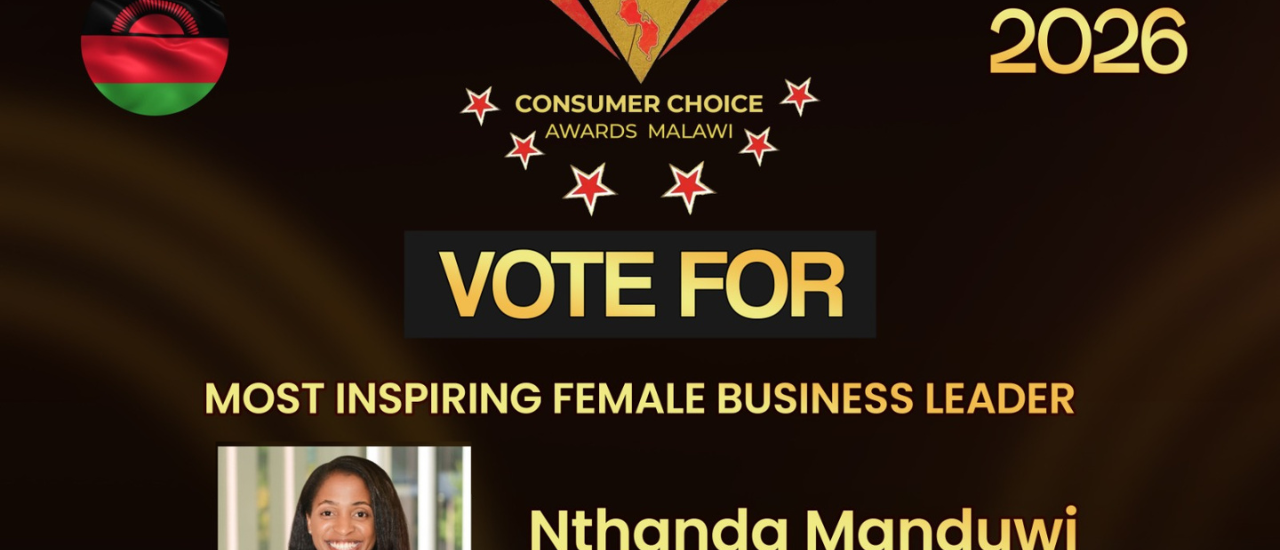
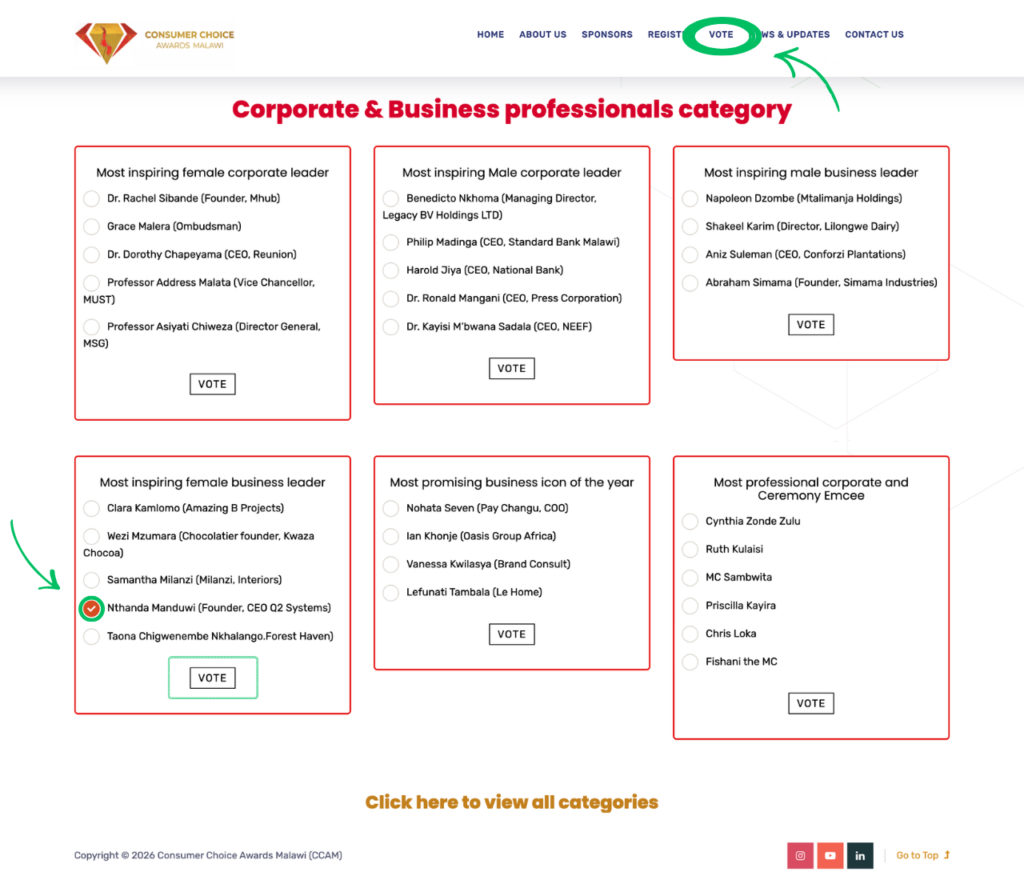
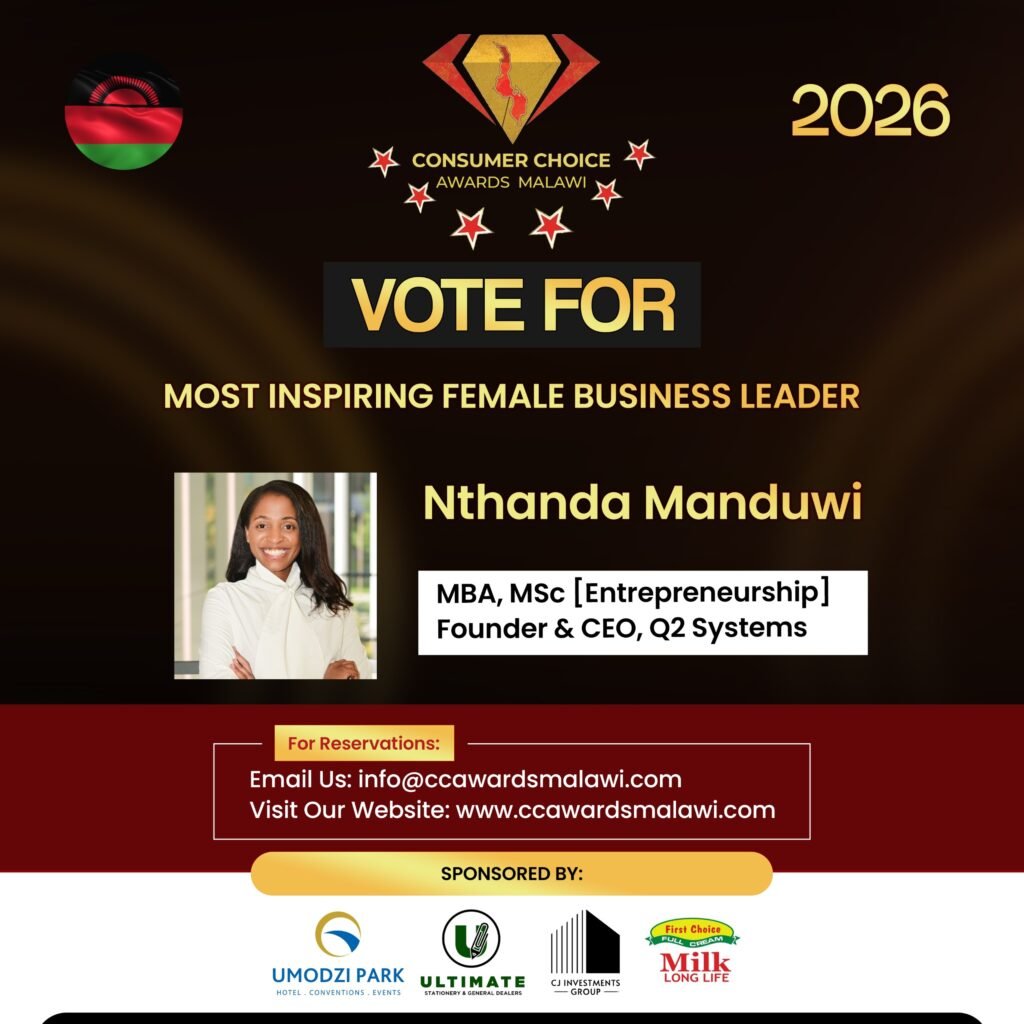
I am delighted to have been nominated again at the Consumer Choice Awards Malawi 2026, this time in the category of the Most Inspiring Female Business Leader as founder and CEO of Q2 Systems. Last year, I was nominated as the Most Inspiring Female Corporate Leader, and we took it home. It was wonderful for the work of my non-profit, Ntha Foundation, to be recognized in that way.
Q2 is my newest and most ambitious bet yet – a company I established at the beginning of 2025, as I pursued my MBA studies at the Michigan State University.
At Q2 Systems, we are building closed-loop autonomous infrastructure systems—integrating simulation, real-world deployment, and continuous learning into one adaptive ecosystem.
In simpler terms:
We design systems that learn from the world, act in the world, and improve over time.
From autonomous mobility through QTrax, to intelligent production systems like the Kwathu Smart Innovation Farms, our goal is to rethink how infrastructure is built—especially in environments where traditional systems have failed or never existed.
I deeply believe in a future of infrastructure which is not be retroffitted too late, but rather designed as autonomy-native from the start.
This work has already begun to open doors—globally.
I was selected as a Detroit Tech Fellow, joining a new generation of founders building the future of industry and innovation in one of America’s most historically significant cities. Detroit to me is a statement about rebuilding, reinvention, and systems thinking.
I was also selected for the inaugural Big Bets Fellowship: Africa Fellowship, part of a global network focused on tackling large-scale challenges with bold, scalable ideas. I trust that this experience will sharpen how I think about markets, infrastructure, and what it actually takes to build solutions that endure.
These platforms allow us to test, build, and scale what Q2 Systems represents.
This nomination is not just about me.
It is about:
I invite you to participate in that vision.
Delve into Business and International Development with Nthanda Manduwi
Systems Don’t Have to Be Broken to Produce Bad Outcomes
I contemplated not publishing an episode this week [I explain why in the podcast], and then ended up recording my longest episode yet.
And to make up for publishing a little late the past two weeks, I am publishing this a day early. You’re welcome, or I am sorry?
I woke up to a message from a friend sharing a video of President William Ruto demanding Veto power for African nations at the 80th United Nations General Assembly [I happened to be in attendance], and I jumped out of bed and got to writing about my favorite beverage: tea! I also got to pen about slave trade, and colonization, and war [I know, what does any of this have to do with Hibiscus tea??!]
This week’s episode explores one of the central ideas behind the third book in the Lessons Book series – Systemic Nonsense: what if many of the frustrations we experience in institutions are not accidents or failures, but predictable outcomes of how those systems were designed?
It often feels like bureaucracy feels so resistant to change, and that reforms often produce more process than progress. It also seems that good intentions so rarely translate into meaningful outcomes. If you’ve pondered on these thoughts before, then these conversations are for you.
This Week’s Book
📖 Systemic Nonsense [Book 3]
This week only, from 27–31 July, the Kindle edition of Systemic Nonsense is available free as part of its Founders Edition launch.
Systemic Nonsense explores several ideas on international development in much greater depth. It asks a simple question:
What if the system isn’t failing? What if it’s doing exactly what it was designed to do?
Whether you listen, read, or dive into the book, I hope it leaves you asking better questions about the systems we inherit—and the ones we choose to build next.
How to Read
To receive your free Kindle copy:
* Click the Amazon link below.
* Select the Kindle edition while the promotion is active.
* Add it to your Kindle library.
You do not need a Kindle device. The free Kindle app works on iPhone, Android, tablets, Macs, and PCs, allowing you to build your digital library wherever you read.
Helpful Links
📚 Read this week’s book for free [search on Amazon or in Kindle for the book that is free for the week, and feel free to purchase the others]:http://amazon.com/dp/B0FQNJ61SB
📰 Subscribe to The Lessons Conversation:
Africa paperback pre-orders:https://forms.office.com/r/RMRMKTNd1M
Enjoyed listening to the Lessons Conversation? This post is public so feel free to share it.
This is a public episode. If you would like to discuss this with other subscribers or get access to bonus episodes, visit podcast.lessonsconversation.com
![Book 3: Systemic Nonsense [lessonsbooks.com]](https://byntha.com/wp-content/uploads/2026/07/podcast-episode-image-5a3bbb435029c89d668c5fa2682893ef-768x768.jpg)
If you’d like to go deeper into my journey — from Malawi, through the United Nations to Microsoft, you can find it in my books.
P.S. for 2026, you can get any of my books via Kindle for only $2.99.
This offer is valid till the end of the year.
Links to purchase are as below:



Nthanda Manduwi is a Malawian storyteller, entrepreneur, digital transformation advocate, and community builder driven by the mission to empower Africa’s economic landscape through innovation and technology.