What five months as a Rockefeller Foundation Africa Big Bets Fellow
clarified for me about human capital, industry, technology,
government and the work of building African capacity
It has been the greatest honor of my life representing Malawian youth and [social] entrepreneurs in the inaugural Africa cohort of the Big Bets Fellowship, operationalized by the Rockefeller Foundation. I stepped into this chapter carrying the stories and dreams of all the innovators and creatives who have walked and will walk through the doors of the Kwathu Kollective.
Delve into Business and International Development with Nthanda Manduwi
Systems Don’t Have to Be Broken to Produce Bad Outcomes
I contemplated not publishing an episode this week [I explain why in the podcast], and then ended up recording my longest episode yet.
And to make up for publishing a little late the past two weeks, I am publishing this a day early. You’re welcome, or I am sorry?
I woke up to a message from a friend sharing a video of President William Ruto demanding Veto power for African nations at the 80th United Nations General Assembly [I happened to be in attendance], and I jumped out of bed and got to writing about my favorite beverage: tea! I also got to pen about slave trade, and colonization, and war [I know, what does any of this have to do with Hibiscus tea??!]
This week’s episode explores one of the central ideas behind the third book in the Lessons Book series – Systemic Nonsense: what if many of the frustrations we experience in institutions are not accidents or failures, but predictable outcomes of how those systems were designed?
It often feels like bureaucracy feels so resistant to change, and that reforms often produce more process than progress. It also seems that good intentions so rarely translate into meaningful outcomes. If you’ve pondered on these thoughts before, then these conversations are for you.
This Week’s Book
📖 Systemic Nonsense [Book 3]
This week only, from 27–31 July, the Kindle edition of Systemic Nonsense is available free as part of its Founders Edition launch.
Systemic Nonsense explores several ideas on international development in much greater depth. It asks a simple question:
What if the system isn’t failing? What if it’s doing exactly what it was designed to do?
Whether you listen, read, or dive into the book, I hope it leaves you asking better questions about the systems we inherit—and the ones we choose to build next.
How to Read
To receive your free Kindle copy:
* Click the Amazon link below.
* Select the Kindle edition while the promotion is active.
* Add it to your Kindle library.
You do not need a Kindle device. The free Kindle app works on iPhone, Android, tablets, Macs, and PCs, allowing you to build your digital library wherever you read.
Helpful Links
📚 Read this week’s book for free [search on Amazon or in Kindle for the book that is free for the week, and feel free to purchase the others]:http://amazon.com/dp/B0FQNJ61SB
📰 Subscribe to The Lessons Conversation:
Africa paperback pre-orders:https://forms.office.com/r/RMRMKTNd1M
Enjoyed listening to the Lessons Conversation? This post is public so feel free to share it.
This is a public episode. If you would like to discuss this with other subscribers or get access to bonus episodes, visit podcast.lessonsconversation.com
![Book 3: Systemic Nonsense [lessonsbooks.com]](https://byntha.com/wp-content/uploads/2026/07/podcast-episode-image-5a3bbb435029c89d668c5fa2682893ef-768x768.jpg)
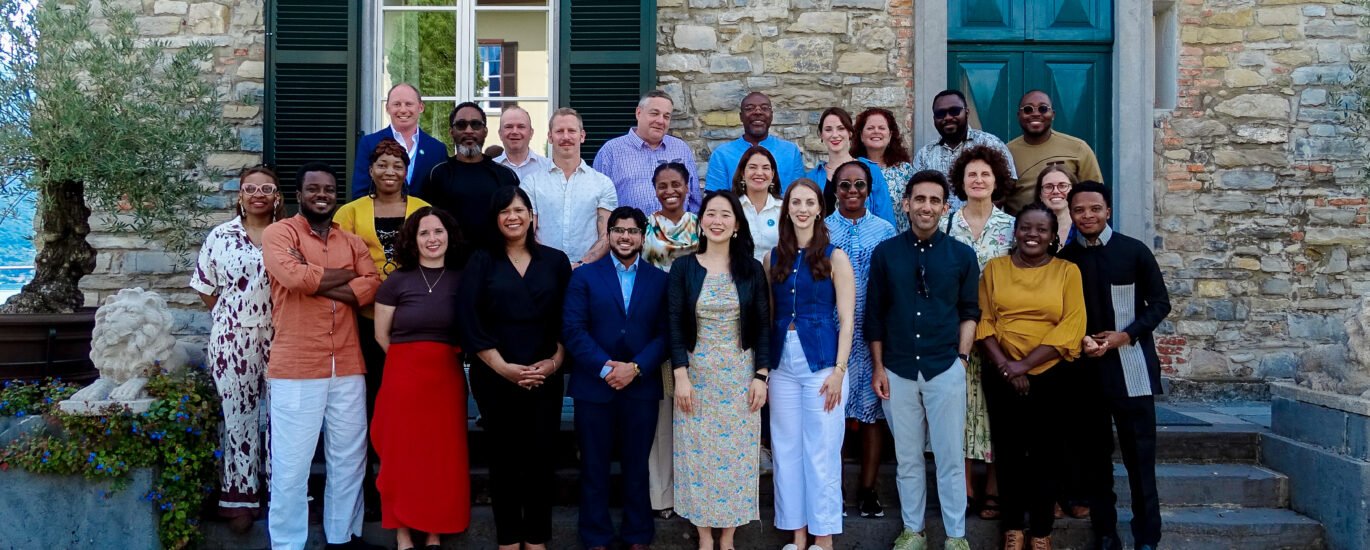
On the morning we left Bellagio, after a week at the Rockefeller Foundation Bellagio Center, I invited John McDonald to join me in the Montale Exclusive Lounge at Milan Malpensa.
John and I have been part of different Big Bets cohorts. I was in the inaugural Africa cohort; he was one of ten U.S. fellows. He is the President and CEO of the Northeast Indiana Innovation Community, and his own Big Bet is built around an idea I find interesting in its own right: begin with real unsolved problems inside existing companies, connect those problems to entrepreneurs, universities and research, and use the resulting demand to create new ventures and good jobs.
We were both flying back into the United States through Atlanta, and somewhere between Bellagio, breakfast, airport lounges and the general decompression that happens when an intense residency has ended, we got into a conversation about [my] politics.
I had been fairly open over the course of the week about the fact that public institutions increasingly occupy my thinking, and more cautiously about my own political aspirations. John asked me why someone with my intellect would wish to waste it on politics.
I understood what he meant. There is a perfectly coherent version of my future in which I continue building technology companies, writing about systems, working with young people, perhaps advising governments from a comfortable distance and generally preserving the freedom to complain whenever public institutions do things I think are stupid. I have spent most of my adult life as an entrepreneur.
Entrepreneurship gives you an extraordinary kind of agency.
If the market does not want something, you change it.
If the unit economics do not work, you revise them.
If a process is absurd, you can often design around it. Politics appears, from that vantage point, to contain considerably less freedom and a remarkable number of ways to become responsible for problems one did not personally create.
I answered John by telling him about an electricity transformer in Mangochi.
In 2021, while establishing the Kwathu Innovation & Creative Centre, our second technology hub, at Excel in Makawa, one of the schools where we were expanding access to digital learning, we ran into the kind of constraint that makes grand language about digital transformation sound slightly ridiculous. The school did not yet have electricity.
When I checked with the Electricity Supply Corporation of Malawi, they mentioned to me that they had plans to extend infrastructure into the area, but the timeline we were given sat somewhere in the next two to five years. At twenty-five, with computers to install and a World Bank-funded programme to run, I found the idea of waiting several years for electricity fairly intolerable. I asked a more specific question: what physically stood between us and power? There was a transformer within reach. What we lacked were the poles and the electric wiring necessary to extend distribution far enough for us to connect. I asked what those would cost. As I was unable to justify this within the confines of the World Bank project, I ended up financing them out of pocket. I used my salary from the World Bank project, and it was done.
The intervention worked.
The school got power.
The hub became possible.
Computers could turn on.
Young people could learn.
The infrastructure also became useful to people beyond the school, which is what infrastructure tends to do when it is genuinely useful. Other households and users connected. Five years later, in 2026, our 6th cohort of the M’mawa Apprenticeship Programme under the Kwathu Upgrade Programme joined us for the year, and they were working for the first time from Excel. They complained to me about persistent blackouts.
My first assumption was that they were describing Malawi’s wider electricity problems. They explained that the immediate issue was more local. Our specific transformer was overwhelmed. Once the poles had arrived, more people had connected via the poles we installed, demand had grown and the piece of infrastructure that had been adequate for the previous level of consumption was no longer adequate for what the intervention itself had helped make possible.
In 2021, I thought I had solved an electricity problem. Five years later, I realised I had moved the problem upstream.
The exchange with John stayed with me because I realised that I had spent much of the past several years encountering different versions of the same problem.
Access exposes capacity.
Capacity exposes infrastructure.
Infrastructure exposes institutions.
An intervention can work and still reveal that the system around it cannot yet carry the success it creates. The obvious entrepreneurial question at Excel would be to ask what it costs to upgrade the transformer. That remains a useful question. It is no longer the only question I know how to ask. Who plans for the demand created when infrastructure succeeds? Who finances capacity whose returns spill beyond the person who originally pays for it? How do we build systems that do not require somebody with spare money and impatience to privately solve every bottleneck as it appears?
My answer to John began with a transformer because my interest in politics increasingly comes from problems that did not begin as political problems.
Blogging about the Lake Malawi took me into the tech industry.
Agriculture took me into engineering.
Engineering took me into infrastructure.
Infrastructure took me into capital, standards, industrial capacity, education and public investment.
Follow those questions far enough and the state keeps appearing, whether one particularly wants it to, or not.
The story, however, begins several years before Bellagio, while I was sitting in New York looking at the distance between what development institutions intended to do and what they were actually able to implement.
For two years, I worked at the United Nations Development Programme’s Independent Evaluation Office in New York. Evaluation can sound either terribly sophisticated or terminally boring depending on how one describes it, but a great deal of the work comes down to deceptively simple questions.
What was intended?
What resources went in?
What was actually done?
What changed?
What did not?
Who benefited?
Under what conditions?
Why did one intervention travel further than another?
What was happening in the wider institutional environment that helped or constrained the result?
I worked at a level where one could look across programmes rather than simply experience a project from inside its implementation team. That changes the way you understand development. A workshop ceases to be interesting because fifty people attended it. A policy ceases to be impressive because somebody published it. A programme can spend every dollar allocated to it, produce every output in its results framework and still leave the underlying system largely unchanged. Equally, an intervention can appear modest on paper and produce consequences nobody planned because it changes incentives, removes a bottleneck or allows other actors to do something they previously could not.
Malawi became particularly difficult to treat as an abstraction. The Independent Country Programme Evaluation published in December 2022 examined UNDP’s contributions to Malawi’s national development goals between 2019 and 2022 and was intended to inform the next country programme through evidence about achievements, constraints and lessons. I was pleased, in one sense, by how much development thinking existed around my country. Malawi did not lack plans. There were strategies, policies, frameworks, national visions, donor programmes, sector plans and institutions ostensibly responsible for moving them. Yet one phrase had already become embedded in the country’s own United Nations development framework:
“Malawi is policy rich and implementation poor.”
The 2019–2023 UN Development Assistance Framework went as far as saying policy support should be reduced and greater attention given to coherence and implementation at national and subnational levels.
I found that framing important because it shifts the question. If a country lacked ideas, one might reasonably conclude that the answer was better thinking. If it lacked policy, perhaps the answer was policy development. But what if the documents were already there? What if people had spent years correctly diagnosing agriculture, education, energy, trade, digitisation and governance, and the real weakness sat in the conversion of stated intention into material capacity?
Evaluation trained me to separate things I had previously bundled together. Policy is not implementation. Funding is not execution. Activity is not capability. A pilot is not a system. A good idea is not an institution. Most importantly, a collection of individually sensible interventions does not automatically add up to structural transformation. Systems have dependencies, incentives, bottlenecks, feedback loops and sometimes behaviour that only becomes visible once you interfere with them.
I had already spent years as an entrepreneur by then, and the tension between the two disciplines became increasingly useful to me. Entrepreneurship had trained me to ask whether something could be made to work. Evaluation kept asking whether it actually worked, under what circumstances and whether the surrounding system could sustain it. I did not leave New York having solved Malawi. I left carrying a much better question: what does it actually take for a country to do what it says it wants to do?
That question followed me home.
Before I went to New York, I had led a World Bank-funded programme in Malawi. In February 2021, Ntha Foundation received US$250,000 under the Government of Malawi’s Digital Malawi programme, operationalised through the Public Private Partnership Commission. The project helped us establish and furnish two technology hubs in Lilongwe and Mangochi, equip a digital media centre with more than fifty computers and related media equipment, and run digital, entrepreneurship and e-work programmes. Our final impact assessment records 647 Malawian youth trained through that specific grant, along with nine entrepreneurs who received business subgrants.
That project sat inside a much longer personal conviction about access.
Long before I understood cyber-physical systems, I understood what a computer and internet connection could do to a young person’s sense of possibility. My first businesses were digital. The Foundation grew out of young people repeatedly asking how they too could learn the things I was learning. Our programmes expanded from basic digital literacy into entrepreneurship, media, software, professional exposure and other forms of applied learning. Across the broader work, thousands of young people eventually passed through longer programmes and many more through workshops and outreach. Our own public reporting now puts that broader training figure above 10,000, with outreach extending much further, though I distinguish those numbers deliberately from the 647 people trained under the Digital Malawi grant itself.
I remain proud of that work. Access matters. Devices matter. Internet access matters. Digital literacy matters. There is nothing intellectually sophisticated about telling a young person to participate in a digital economy while denying them the equipment, connectivity or basic knowledge required to enter it.
But I came back from the United Nations looking at the hubs differently. We had bought technology. Fine. We had spaces. Fine. What was the highest-value thing we could now do with them? What problem was serious enough that we should spend years applying the infrastructure, people and institutional relationships we had accumulated towards it?
I did not know.
That uncertainty is important because founder stories become suspiciously neat in retrospect. We tell them as if the company name, market and product descended whole into our minds. My process was considerably messier. I opened the hub and talked to people. Young people came through. Entrepreneurs came through. Development practitioners came through. Public officials came through, including fairly senior people. I asked what they were seeing, what Malawi needed, where technology might be useful and what problems repeatedly resisted the interventions already aimed at them.
Agriculture kept coming back.
This was hardly surprising. Agriculture remains a cornerstone of Malawi’s economy, contributing materially to output, exports, employment and food security. The World Bank’s 2025 Agriculture Public Expenditure Review notes that Malawi has consistently prioritised agriculture in public expenditure, including meeting or exceeding the African Union’s 10 per cent budget benchmark, yet the sector’s performance has remained weak. The latest food-security picture makes the material consequence difficult to romanticise. An August 2026 IPC analysis cited by the World Food Programme estimates that more than 1.9 million people are already facing crisis-level food insecurity, with that figure projected to rise above 2.6 million during the lean season.
There is something deeply uncomfortable about a country spending so much public attention, land, labour and political energy on agriculture while still remaining chronically vulnerable to hunger.
Agriculture was not a vertical I selected from a startup spreadsheet. It was the problem Malawi kept handing back to me.
I had identified the problem area. I still did not know what I wanted to build.
That was part of why I went to Michigan.
I came to Michigan State University with a question that preceded my time at Xbox and, frankly, preceded my ability to articulate it properly: what are the most advanced technologies we can build for farmers?
My instinct was to resist beginning with Malawi’s current constraints. I knew those constraints. I had lived with unreliable power, expensive connectivity, infrastructure gaps and limited capital. Beginning there risked asking only what technology was immediately feasible inside the system that already existed. I wanted to go in the opposite direction first. What is technologically possible at the frontier? What are engineers, software developers and industrial companies able to do when the surrounding infrastructure is strong enough to support the ambition? Once I understood that, I could ask a more useful second question about what should be adapted, simplified, redesigned or built differently for African conditions.
That position is easy to misread as believing that technology from wealthy countries should simply be imported into Africa. I mean almost the opposite. You cannot intelligently decide what to localise if you do not understand the frontier you are adapting from. You cannot know which legacy infrastructure might be unnecessary, which standards remain essential and which cost assumptions can be challenged if you have never seen how the system works when the constraints are different.
This connected naturally with an education principle I had carried for years: you can’t be what you can’t see. The phrase has a long life in education because representation and exposure affect the range of futures people understand as available to them. My work with young people had shown me this repeatedly. Someone encounters a software engineer for the first time and suddenly software is a profession rather than an abstract thing other people make. Someone sees a founder who looks like them and a company becomes imaginable. Someone gets access to a computer and discovers that the internet contains entire industries their school had never mentioned.
Over time, I began extending the question beyond careers.
Can you build what you cannot see?
How does a young engineer imagine an autonomous farm if they have never encountered autonomy? How does someone design a digital twin if they have never interacted with one? What does advanced manufacturing mean to a student whose technical education has remained primarily theoretical? How do you imagine an industrial software company when most of the technology businesses visible around you build websites, applications, financial services or digital platforms?
Exposure changes the technical possibility set.
I used to think about that mainly in relation to African youth with limited access to advanced systems.
Then I discovered that I was not exempt.
My MBA Microsoft internship did not seem particularly agricultural when it appeared.
I joined Xbox.
I had gone into the MBA thinking about food systems, agriculture and industrial technology, and somehow I found myself inside one of the world’s most recognisable gaming businesses. The sensible response was to learn gaming properly.
At Xbox, I encountered a different way of thinking about systems. Games have economies. They have rules, resources, actors, progression, constraints, incentives and feedback. A designer changes one variable and players change their behaviour. A mechanic that appears small can destabilise an entire economy. A beautiful experience that nobody returns to has a commercial problem. A compelling world can produce communities, markets and extraordinary amounts of revenue.
Meanwhile, I continued designing the farming system I thought I wanted to build. What would it produce? What would happen in each part of the operation? Where would data enter? How would production move? What machinery might exist? What decisions would an operator make? What variables would affect yield? How would I explain the system to somebody who had never seen it?
At some point in Redmond, I looked at what I had drawn and realised that I had already designed the bones of a simulation.
There was a world.
There were rules.
There were resources.
There was progression.
There were interacting systems.
There were consequences.
I simply had not called it a game.
I started looking more seriously at farming simulation and the commercial market around simulation games. That was another useful correction. I had been approaching simulation primarily as a learning technology. Xbox forced me to respect it as a product category. People already paid to inhabit complicated representations of farms, cities, transport systems, logistics and other real-world environments. My own public notes from that period trace the same conceptual collision: the agricultural system I was designing and the simulation logic I was learning at Xbox began to look less like separate projects and more like different interfaces to the same underlying system.
The commercial possibility mattered because I have become increasingly wary of designing development interventions whose only economic engine is another grant proposal. If a simulation can educate and generate revenue, that changes its place in the system. If a commercial product helps finance research, physical experimentation or educational access, that creates a different sustainability question from one in which every cohort requires a new donor.
There is also a deeper educational argument. I am not particularly excited by gamification when it means adding points, badges and cartoon characters to an otherwise uninspired lesson. Simulation is interesting to me because it allows people to rehearse complex systems they might otherwise never experience. There is evidence that well-designed digital game-based learning can improve STEM outcomes. A 2023 meta-analysis synthesising 86 comparative studies found a medium-to-large average advantage over non-game STEM learning, while also finding considerable variation depending on subject, game design and learning objective. That variation is important. Games are not magic. Design still matters.
A flight simulator does not make aviation useful because learning becomes cute. It allows people to experience decision-making, feedback and failure in an environment where failure is dramatically cheaper.
There is something similar in agriculture. Let a student make a terrible irrigation decision inside a simulation. Let the virtual crop suffer. Let them destroy the fictional unit economics. Let them trace which assumption failed.
Then take them to the farm.
A few months later, my company, Q2 Systems, was selected to represent the Michigan State University at TechCrunch Disrupt in San Francisco. The 2025 conference ran from 27 to 29 October, and Waymo’s co-CEO Tekedra Mawakana was there talking about the much less glamorous realities of scaling autonomous vehicles: safety, public trust, operations, regulation and the enormous difficulty of taking something that works technically and making it work repeatedly in the physical world.
My personal Waymo revelation was considerably less sophisticated.
I saw one.
I did not properly know what it was.
There were Jaguars moving around San Francisco with an unusual collection of hardware mounted on them. Alvaro explained that they were robotaxis. I learnt how the service worked, downloaded the app and eventually got into one.
The car drove away without a human driver.
There is a peculiar difference between intellectually knowing a technology exists and experiencing it as ordinary infrastructure. Autonomous vehicles were not new when I sat inside that Waymo. I was simply new to them. I had worked at the United Nations. I had completed a master’s degree. I was doing an MBA. I had worked at Microsoft. I had spent years building technology companies.
None of that protected me from the effect of seeing.
The car navigated traffic. It turned. It stopped. It sensed. It responded. The technological category moved from something I had read about into something operating around me, taking paying customers through a city.
My brain went immediately back to agriculture.
If a vehicle could sense and navigate an urban environment, what did autonomy mean on a farm? Could smaller machines scout? Haul? Monitor crops? Move inputs? Perform repetitive operations? What would happen if we designed machinery around the conditions of specific productive environments rather than assuming that the form factor of today’s equipment was fixed?
I was adamant: we had to ride in one, and despite resistance from several of my peers on the trip, I ordered one. The app onboarding experience made it oh the more efficient, but this is a story for a different day.
My infrastructure questions then arrived. What surfaces would those systems need? What connectivity? What mapping? What power? What happens when the vehicle leaves a carefully mapped American city and enters a farm, logistics corridor, mine or industrial zone in a low-infrastructure environment?
Waymo did not hand me a farm design. It gave me a technological category with which to think.
That was enough.
It also made my education philosophy considerably less patronising. When I say young Africans need exposure, I am not describing an intellectual deficiency in somebody else. I needed exposure too. Seeing one autonomous car materially expanded the range of systems I could imagine building.
You can’t build what you can’t see had become autobiographical.
Once autonomy entered the agricultural idea, the components began pulling one another together.
An autonomous machine operating in a physical environment needs to know something about that environment. Sensors can observe conditions. Data moves. Software interprets it. A model may estimate what is happening or what is likely to happen next. A control system makes a decision. An actuator or machine changes something in the physical environment. The environment responds, generating new information.
The digital and physical worlds form a loop.
NIST describes cyber-physical systems as systems in which digital, physical and human components are engineered to function together through integrated computation and physical processes. In more practical language, computation, communication, sensing and actuation become tightly connected to the material world. The examples are everywhere once you know what you are looking for: smart manufacturing, autonomous transport, intelligent energy grids, advanced building systems, medical devices and industrial control.
I started using cyber-physical infrastructure [CPI] to think about the wider enabling layer: the physical assets, data environments, networks, compute, sensing, standards, operating systems and institutions that allow cyber-physical systems to function across space and over time. I remain careful with the term because terminology in this area is still evolving and different technical communities draw boundaries differently. What I care about more than the label is the systems logic.
A train is useful as an example. A railway is already physical infrastructure. Add sensing, communications, predictive maintenance, real-time data, automated control, intelligent scheduling and eventually increasing levels of vehicle autonomy, and the infrastructure acquires an information layer that can observe and respond to its own operation. The physical system produces data. The data improves the model. The model informs action. The action changes the physical system. The loop repeats.
Agriculture can behave the same way.
A soil sensor sees moisture. Weather data changes the irrigation decision. A machine observes crop conditions. A digital model incorporates what has happened historically. A simulation allows the operator to test a choice before spending physical resources. A robotic system acts. Yield and operational data return.
Following hunger had somehow led me into IoT, digital twins, simulation, artificial intelligence, robotics, autonomous systems, cyber-physical infrastructure, and the odd conclusion that Africa is best positioned with a blank slate, to experiment quite broadly.
I had arrived at a technological frontier by following one of humanity’s oldest problems: how to feed people.
That is where Kwathu Smart Innovation Farms [KSIF] started making much more sense to me. My Rockefeller 2026 Big Bet captures the current ambition fairly well:
We are still doing the R&D on the small autonomous farming robot concept we call Bee.
Parts of KSIF are operational as programmes and physical learning environments. Other parts of the cyber-physical architecture are being designed, prototyped or tested. The robotics platform is not a mature commercial agricultural fleet roaming across Malawi. The more ambitious autonomy and infrastructure concepts remain hypotheses that need engineering, capital, field trials and possibly a great deal of failure before I know which ones deserve to survive.
I have ideas about compacted or gravel autonomy corridors, for example, that may eventually make sense for farms, mines, industrial areas or low-volume logistics environments. They may not. My existing work explicitly treats that proposition as something to test rather than a foregone conclusion.
The important shift for me is less any single machine than the system around it.
Once I began thinking of the farm as a cyber-physical system, another possibility became obvious. The farm could produce food, but it could also produce people who know how these systems work.
Think about the disciplines sitting inside even a modest smart agricultural environment. Software engineering. Mechanical engineering. Robotics. IoT. Networking. Data science. Artificial intelligence. Control systems. Agricultural science. Energy. Economics. Logistics. Operations. Supply chains. Finance. Maintenance. Human factors.
Those fields are normally taught in separate departments.
A farm does not care.
The tomato does not care that the student who designed the sensor is enrolled in computer science and the person modelling the irrigation economics is in business school. The robot does not care that mechanical engineering, software and operations sit in different academic buildings. A functioning productive system forces those disciplines to meet because reality is impolite about our departmental boundaries.
That is increasingly what interests me about experiential education.
Get into my mind: imagine three connected learning environments.
First, the physical system: an actual farm with actual crops, machines, costs, workers, weather, soil and mistakes. Second, a digital representation, which might range from a relatively simple operational model to a more sophisticated digital twin as the data and fidelity improve. Third, a playable simulation in which learners can manipulate variables, test strategies and observe consequences.
A student might first see the system.
Then model it.
Then manipulate it.
Then operate within it.
That movement is different from reading a chapter on precision agriculture and answering ten questions at the end.
I remain a believer in theory. I am currently trying to design something I explicitly want to be degreed. Universities matter. Formal education gives people conceptual foundations that practical exposure alone may never produce.
The mistake is treating theory and practice as competing philosophies when the harder educational problem is building the bridge between them.
Simulation is useful here because reality is expensive. We cannot send every Malawian engineering student to San Francisco to ride in a Waymo. We cannot give every learner unrestricted access to an advanced factory. We cannot let twenty-year-olds experiment freely with expensive farm machinery or industrial systems.
We can, however, make more of those systems visible. We can simulate parts of them. We can create laboratories. We can expose students to real operating environments with appropriate supervision. We can allow them to fail in environments where failure produces information rather than disaster.
This has brought me back to a phrase from both Alex and John, with which much of my education work began.
You can’t be what you can’t see.
I now think there is a second half.
You cannot build what you cannot see either.
There is, however, an obvious danger in everything I have written so far.
Technology is seductive.
There is a version of African development discourse that keeps discovering a new technology and deciding that this time we can skip all the boring parts.
Mobile phones arrived and we discovered leapfrogging.
Then mobile money.
Then blockchain.
Then artificial intelligence.
Now perhaps robotics and autonomous systems.
I believe leapfrogging is real in specific contexts. Countries do not need to install every technology in the order richer countries encountered it. There are legacy systems Africa has no reason to reproduce simply because somebody else spent a century building them.
But the term becomes dangerous when it allows us to imagine we can leapfrog material reality.
You cannot eat a digital twin.
The farm is physical.
Food is physical.
A robot is physical.
A sensor is manufactured somewhere.
A motor is manufactured somewhere.
A battery requires minerals, processing, components, logistics and power.
Machines break.
Roads matter.
Water matters.
Warehouses matter.
Cold chains matter.
Processing plants matter.
Technicians matter.
Capital matters.
Electricity matters.
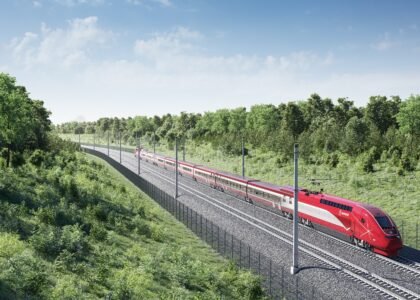
A few days before Bellagio, on a train from Brussels to Paris, I wrote something that ended up travelling much further online than I expected:
Africa will not be saved by entrepreneurship, and we cannot vibecode ourselves into the Fourth Industrial Revolution.
My argument was not that entrepreneurship or software is useless. I am an entrepreneur and, these days, quite a shameless vibecoder myself. The question was what sits underneath the interface. Where are the factories? Where is the reliable power? Where are the logistics networks? Who makes the sensors? Who makes the chips? Where is the industrial tooling? Who owns the productive capacity? Those were the questions underneath the tweet.
The industrial numbers remain uncomfortable. The African Development Bank’s 2025 Industrialisation Index estimates that manufacturing value added across Africa rose from about US$285 billion in 2020 to US$351 billion in 2025. In absolute terms, that is growth. Yet the continent still accounts for less than 2 per cent of global manufacturing output and only about 1.4 per cent of global manufacturing exports. Manufacturing value added per person remains below its pre-2014 level.
That is the industrial layer I worry gets lost whenever we talk excitedly about AI.
The Fourth Industrial Revolution does not abolish the industrial revolutions beneath it. It makes physical productive systems more intelligent.
There must be something to sense.
Something to automate.
Something to optimise.
Something to manufacture.
Something to move.
You cannot digitally twin a productive economy you never built.
The challenge, then, is not that Africa must recreate the nineteenth and twentieth centuries exactly before being permitted to touch the twenty-first. That would be equally absurd.
The opportunity is to build foundational industrial capacity while taking advantage of technologies available now. Build power systems that are designed for increasingly distributed generation and intelligent management. Build logistics infrastructure with data embedded into how it operates. Develop manufacturing while training workers in automation, quality systems and advanced digital tools. Design agricultural processing with traceability and sensing. Build roads, but interrogate which categories of transport require which surfaces rather than assuming every kilometre must inherit the design logic of a different place and century.
I have come to describe this as industrialising for the Fourth Industrial Revolution.
The distinction matters.
Once you imagine a more technologically sophisticated productive economy, the next question arrives fairly quickly.
Who builds it?
For years, our work has been focused on young people. We have impacted tens of thousands across digital and entrepreneurship programmes. We have run fellowships, workshops, apprenticeships and technology initiatives. Students have graduated through programmes we have supported and some have done extraordinarily well academically. Our current M’mawa cohort, for instance, came through work-integrated learning alongside their degrees, and the Foundation has been increasingly explicit that the interesting question is what happens after the certificate.
Bellagio forced me to sharpen the language.
At some point I wrote one word in large letters on a sheet of paper:
COMPETENT.
I had spent years using words like trained, educated, empowered, exposed and graduated. None of those necessarily tells me what someone can do.
A country can produce graduates and still have employers saying they cannot find the people they need.
Graduates can say there are no jobs while companies say there is a talent shortage.
Both statements can be true because the conversion between formal education and productive capability is neither automatic nor costless.
I have also become more sensitive to what happens socially when somebody becomes the first university graduate in a family.
Development narratives can make the degree sound like the end of the mobility story. For many people, it is the beginning of a complicated responsibility. The graduate may have parents who invested everything in getting one child through school, siblings whose opportunities are tied to the graduate’s income, little inherited professional knowledge, no family capital and no financial runway in which to spend several years optimising for a perfect career.
I have had to become slower to mistake survival strategy for lack of ambition.
Someone can be highly educated and take work dramatically below their qualifications because income today has a different value when other people’s food, rent or fees depend on it. That does not eliminate agency. People still make choices, some better than others. But systems thinking requires us to understand the constraints inside which those choices are made.
This changed how I looked at our own education programmes.
Formal education is necessary.
It is not enough.
And the answer cannot simply be another training course floating beside the university system.
Two programmes we have been building began to look different to me at Bellagio once I placed them inside this larger human-capital question.
The Nyenyezi Fellowship is our entrepreneurship pathway. It is designed around venture-building: identifying opportunities, understanding markets, developing propositions, experimenting, selling, organising resources and creating things that do not yet exist. Africa needs people who can build new firms and challenge inherited assumptions. I remain deeply committed to that.
The M’mawa Apprenticeship is different. It is an apprenticeship and professional execution pathway. Its focus is learning to operate inside organisations: working with teams, managing projects, communicating professionally, solving problems, understanding systems, executing reliably and improving what already exists.
We have sometimes treated entrepreneurship as though becoming a founder represents the highest form of ambition available to a young African.
It does not.
A productive economy needs extraordinary founders.
It also needs extraordinary engineers, technicians, managers, operators, researchers, accountants, civil servants, designers, quality specialists, machinists, analysts and people who can run complicated organisations without needing to own them.
Nyenyezi and M’mawa therefore solve different pieces of the competence problem. One develops people who can build new systems. The other develops people who can enter systems and make them work.
At Bellagio, I began wondering whether the more interesting next step was to place both pathways inside a one-year, university-partnered, degree-conferring structure. Six months focused on one form of productive capability. Six months focused on the other. Simulation where simulation is useful. Real project environments where consequences matter. Paid placements where possible, because a first-generation student with family obligations cannot always afford to perform professional development for free. Employers helping define the capabilities they actually require rather than appearing only at the end of the education process to complain about graduate quality.

I do not yet have the university partner.
The degree does not exist.
But I now think the question is worth testing.
Part of what Bellagio gave me was permission to stop assuming each programme had to remain the thing it had originally been designed to be.
Agriculture creates a similar problem.
Suppose we become better farmers.
Good.
Then what?
The product leaves the farm.
Where does it go?
One of the more useful conversations I had immediately after Bellagio did not begin with Malawi. A friend had visited a chocolate factory in Antwerp and was struck by something obvious once you see it physically: Belgium is globally associated with chocolate and does not grow cocoa.
Africa does.
The International Cocoa Organization estimates that Africa produced about 3.25 million tonnes of cocoa in the 2024/25 season, roughly 69 per cent of world production. Côte d’Ivoire alone produced about 1.68 million tonnes and Ghana around 600,000. Yet the value chain becomes more interesting as the commodity moves. UNCTAD’s trade analysis shows that in 2022 the unit values of cocoa beans exported by major producers such as Côte d’Ivoire and Ghana sat around US$2.50 per kilogram, while cocoa butter was above US$4 per kilogram and some categories of finished chocolate bars were above US$5 and US$7 per kilogram. Those figures should not be read as a simple estimate of profit. Processing, ingredients, transport, branding, retail and capital all have costs. They do, however, illustrate what happens as differentiation and productive capability accumulate further down the chain.
Africa is hardly absent from processing. Côte d’Ivoire and Ghana have both invested in grinding and local processing, and there are African chocolate manufacturers. The story is more complicated than the slogan that Africa exports every bean raw and Europe captures everything. That complexity is precisely why I find the value chain more useful than the slogan. UNCTAD still describes a structural pattern in which many African cocoa producers participate most heavily through raw materials and semi-processed intermediates while much higher-value final manufacturing is concentrated elsewhere.
The question I care about is where capability accumulates.
Who understands the machinery?
Who designs it?
Who repairs it?
Who formulates the final product?
Who controls quality?
Who owns the brand?
Who finances inventory?
Who controls distribution?
Who collects consumer data?
Who trains the next engineer?
That is why industrialisation is also an education process.
I wrote recently about China and Apple’s supply chain, and one observation stayed with me: factories produce products, but factories also produce knowledge. Engineers learn. Suppliers improve. Workers become more capable. Tooling becomes more sophisticated. Clusters develop. Eventually a country can make things it could not make before.
That is the logic under which I am building new extensions to my business: Moyo Botanicals and Effortless Natural. These new ventures are not meant to suggest that one small botanical value chain will industrialise Malawi. They create another laboratory. Cultivation can connect to harvesting, processing, formulation, packaging, branding, distribution and markets. A student can see the difference between producing matter and creating economic value from matter.
The farm cannot end at the farm gate.
Neither should the education.
This brings me back to Excel.
I like the poles story because it is a fairly clean example of what entrepreneurship does well.
There was a bottleneck.
I did not particularly care that the official timeline was several years.
I asked why.
I found a narrower constraint.
I paid.
The thing happened.
That habit has served me well. Entrepreneurs become unusually comfortable with acting in systems that do not work properly because waiting for every underlying institution to improve is not a viable business model. My earlier writing on entrepreneurship describes this as a generation learning how to operate around broken systems and developing a particular resourcefulness from doing so.
But the transformer reveals the limit of that logic.
I can finance poles.
Perhaps I can finance the transformer too.
What about the transmission network?
Generation capacity?
Grid stability?
Engineering standards?
Maintenance?
Long-term demand forecasting?
Universal access?
Tariff design?
A private company can build a power plant. Private capital absolutely belongs in energy. But the electrical system as a whole contains public goods, natural monopolies, cross-subsidies, regulation and network effects that no impatient founder can solve one connection at a time.
The same problem appears in industrialisation.
A company can build a factory.
It cannot individually build the entire road network serving every firm.
A logistics company can solve one corridor.
It cannot set national engineering standards.
A technology company can demonstrate an autonomous system.
It cannot create the complete legal, physical, educational and technical environment required for autonomous infrastructure across a country.
A foundation can fund a pilot.
It cannot permanently substitute for the state.
That is why I care about public investment, and specifically good public investment. More government spending does not automatically equal development. Africa has enough abandoned projects, badly procured systems, politically protected firms and infrastructure whose maintenance was somehow nobody’s problem to make that fantasy impossible to sustain.
The World Bank’s 2026 Africa Economic Update is useful precisely because its return to industrial policy is not nostalgic. It argues that Africa’s structural growth problem requires deliberate industrial strategy while being explicit about the conditions that make such strategies work: infrastructure, skills, finance, sufficiently large markets and institutions capable of implementation. Public capital investment in Sub-Saharan Africa remains roughly 20 per cent below its 2014 level, even as debt-service burdens have increased substantially. At the same time, more than 620 million people are expected to enter the continent’s labour force by 2050.
Governments can waste money.
Markets can also underprovide things whose social returns extend far beyond what one investor can capture.
The interesting work is in understanding the boundary.
This was the answer I was trying to give John in Milan.
I am not especially interested in politics instead of engineering.
I keep following engineering problems until they become institutional ones.
Take agriculture. A smart agricultural system eventually requires reliable energy, water, roads, storage, connectivity, standards, machinery, finance, land governance, trade systems, research, training and markets. A robotics company may solve an important slice of that. A farm may demonstrate how several pieces can interact. An investor might finance scale. Yet somebody still has to coordinate the systems in which those investments operate.
One of the people who advises my technology work once read through what I was building at Q2 Systems and told me, with the sort of confidence that makes a founder mildly defensive, that I was building a government rather than a business. I initially thought that was ridiculous. Then I looked at the work. Transport. Industrial standards. Procurement. Skills. Research. Regulation. Capital. Autonomous systems. Energy. Land. Education. Public investment. At some point, a founder has to admit when the problem has escaped the boundaries of the startup.
That recognition does not mean I want government to run companies. I have spent too long in business to believe political control makes a firm more commercially intelligent. Nor do I think a government is simply a very large company with citizens as customers. Companies can decide a market is unattractive. Government cannot abandon a remote district because serving it has terrible unit economics. Companies can fire customers, close products and choose profitable geographies. States have obligations to people who are poor, sick, old, geographically inconvenient or otherwise unattractive as market segments.
The state has different responsibilities.
What I want, or perhaps I should say need, is state capacity.
Public institutions capable of understanding the technology they regulate. Procurement systems capable of distinguishing a serious engineering proposition from a PowerPoint containing the words AI, blockchain and smart city. Civil services capable of attracting and retaining technically excellent people. Institutions that collect data, remember what they tried, understand why something failed and do not reset their entire operating memory every time the political administration changes.
I wrote recently that Africa cannot be one brilliant president away from development every election cycle. I still believe that. If the system collapses when the competent leader leaves, the country did not build institutional capacity. It built dependency on a competent individual.
My own interest in politics remains unresolved in practical terms. I do not know what formal public office, if any, belongs in my future. What has become clearer is why the question does not feel unrelated to my technology work.
At sufficient scale, infrastructure becomes politics.
My political imagination has become increasingly downstream of my engineering imagination.
The state question becomes even more complicated when you move from Malawi to Africa’s relationship with external capital.
We need investment.
A great deal of it.
Domestic capital. Foreign capital. Public capital. Private capital. Development finance. Commercial finance. Africa cannot industrialise by deciding that everybody outside the continent is suspicious and then attempting to manufacture every machine, finance every road and invent every technology alone. The economies we admire did not develop that way either.
But “Africa needs investment” is the beginning of a sentence.
Investment for what?
On what terms?
What remains?
Howard W. French’s China’s Second Continent is useful to me because it resists reducing China in Africa to a simple government-to-government story. French travelled across multiple African countries and documented Chinese entrepreneurs, migrants, farmers, traders and construction businesses alongside the much larger strategic relationship. A Foreign Affairs review of the book noted the same complexity: many Chinese migrants were pursuing their own commercial lives and opportunities even while the broader expansion could not be separated entirely from China’s national strategic ambitions.
I do not find either of the easy conclusions particularly useful. “China is saving Africa” is unserious. “China is recolonising Africa” can be equally lazy when it substitutes a label for examination of actual contracts, assets, employment, debt, technology transfer and bargaining power.
The empirical picture is mixed, which is exactly what should make us pay attention. A 2025 study across ten African countries found Chinese-financed infrastructure projects increased local employment around project sites, including some longer-run gains around education, health, water and power infrastructure. Research on Chinese economic and trade zones in Africa documents genuine training and skills acquisition, but the depth of transfer depends heavily on workplace practices, sector and institutional arrangements. Other research on Chinese firms in Ethiopian infrastructure finds that while on-the-job training is widespread, transfer of core proprietary technology to local firms can remain limited where companies have little commercial or regulatory incentive to provide it.
That is a much more useful conversation.
The fact that a road exists matters.
So does who can maintain it.
The fact that a railway creates jobs matters.
So does whether local engineers can eventually operate, redesign and reproduce the system.
The fact that a foreign company brings technology matters.
So does whether domestic firms move up the supplier chain.
The fact that capital arrived matters.
So do the debt terms, fiscal returns, procurement arrangements and downstream industries the investment makes possible.
I have started thinking of sovereignty less as separation from the world and more as accumulated capacity.
A sovereign country does not need to make everything itself.
It needs enough productive, technical, fiscal and institutional capability to choose.
That distinction matters enormously. Foreign capital feels different when you have alternatives. Negotiation feels different when you know how to build part of the system yourself. Technology transfer feels different when domestic engineers are capable of absorbing it. A mineral resource has different strategic value when the country can credibly choose among exporting ore, processing it regionally, supplying a domestic industry or bargaining with several competing investors.
Sovereignty is capability made politically meaningful.
The Rockefeller Foundation Big Bets Fellowship came into my life while many of these ideas were already moving.
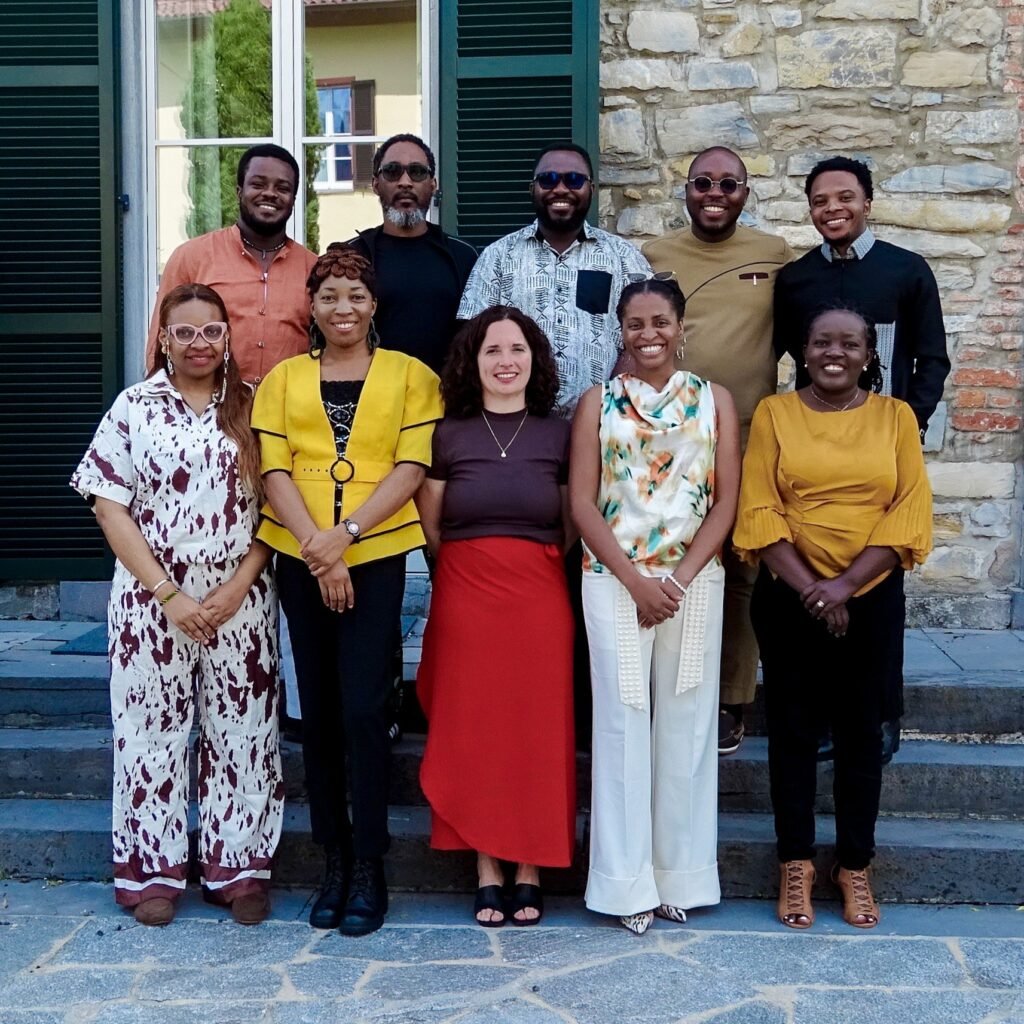
The Africa programme was launched in Nairobi in April 2026 with ten fellows from Ghana, Kenya, Malawi, Nigeria, South Africa and Tanzania working across areas including energy, food systems, financial inclusion, healthcare, climate resilience and economic opportunity. It is the Foundation’s first Africa Big Bets cohort. The fellowship has run for five months, with weekly virtual programming from May through August, an in-person week at Bellagio that we just completed this August, and an amplification phase scheduled for the autumn.
The formal description of my Big Bet was already ambitious enough.
I was proposing to connect autonomous agricultural technologies, simulation and experiential learning around a fairly fundamental development problem: food security.
I arrived at the fellowship with several years of thinking already sitting underneath that proposition. The United Nations had given me the implementation question.
Digital Malawi had given me physical technology infrastructure and years of youth programming.
Returning home had pointed me towards agriculture.
Michigan State had given me the space to investigate what was technologically possible at the frontier.
Xbox had introduced simulation as both a learning environment and a commercial product.
Waymo had made autonomy physical for me in a way reading about it never had.
Q2 Systems and KSIF were beginning to connect those strands through robotics, digital twins and cyber-physical systems.
I thought the Big Bet was principally about the technology. Bellagio forced me to look more seriously at the system in which that technology would have to live.
The week was considerably more structured than the word residency may suggest. The programme described Bellagio as a “Space of Possibilities”, and its design moved quite deliberately from divergence towards convergence. We were first asked to stretch the boundaries of what we had brought with us before being required to bring that expanded thinking back down into choices.
What actually mattered most?
What was central to the Bet and what had simply accumulated around it?
What could wait?
Which assumptions belonged to the present operating environment rather than the future we were supposedly trying to create?
If we allowed ourselves to think beyond what was immediately feasible, what might meaningfully alter the trajectory of the work?
The latter part of the week then turned those questions back towards execution: what would the expanded ambition require in practice, what partnerships would become necessary, what would need to change in the strategy, and what exactly were we going to do when we left?
The sequencing mattered. On our first afternoon at Bellagio, after arriving from Milan and setting our individual intentions for the week, we went into an exercise called Emboldening Ambitions, where we had to imagine three possible futures for our Big Bets. The following day was explicitly titled Stretch Your Thinking. We pressure-tested our theories of change against disruptions in the operating environment, worked through strategic futuring and the megatrends likely to reshape our work, translated preferred futures into strategic choices and then moved directly into partnership strategy. Importantly, the partnership conversation was not framed simply around identifying institutions from which we wanted money, legitimacy or access. We were pushed to become clearer about the value we ourselves brought, the capabilities we lacked, and the kinds of relationships that could create shared value over time.
I found that discipline useful because making a development ambition larger is actually very easy. Add another country. Add another million beneficiaries. Add artificial intelligence. Add “systems change”. Suddenly the PowerPoint looks much more consequential. The harder exercise is expanding the ambition while making the logic underneath it more rigorous.
If the Bet became larger, it also had to survive more difficult questions.
What happened if the economic or technological environment changed?
Which parts of the theory of change still held?
Which assumptions failed?
What had to be true for the preferred future to become plausible?
By the end of that second day, I was no longer asking only whether an agricultural technology model could scale. I was asking what would have to exist around the technology for scale to produce the development outcome I actually cared about.
The next phase brought the work closer to reality. Paired walks around the grounds gave us space to work through ideas in conversation rather than perform finished answers to a room. I took a walk with Nina, and I brought the work that sounds like robotics on the frontend, down to the 6 year-old future engineerings playing games in our innovation hubs.
Engagement with the Mr. William Asiko, the Senior Vice President of Rockefeller Foundation’s Africa Regional Office brought the discussion back towards the particular political and economic realities in which African work has to operate. He emphasized the value of unlikely partnership, and how important it is that both private sector and the impact sector speak the same language.
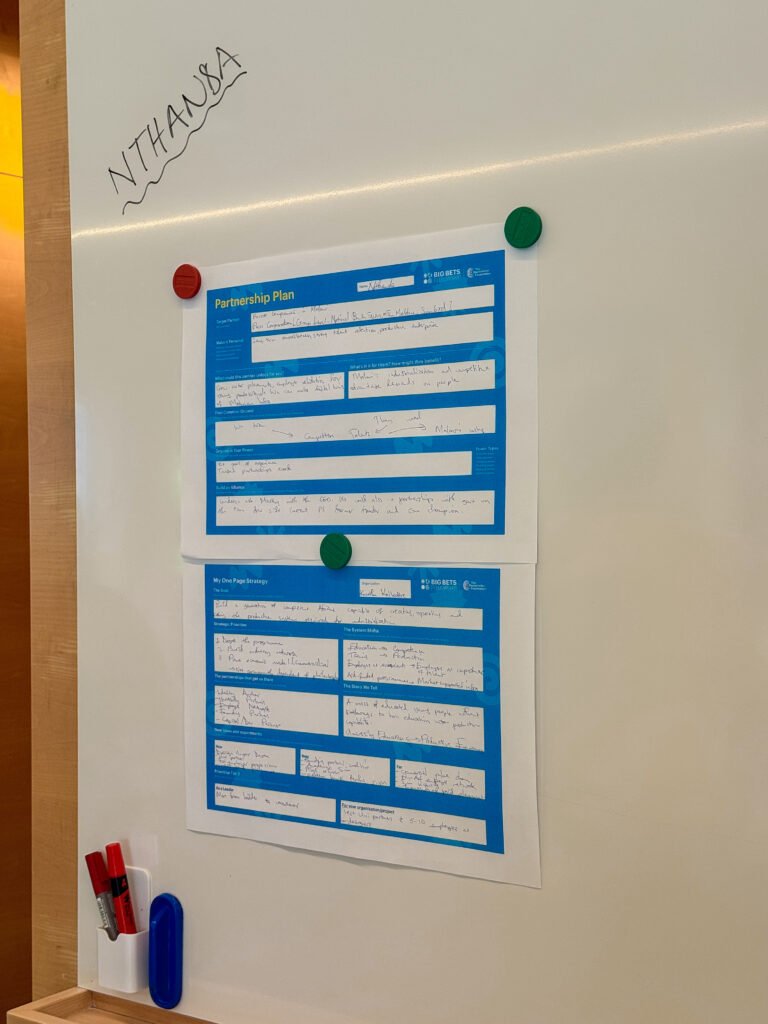
We revisited partnership maps, considered failure scenarios, identified organisations and leaders who could bring capabilities we did not possess ourselves, exchanged concrete asks and offers with other fellows, and then spent time integrating all of that back into our strategies. One of the agenda items was simply to assess how the strategy had evolved and identify the shifts required to strengthen the Bet. That is probably the best description of what was happening in my notebook by then. The technology had not disappeared. It was becoming increasingly obvious that the technology was only one part of what would have to work.
The design of the week also benefited enormously from bringing the Africa and U.S. cohorts together.
We met at dinner in Milan before travelling to Bellagio and continued sharing plenaries, meals, exercises and eventually our Big Bet showcases throughout the week. We were working in different political economies, industries and institutional environments, which was precisely what made the exchange useful.
Someone who does not share your operating assumptions can sometimes see them much faster than you can. John McDonald, for instance, was thinking about how to take real problems inside Indiana industry and connect them with entrepreneurs, researchers and institutions capable of turning those problems into companies and jobs. My own questions were emerging from Malawi’s food systems, human capital and infrastructure. The contexts were profoundly different, but we were both thinking about the conversion of problems into productive capacity. It made sense that we would still be pulling at some of those questions together in the airport after the formal residency had ended.
By the final full day, after several days of expanding, pressure-testing and reorganising the work, we had to explain it again. Your Story, 3 Ways required us to take the same underlying proposition and communicate it for different audiences. The Africa cohort then shared our journeys through an informal showcase before listening to the U.S. cohort do the same later in the afternoon. I had also gone through individual storytelling coaching earlier in the week. I appreciated that the narrative work came after the strategic work. There is a temptation in development and entrepreneurship to improve the story before improving the underlying idea. Here, we had first spent several days making the thinking more difficult. Only then were we asked whether we could explain what had changed.
That sequence produced something quite specific for me. I stopped treating the components of my work as if each needed to remain inside the organisational box in which it had originally developed. KSIF did not have to be understood only as an agricultural technology initiative. Nyenyezi did not have to remain simply an entrepreneurship fellowship. M’mawa did not have to remain only an apprenticeship programme. Simulation did not have to sit separately as a game product. Moyo Botanicals and Effortless Natural did not have to be understood only as consumer-facing businesses. Once I started asking what capabilities the larger Bet required, rather than which company or programme owned each activity, the pieces began behaving differently.
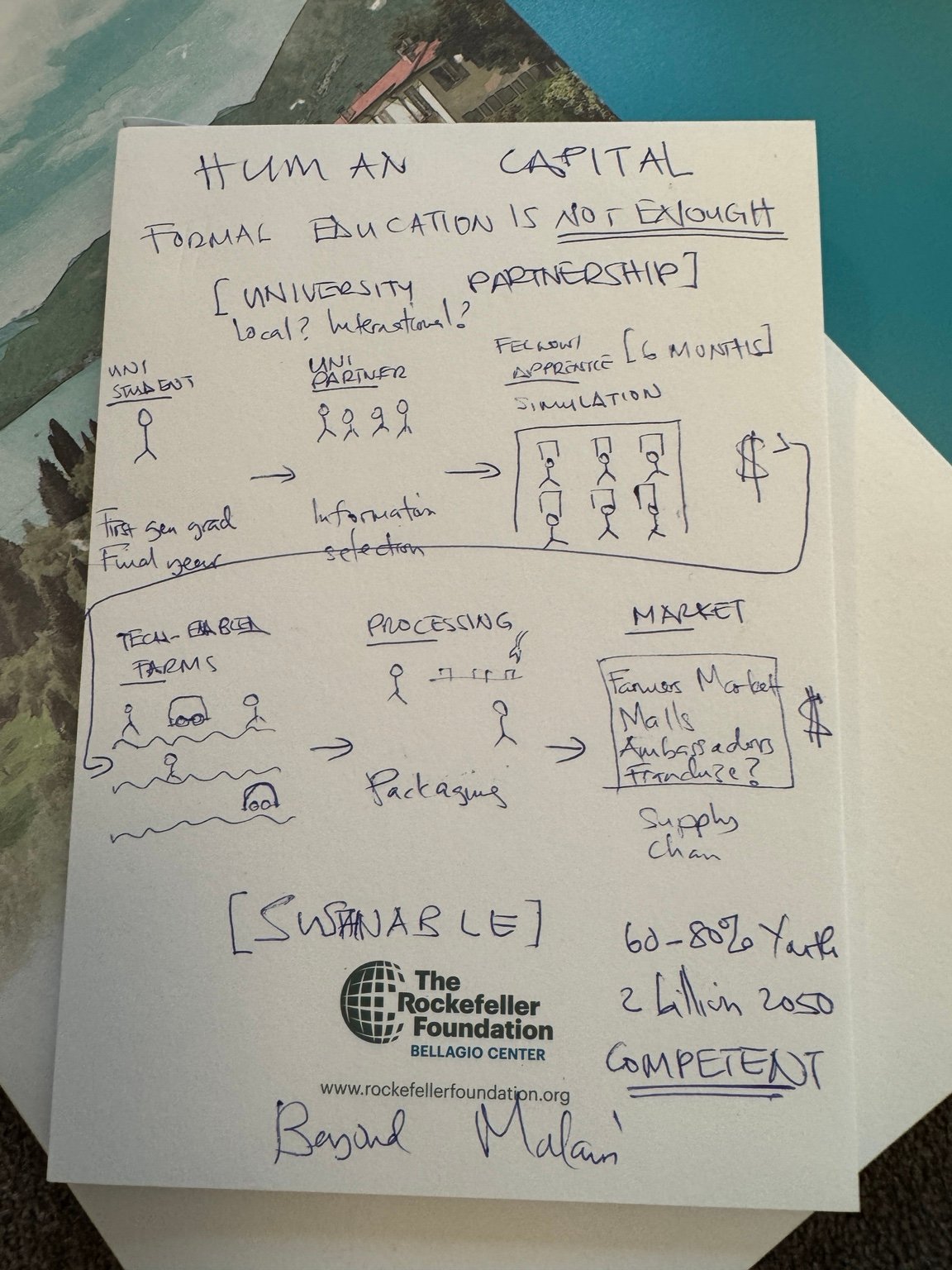
One morning, on one of the worksheets we were using, I wrote HUMAN CAPITAL across the top. Underneath it I wrote:
FORMAL EDUCATION IS NOT ENOUGH.
Then came a student, a university, selection, fellowship and apprenticeship, simulation, farms, processing, packaging, markets and money. Somewhere else on the page I had written SUSTAINABLE, because I remain constitutionally incapable of designing a programme without eventually asking who pays for it. There were notes about Africa’s youth population, competence and taking the model beyond Malawi. The page looks remarkably unserious for the amount of thinking it represents: arrows, boxes, stick figures and fragments of ideas that had previously lived in different parts of my work.
The human-capital question then began changing the architecture. Nyenyezi and M’mawa could potentially sit inside a university partnership rather than beside formal education. The two six-month pathways might become a one-year degree programme, with different emphases but a common purpose around productive competence. Employers could become part of the formation process rather than organisations expected to receive graduates only after universities had finished with them. Paid placements became more important once I thought seriously about first-generation graduates who cannot necessarily afford to treat professional formation as an unpaid luxury. Industry partners could expose students to the actual operating environments of finance, telecommunications, manufacturing, agro-processing, energy, tourism, technology and smaller enterprises. The university could provide academic depth and credentialing; industry could provide consequence, context and repetition.
Our own companies also started occupying different positions in the model. KSIF could become a technical and agricultural laboratory in which computer science, engineering, agriculture, business and systems thinking meet around real physical problems. Moyo Botanicals could carry agricultural production further into processing. Effortless Natural could continue the chain into formulation, manufacturing, packaging, branding and distribution. Simulation could operate both as learning infrastructure and as commercial intellectual property. The point was no longer that every student should work for one of our companies. The companies could help us demonstrate what it means to move from knowledge to operation, from raw material to product and from a physical system into a digital representation that can be studied, modified and eventually improved.
None of those arrows creates an institution merely because I drew them next to one another. The university partnership does not yet exist. The degree is still an idea. The employer proposition needs to be tested. Some of the technologies need significantly more engineering work. The commercial engines need to prove that they can actually generate the revenue I keep drawing back into the system. Bellagio did not resolve those questions for me, and I would be suspicious of any four-day process that claimed it could.
What it did was make the relationship among the questions much clearer.
The Big Bet I had taken into the fellowship was centred on food security, technology and learning. By the time I left Bellagio, I was thinking about something larger: how African talent moves from education into competence; how competence enters farms, firms and institutions capable of producing real economic value; how those productive systems acquire greater technological sophistication; and how the value and learning generated inside them can be retained and reinvested rather than continuously starting again from zero.
The technology was still there.
It just was no longer the whole Bet.
The week at Bellagio came at the end of an unusually compressed few days in Europe. Brussels. Paris. Milan. Lake Como. Trains, airports, old cities, extraordinary infrastructure, wealth accumulated over centuries and the visible residue of industrial histories one can sometimes take for granted when living inside them.
Travel does something strange to my brain.
I rarely look at a functioning system elsewhere and simply think that I want to live inside it.
I start asking how it works.
Then my mind goes home.
A train becomes a transport question.
A factory becomes a value-chain question.
An airport becomes a logistics question.
A city becomes a public-finance question.
A chocolate shop becomes an industrial-policy question.
An autonomous vehicle becomes an infrastructure question.
This is not because Europe represents some final model Africa should copy. Far from, in fact. Europe’s wealth has its own history, including industrialisation, empire, extraction, conflict, state-building and centuries of accumulated capital. African economies have different geographies, demographics, institutional histories, resources and possibilities. There are systems worth learning from and systems we would be foolish to inherit unquestioningly.
Nor is Africa one country, one market or one development problem. Malawi’s constraints are not Nigeria’s. Ghana’s cocoa economy is not Kenya’s technology sector. South Africa’s industrial base creates possibilities that do not exist in many smaller economies. Regional integration becomes important precisely because fifty-four fragmented markets cannot all build every capability efficiently on their own. A new World Bank report released as I was finishing this fellowship makes the same point in rather more formal language: AfCFTA’s promise depends on whether African countries can connect customs, standards, transport, power, payments, digital systems and production networks well enough for firms to operate across borders and reach scale.
Still, there is a personal commitment underneath the analysis.
A few days ago, in a private conversation, I found myself saying something I have been thinking for years in different forms.
Africa is my singular business.
I do not mean that in the sense that I have no curiosity about the rest of the world. Much of my education has come precisely from moving between systems. Malawi. New York. Redmond. Michigan. Detroit. San Francisco. Bellagio. Development institutions. Corporations. Startups. Universities.
I mean that wherever I learn something, my mind eventually asks what it means for African capability.
Can we finance it?
Can we build it?
Can we adapt it?
Should we even want it?
What has to exist underneath it?
Who needs to learn?
Who needs to own?
What belongs in the market?
What belongs in the state?
What should be regional?
What can be local?
Which constraint should we accept and which one have we simply inherited without interrogating?
Those are the questions that keep following me home.
Which brings me, finally, back to Excel.
There are now electricity poles standing in Makawa because, five years ago, I was impatient.
That impatience produced something useful.
The school got electricity.
The hub became possible.
More people connected.
Then the transformer became the problem.
Suppose we upgrade the transformer.
Maybe the next constraint is generation.
Suppose generation improves.
Perhaps it is transmission.
Or affordability.
Or machinery.
Or a road.
Or finance.
Or the skills to maintain what has been built.
That is not evidence that the first intervention failed.
It is what happens when systems develop.
The pattern now appears everywhere I look.
We solved parts of digital access and discovered application.
We expanded education and discovered competence.
We build competence and discover that people need productive organisations in which to deploy it.
We build firms and encounter the limits of infrastructure.
We improve primary production and discover processing.
We process and discover industrial technology, finance and markets.
We build industry and discover the need for automation, engineering depth and research.
We introduce advanced technology and discover how much foundational infrastructure it assumes.
We attract investment and discover that capital entering a country is different from capability accumulating inside it.
We build a brilliant programme and discover that it still needs an institution capable of surviving the people who created it.
Every time I think I have reached the problem, the problem moves upstream.
I no longer find that discouraging.
It is a better diagnosis than believing one intervention was supposed to solve everything.
The mistake would be thinking the next constraint invalidates the previous work. The computers were worth buying. The young people were worth training. The poles were worth financing. Entrepreneurship was worth teaching. The farms are worth building. The simulations are worth designing. The robots are worth testing. Foreign investment can be worth taking. Public investment can be worth making.
The harder discipline is understanding what each intervention makes possible, what new pressure it creates and which layer becomes binding next.
That is where my thinking has shifted most over these past few years, and where five months with the Rockefeller Foundation helped several pieces finally sit together. I began this work with a fairly simple belief in access. If young people could get technology and skills, they could participate. I still believe that. I now think participation is an embarrassingly low ceiling for what Africa needs.
I want young Africans who can build.
I want graduates who can operate difficult systems competently.
I want engineers who understand the physical and digital worlds well enough to connect them.
I want farms that produce food and knowledge.
I want firms that move further through value chains rather than stopping where the raw material leaves.
I want countries capable of absorbing foreign investment without outsourcing the learning.
I want public institutions technically competent enough to know what they are buying, regulating and building.
I want industrial capacity strong enough that artificial intelligence becomes something we embed into productive systems rather than another layer we consume from infrastructure owned elsewhere.
I want enough capability that sovereignty is not something we perform rhetorically while depending on somebody else for every critical system underneath modern life.
I do not yet know exactly what institutional form all of this should take.
The degree is an idea.
Some of the robotics are prototypes.
Some of my infrastructure propositions may fail engineering or economic tests.
The employer model needs validation.
KSIF has to prove far more than I can prove from a diagram.
Moyo and Effortless Natural have to become real businesses capable of carrying value through the chain.
Q2 has to ship cyber-physical infrastructure.
And if my interest in public institutions ever moves from reflection into formal responsibility, the standard should become considerably less forgiving, not more.
That is the work.
The problems have become larger as I have understood them better. I consider that progress.
Every successful intervention creates the possibility of its next constraint. The answer cannot be to stop solving problems because another one waits behind them.
We have to become capable of building one layer deeper.
There is more work to do.

Africa is my business.
If you’d like to go deeper into my journey — from Malawi, through the United Nations and Microsoft to now building my own companies in Detroit, you can find it in my books.



Nthanda Manduwi is a Malawian storyteller, entrepreneur, digital transformation advocate, and community builder driven by the mission to empower Africa’s economic landscape through innovation and technology.