What happens when we stop looking at football only as a sport, and start following the money, the labour, the attention and the markets around it?
Malawi is going to a FIFA World Cup!
In August 2026, the Malawi Women’s National Football Team [the Scorchers] completed the most consequential tournament run in the team’s history.
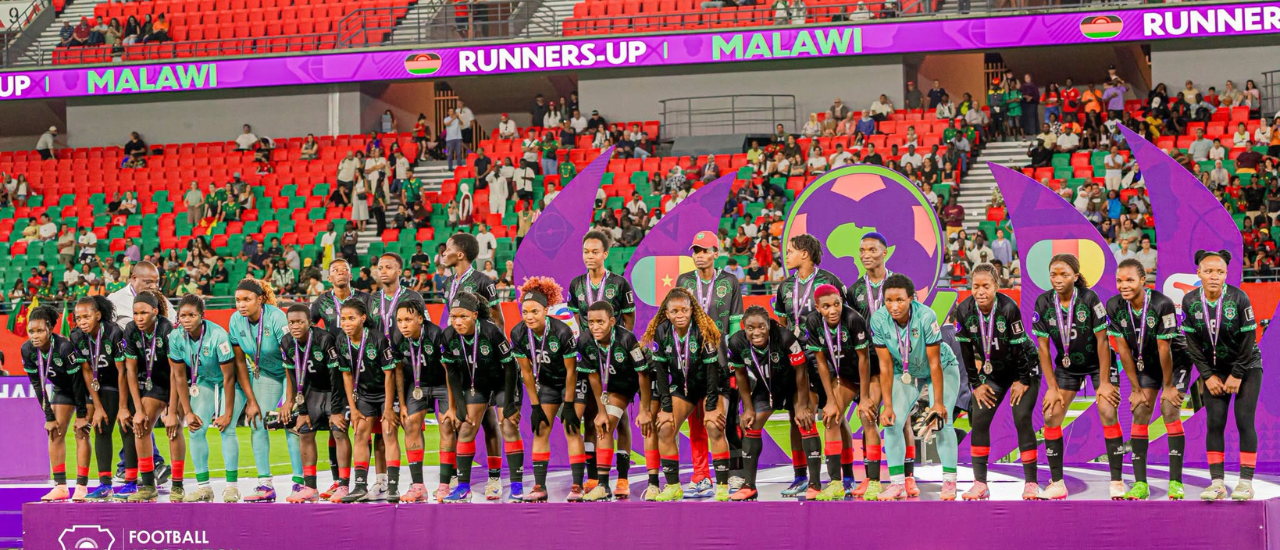
Malawi arrived at the Women’s Africa Cup of Nations in Morocco as first-time qualifiers, ranked 153rd in the FIFA women’s world ranking. Their opening assignment was Nigeria: defending African champions, ten-time WAFCON winners and one of the continent’s established football powers. Malawi beat them 3–2. The Scorchers went on to defeat Egypt, finish top of their group, beat Ghana in the quarter-final to secure qualification for the 2027 FIFA Women’s World Cup in Brazil, and defeat Algeria to reach the WAFCON final. Cameroon eventually stopped the run with a 3–0 victory in the final, leaving Malawi as African runners-up on their tournament debut.
There were individual milestones inside the collective achievement. Temwa Chaŵinga finished as the tournament’s Golden Boot winner with five goals, adding another major scoring title to a career that already includes consecutive NWSL Golden Boots and MVP awards in the United States. Her sister, captain Tabitha Chaŵinga, scored four times, and was a one time player of the match. But perhaps more consequential for the future of Malawian football was how many other names entered the conversation: 19-year-old Faith Chinzimu, whose two late goals against Angola had secured Malawi’s historic WAFCON qualification in the first place; Rose Kadzere, whose quarter-final winner against Ghana sent Malawi to the World Cup, resulting in her being named as the play of the match; Asimenye Simwaka, Letticia Chinyamula, Benadetta Mkandawire and a wider squad that demonstrated that the country’s women’s football proposition extends beyond its two most internationally famous players.
The Scorchers have therefore returned from Morocco with considerably more than silver medals. They have brought Malawi its first senior FIFA World Cup qualification, a US$750,000 CAF runner-up allocation, a substantially larger international audience and, perhaps most importantly, new information about the quality of football talent the country possesses.
Between now and Brazil in June 2027, there will understandably be a great deal of discussion about how Malawi prepares the team to compete. I am interested in a related question: what exactly has Malawi just discovered the economic value of—and what would it take to develop that value deliberately?
Watch my recap of WAFCON with the Scorchers via YouTube
Between ages 11 and 14, I played midfield for the MAMOSS football team at Marymount Secondary School.
I was not particularly good.
I was fast. As a child, I was a sprinter. Noone could outpace me [boys or girls] in primary school. Speed was probably the one part of football that came naturally to me. The ball, unfortunately, was another matter. I struggled with control. I hardly ever had a meaningful shot on target. Perhaps, with enough deliberate training, I might eventually have become a decent footballer. At the time, however, I concluded that I simply did not have the natural talent for it.
There was another consideration that probably mattered just as much: I could not see a future in football. I was a brilliant mathematician [top of my class], and I then thought I would have a successful career in the sciences.
I could understand why we played football at school. I could understand why people loved watching it. I could not imagine how a Malawian girl turned football into a serious career.
So when I graduated from secondary school, I stepped away from the pitch for what then I thought was ‘forever’.
Football did leave me with one professional curiosity. When I was younger, I would occasionally watch matches with my father, and my attention would drift toward what was happening around the match itself. I was fascinated by the cameras, the production, the people responsible for turning 90 minutes inside a stadium into something millions of people could experience elsewhere. For a while, I remember thinking that perhaps I would like to produce football for television.
That idea disappeared too.
I eventually went into international development, economics, technology and business, and for years I barely watched football. There is therefore no compelling childhood-destiny story connecting me to what has occupied an unreasonable amount of my attention over the past few weeks: the Malawi Scorchers, the Women’s Africa Cup of Nations, transfer markets, sports media, player brands and the economics of professional football.
The more useful connection for me begins in Madrin, Spain, shortly after a trip to Segovia.
In March 2025, during my MBA at the Michigan State University Broad College of Business, I participated in a study-abroad programme in Madrid. We visited several companies and institutions, and one of our stops was LaLiga, specifically the LaLiga Business School. I wrote at the time that we were exploring sports, business and global branding.
I took the assignment seriously, but football was probably among the industries I was least interested in entering. Our problem was nevertheless fascinating from a business-development perspective: how does a Spanish football property deepen its penetration of the United States?
LaLiga had already spent years working on precisely that problem. Its North American operation manages media rights and commercial agreements while using content, events, activations, marketing partnerships, academies, coaching programmes and exhibition tours to develop the market. By 2025, LaLiga reported an international presence in 41 countries through 11 offices and 44 delegates.
The lesson I carried away was not simply that football clubs and leagues need sponsors. It was that a market has to be built.
Business school had already been changing the questions I asked about markets. Earlier in my entrepreneurial life, I often started from supply: What am I good at? What can I build? What can I give the world? Would somebody pay me for it?
Marketing added a more difficult question:
Why would somebody pay me?
And then another:
Where did the money they are paying me actually come from?
That distinction matters enormously in football. A sponsor may write the cheque, but the sponsor is not necessarily the ultimate customer. A broadcaster may pay billions for media rights, but the broadcaster is not necessarily the ultimate customer either. If we keep following the money backwards, we eventually find the economic foundation underneath almost the entire football industry.
That foundation is people.
And that is where I want to begin thinking about the Scorchers.
Malawi has just watched a women’s national team arrive at its first WAFCON ranked 153rd in the world, beat Nigeria in its first match, finish top of its group, qualify for its first FIFA Women’s World Cup, reach the continental final and return home with a silver medal. FIFA itself has described this success as the product, in part, of years of investment in women’s football and grassroots structures.
That is a sporting result.
It is also market information.
The question now is what Malawi does with it.
For somebody who does not follow football closely, the industry can initially seem unnecessarily complicated. There are clubs and national teams, leagues and cups, FIFA and CAF, transfers and loans, academies, agents, media rights and sponsorship agreements. The easiest way to understand it is to separate the institutions according to what they actually do.
| Part of the system | Economic function |
|---|---|
| Players | Produce the sporting performance |
| Coaches and technical staff | Improve player capability, tactics and probability of sporting success |
| Clubs | Employ and develop players and compete throughout the season |
| National federations | Govern football nationally and operate national teams |
| Leagues/competition organisers | Create recurring competitive products |
| Confederations such as CAF | Organise continental competitions and development |
| FIFA | Governs the global system and organises global competitions |
| Academies | Identify and develop future players |
| Agents/intermediaries | Represent players and facilitate contracts and transactions |
| Broadcasters/platforms | Package and distribute football to audiences |
| Sponsors | Buy association with football properties and access to their audiences |
| Fans | Supply attention, identity, participation and direct spending |
| Consumers | Ultimately finance a large share of the commercial system |
On the pitch, football is straightforward enough. Two teams play with a maximum of eleven players each, including one goalkeeper. The remaining outfield players are broadly divided among defenders, midfielders and forwards, although modern tactical roles are far more fluid than those three labels suggest. Competitions also allow substitutes according to their own rules within football’s governing framework.
The economic distinction between club football and national-team football is more important for this discussion.
Most professional footballers spend the majority of the year employed by clubs. Temwa Chaŵinga, for example, is employed by Kansas City Current. Tabitha Chaŵinga is contracted to OL Lyonnes. Faith Chinzimu plays in Sweden for BK Häcken. Rose Kadzere plays for Montpellier HSC Féminines. When Malawi calls those players into the Scorchers, FAM is not buying them from their clubs; they are being selected to represent their country during international competition. CAF’s own pre-tournament reporting identified those club relationships when profiling Malawi’s squad.
That means there are several separate markets around the same woman.
There is the market for her labour, represented by her club contract and wages.
There is the market for her registration, which becomes relevant if one club wants to transfer her from another.
There is the market for her commercial identity: endorsements, appearances, image rights and partnerships.
There is the economic value she creates for her national team through performance, audience, sponsorship and tournament success.
And there is the longer-term economic value of whatever academy or club developed her.
Those markets interact, but the money does not automatically flow between them.
A transfer fee, for example, is not the same thing as a player’s salary. If Club A pays Club B for a player under contract, that transfer payment is principally a transaction between clubs for the contractual and registration position that allows the player to move. The player separately negotiates employment terms with the new club. FIFA requires international transfers to be recorded through its Transfer Matching System, and its regulatory architecture distinguishes permanent transfers from loans and tracks player-registration histories through electronic player passports.
This distinction becomes important later, because making a Scorcher more internationally visible does not mean that FAM itself can sell her for a transfer fee.
But it can help create the conditions under which she becomes more valuable in several interconnected markets.
Football is already an enormous industry.
Deloitte’s 2026 Football Money League found that the 20 highest-revenue clubs generated €12.4 billion in the 2024/25 season. Of that, €5.3 billion came from commercial revenue, €4.7 billion from broadcasting and €2.4 billion from matchday revenue. Commercial income had become the largest category for the third consecutive year. Across European top-flight football more broadly, UEFA expects annual club revenues to pass €30 billion.
Those categories tell us where clubs record revenue.
They do not yet tell us where money originates.
Consider matchday revenue.
A person earns income. That person buys a ticket.
Person → ticket → club → football operations → player wages
That chain is easy to see.
Merchandise works similarly.
Consumer → shirt → retailer/manufacturer/licensor → club or football property
Broadcasting introduces another layer.
A television network or streaming platform might pay a league hundreds of millions for the right to show matches. But where does the broadcaster obtain the money?
Part of it may come from subscriptions:
Viewer → subscription → broadcaster → league → club → player
Another part may come from advertising.
Now the chain looks different:
Consumer → company → advertising budget → broadcaster → league → club → player
Suppose a bank spends $1 million sponsoring a football team. The bank appears on the accounting statement as the customer. But the bank earns its money from customers using accounts, loans, cards and other financial products. It reallocates some of those revenues into marketing because it believes that the football property gives it valuable access to current or potential customers.
The sponsor is therefore buying something.
That something is not football in the abstract.
It is access to people who care about football.
This is the economic insight that made the industry click for me.
Football’s deepest commercial asset is recurring, emotionally intense human attention.
The fan experiences entertainment, identity, belonging, rivalry and community. The business sees a concentrated audience. The broadcaster sees programming capable of repeatedly attracting that audience. The sponsor sees potential customers. The investor sees claims on the future economic value of the institution that organizes those relationships.
The fan does not even have to spend directly on football to help finance football.
A person may never buy a ticket but purchase products from a company that spends part of its revenue advertising around football. In that case:
consumer expenditure → corporate revenue → marketing expenditure → football
There are important exceptions. Wealthy owners can inject capital into clubs. Governments can finance stadiums or federations. Lenders can provide debt. FIFA and confederations redistribute competition revenues and development funds. These flows matter, particularly in football systems that are not yet commercially self-sustaining.
But capital and operating revenue should not be confused. Investors can finance losses for a period. Governments can subsidise infrastructure. Sustainable commercial growth ultimately requires somebody to value the product enough to keep paying.
This is also why sporting organisations cannot simply manufacture revenue by adding more sponsors to a presentation deck. Sponsorship value is downstream of audience value.
The question before sponsorship is therefore:
Who cares?
Then:
How many people care?
Where are they?
How often do they engage?
How deeply do they care?
What purchasing power do they possess?
What do they buy?
And can the football property maintain a relationship with them?
Those are marketing questions, but they are also fundamental football-economics questions.
This was the second question that bothered me.
Why does one club pay another hundreds of thousands—or tens of millions—of dollars simply for the ability to sign a player, and then pay that player wages on top of the transfer cost?
The lazy explanation is that famous footballers sell shirts.
Some do.
But shirt sales alone cannot explain the economics of most transfers.
A footballer is simultaneously several things from the perspective of a club: productive labour, a scarce sporting resource, a contractual asset with potential resale value, and sometimes a commercial audience asset.
A simplified analytical framework is:
Player Economic Value ≈ Sporting Value + Commercial Value + Expected Resale Value − Total Cost
That is not an accounting identity. It is a way of thinking about the investment decision.
The most important component for most players is still sporting value.
Clubs buy probability.
A better striker may increase the probability of scoring goals. Goals alter probabilities of winning matches. Wins alter probabilities of finishing higher in a league, avoiding relegation, qualifying for continental competition, advancing through knockout tournaments or winning championships.
Those outcomes carry financial consequences.
Consider a deliberately simplified hypothetical.
A club estimates that without a particular player, it has a 30% probability of qualifying for a competition. With her, based on its performance models, squad structure and alternative options, management believes that probability rises to 45%.
Suppose qualification is worth an expected $40 million in additional competition distributions, broadcast revenue, matchday revenue and commercial effects.
The change in expected value is:
(45% − 30%) × $40 million = $6 million
That does not mean the player personally “created” $6 million. Football is a team sport and those probabilities are modelled under uncertainty. But it demonstrates why spending $2 million to acquire a player could be economically rational even if she sells almost no merchandise.
Sporting outcomes genuinely affect revenues. Deloitte’s latest club analysis notes that broadcast income shifts with competition participation and performance, while UEFA’s competition distributions explicitly contain significant performance-linked components.
Relegation creates the inverse calculation. If relegation could cost a club tens of millions in media and commercial income, a January signing that meaningfully lowers that probability can function economically like very expensive insurance.
Then there is resale value.
A club that acquires a talented 19-year-old does not necessarily expect to keep her until retirement. It may believe that better coaching, stronger competition and greater exposure will make her substantially more valuable at 22.
This is one reason youth-development systems matter commercially. An academy can spend years developing players at relatively low cash cost compared with purchasing established stars. If a small number of those players later become high-value professionals, the transfer economics can help finance the development structure around them.
This market is already expanding rapidly in women’s football.
FIFA recorded 2,440 international transfers of professional women players in 2025, up 6.3% from the previous year. Transfer-fee spending reached a record US$28.6 million, more than 80% higher than in 2024. That remains tiny beside the US$13.08 billion spent on international transfer fees in men’s professional football, but the direction of travel is clear: clubs are increasingly willing to pay for women’s football talent rather than relying overwhelmingly on free transfers.
Contract duration also affects price.
An outstanding player with five years left on a contract may command a substantial fee because her existing club has leverage. If the same player’s contract expires next month, another club may be able to wait and sign her without paying a transfer fee to her former employer. The player’s ability has not suddenly changed. The contractual scarcity has.
Loans solve a different problem. A club may want access to a player for one season without purchasing her permanently. The parent club may want her playing regularly elsewhere rather than sitting on its bench. The receiving club may contribute wages and sometimes a loan fee while avoiding a larger permanent acquisition. FIFA’s transfer reporting shows that loans comprise a significant portion of global transfer activity.
All of this matters for Malawi because the Scorchers do not enter a neutral international labour market.
They enter a market in which information, visibility, competition quality and reputation influence how clubs perceive risk.
That brings us to WAFCON.
Faith Chinzimu did not become a different footballer during the last three weeks.
What changed was the amount and quality of information available about her.
Before WAFCON, a European club considering Faith could examine her performances for BK Häcken, her earlier development, national-team appearances and scouting information.
After WAFCON, there was additional evidence.
She had played in a major continental championship.
She had competed against players from Nigeria, Egypt, Zambia, Ghana, Algeria and Cameroon.
She had done it under knockout pressure.
She had been broadcast internationally.
She had played inside a team that reached an African final.
In economics, this resembles price discovery. In statistical reasoning, it resembles Bayesian updating: new evidence causes decision-makers to revise prior beliefs.
A scout might previously have thought there was a 15% probability that a young player could perform at a particular level. Evidence from high-quality competition may shift that estimate upward—or downward. Either way, the tournament reduces uncertainty.
That is one of the economic functions of elite competition.
And Malawi supplied a lot of new information in Morocco.
The Scorchers entered the tournament 153rd in FIFA’s June 2026 ranking and had never previously played at WAFCON. Their very first match was against Nigeria, the defending champions and record ten-time winners. Malawi won 3–2, with Temwa Chaŵinga scoring twice and Tabitha Chaŵinga scoring the other.
Their tournament then looked like this:
| Stage | Opponent | Result | What it changed |
|---|---|---|---|
| Group C | Nigeria | Won 3–2 | Beat the defending champions on WAFCON debut |
| Group C | Egypt | Won 3–1 | Moved to six points after two matches |
| Group C | Zambia | Lost 1–2 | Still finished top of Group C on tiebreak criteria |
| Quarter-final | Ghana | Won 2–1 | Qualified for Malawi’s first FIFA Women’s World Cup |
| Semi-final | Algeria | Won 3–1 | Reached the WAFCON final on debut |
| Final | Cameroon | Lost 0–3 | Finished runners-up in Africa |
The WAFCON result should not be narrated as a miracle produced from nothing.
FIFA explicitly points to investments already made by FAM, the Malawi government, the National Bank of Malawi, and FIFA Forward. Facilities at Chiwembe Technical Centre have been improved. An inclusive academy opened in Mzuzu in 2024. FIFA Forward funding has supported U-14 and U-16 leagues and women’s regional competitions. Malawi had already won its first COSAFA Women’s Championship in 2023, winning all five matches in that campaign. Earlier in 2026, the Scorchers also participated in the FIFA Series, playing Australia and India.
There is therefore already a development system producing results.
The economic question is whether it is sufficiently resourced, connected and commercialized to compound them.
WAFCON also expanded the number of Malawian players the international public had reason to know.
Temwa arrived as one of the most established stars in the squad and left with the WAFCON Golden Boot after five goals and two assists. Before the tournament, she was already a two-time NWSL Golden Boot winner and two-time NWSL MVP with Kansas City Current, and had captained Malawi to the 2023 COSAFA title while winning that tournament’s Golden Boot and Golden Ball.
Tabitha captained the team through the tournament and scored four goals before the final, including twice in the semi-final against Algeria. Together, the sisters scored nine of Malawi’s 12 goals entering the final.
But the economically interesting discovery was not that the Chaŵinga sisters were excellent. International football already knew that.
It was the emergence and revaluation of the women around them.
Faith Chinzimu is 19. Her senior Malawi story had already included one of the most consequential moments in the history of the national team: with the WAFCON qualifier against Angola still goalless after the first leg and most of the second, she scored in the 82nd minute and again in the 84th to secure Malawi’s first WAFCON qualification. At the tournament itself she scored against Egypt. CAF’s profile of her traces an earlier pathway through Malawi’s youth sides and Ascent Soccer before her move to BK Häcken.
Rose Kadzere scored against Egypt and then scored the 79th-minute winner against Ghana that sent Malawi to Brazil.
Letticia Chinyamula entered this cycle with evidence of domestic productivity: FAM named the Ascent Soccer player Malawi’s women’s Player of the Year after a season in which she finished as Central Region Women’s League top scorer with 18 goals.
Asimenye Simwaka brings an unusually interesting profile because she has competed at two Olympic Games in athletics, Tokyo 2020 and Paris 2024, before now becoming part of a football team going to a World Cup.
Benadetta Mkandawire played every minute of Malawi’s six WAFCON matches and had two assists entering the final. CAF highlighted her as one of five Scorchers to have played all 540 available minutes.
None of these facts automatically tells us what any player is “worth.” Football transfer valuations are notoriously noisy, and the women’s game has less public transaction data than the men’s game. It would be irresponsible to take a strong WAFCON performance and invent a transfer figure.
But the tournament has reduced information asymmetry.
International clubs now know more.
Fans know more.
Sponsors know more.
Media organisations know more.
And, importantly, the players themselves now have additional evidence with which to negotiate the next stage of their careers.
That is market value being formed.
This distinction matters because marketing cannot manufacture football ability.
No amount of beautiful photography can turn an average midfielder into an elite one. A documentary cannot create first touch. Search-engine optimization cannot improve finishing. A website cannot make somebody faster.
What media can do is ensure that real sporting value becomes legible to the market.
Imagine two equally talented 19-year-old footballers.
One has:
reliable match footage, accurate statistics, a documented playing history, professional photographs, an authoritative biography, searchable media coverage, active social channels and international competition exposure.
The other has almost none of those things.
Their underlying football talent might be identical.
Their market accessibility is not.
A scout can evaluate one more cheaply.
A journalist can write about one more accurately.
A sponsor can understand one more quickly.
A fan can form a relationship with one more easily.
Media infrastructure therefore reduces transaction costs and information asymmetry.
This is why I now think differently about something as apparently mundane as a footballer’s website. The website is not the business model. It is one node in a much larger information system.
The same applies to statistics, match archives, professional photography, highlight packages, documentary production, press kits, player interviews and properly maintained social channels.
They create a bridge between:
talent and scouts;
players and audiences;
teams and sponsors;
football properties and capital.
This is also the lesson I now better understand from LaLiga’s approach to internationalization.
LaLiga North America’s strategy has not been limited to selling American broadcast rights. Its operation has combined rights, commercial agreements, content, consumer events, marketing partnerships, academies, coaching programmes and tours. It has created market-specific experiences such as its El Partidazo event series and invested in youth academies and talent-development programmes in the United States.
That matters because distribution alone does not create fandom.
A match can technically be available in a country without people caring about it.
Fandom has to be cultivated through repeated contact, personalities, stories, rivalry, cultural relevance and experiences.
The women’s game is generating increasingly persuasive commercial evidence of this.
Deloitte reports that the 15 highest-revenue women’s clubs in its 2026 Money League generated more than €150 million collectively. Arsenal Women led at €25.6 million, followed by Chelsea at €25.4 million and Barcelona at €22 million. Arsenal had invested specifically in fan data and activation, and recorded crowds above 35,000 on five occasions in 2024/25.
This is an instructive example for Malawi because Arsenal’s advantage is not simply that “many people like Arsenal.”
The organisation invests in understanding which people, how they behave, what persuades them to attend, what makes them return and how the audience can create value for commercial partners.
The NWSL provides another case. Its four-year US$240 million media-rights agreement with ESPN, CBS, Prime Video and Scripps began in 2024 and, according to the league, quadrupled audiences in its first year. The league subsequently expanded its media distribution further.
This matters directly to Malawi because Temwa is already playing inside that market.
And Brazil 2027 will amplify it.
FIFA has given Netflix exclusive United States rights to the 2027 and 2031 Women’s World Cups. More interesting to me than the live rights alone is that Netflix will also produce documentary series in the lead-up to both tournaments, specifically telling the stories of players and the growth of women’s football.
Pause on that.
One of the world’s largest streaming companies has not concluded that the economic product begins when the referee blows the whistle in Brazil.
It is investing in storytelling before the tournament.
That tells us something about what creates value.
People watch matches because they care about outcomes.
They care about outcomes more intensely when they care about the people involved.
Which means player storytelling is not decorative PR attached to the sports business.
It can be part of the infrastructure that creates demand for the sports business.
This is where the argument for international relevance needs care.
I am not arguing that Western audiences are inherently more important than Malawian or African audiences.
Malawi is the Scorchers’ home market. It supplies identity, national meaning and the core constituency from which the team draws legitimacy. Africa supplies competition, continental scale and regional rivalries.
But if we are analysing the market for professional women’s football labour, media and sponsorship, we have to ask where the deepest pools of current commercial demand exist.
The largest women’s club revenues are presently concentrated in mature European football systems. England’s Women’s Super League generated £90 million in club revenue in 2024/25. The NWSL has built a nine-figure US media-rights deal. The global market for women’s elite sport is growing rapidly enough that Deloitte expects revenues across women’s elite sports to reach at least US$3 billion in 2026.
Those are markets with developed professional clubs, media infrastructure, sponsors, fan-data systems, sports agencies and comparatively deep commercial ecosystems.
For a Malawian player, international visibility can therefore affect the probability of:
being scouted;
moving into stronger leagues;
earning higher wages;
negotiating better contracts;
securing endorsements;
gaining media exposure;
building an international fan base;
and developing post-playing career options.
The relevant question is not whether Malawi should “send its best talent away.”
It is:
Where can a unit of elite Malawian football talent currently earn its highest return?
We routinely understand this logic in other labour markets.
A Malawian engineer may work in Johannesburg.
A Malawian academic may work in London.
A Malawian technology professional may work in Seattle.
Their departure does not prove that Malawi should stop developing engineers, academics or technologists. It raises a different policy problem: how do we create pathways through which globally competitive Malawian human capital benefits the individuals concerned and strengthens the ecosystem that produced them?
Football requires the same systems thinking.
The answer, however, is more complicated than saying that overseas players will pay tax in Malawi.
Malawi’s tax system places significant importance on the source of income, including where services are rendered. It would therefore be wrong to assume that a Malawian citizen earning a club salary for football played abroad automatically generates Malawi income-tax revenue simply because she remains Malawian. Individual tax outcomes depend on source, residence, treaty and personal circumstances.
The return channels are broader.
A successful international career can create household transfers, domestic consumption and investment where players choose to deploy income at home. Players can finance businesses or academies. Their international success can increase demand for Malawian football. It can strengthen the reputation of domestic clubs and academies as sources of talent. We already see this with Tabitha, who has established TC11 Group of Companies in Malawi, and also the TC11 Academy.
There are also formal football mechanisms intended to reward development.
FIFA’s Clearing House exists to process training rewards, including training compensation and solidarity contributions, where regulatory conditions are satisfied.
For the Women’s World Cup specifically, FIFA already operates a Club Benefits Programme. After the 2023 tournament, FIFA distributed US$11.3 million to 1,041 clubs across 48 member associations that had released and/or trained participating players. That programme was explicitly designed to recognize the role clubs play in creating high-performance environments for female players.
That is a far more interesting development-economics model than simply saying, “our best players have left Malawi.”
If the system is designed correctly, an academy that identifies a girl can help her become a national-team player; international competition can raise her visibility; stronger clubs can employ her; global tournaments can generate club benefits and other economic opportunities; and some of that value can return to the institutions developing the next cohort.
The challenge is ensuring that the connections actually exist.
Without documentation of player histories, compliant club structures, proper registrations, contracts, rights management and administrative capacity, value can be created by Malawian talent while very little is captured by the system around it.
There is another reason I am particularly interested in women’s football as a marketing problem.
Women are not merely the athletes.
They are consumers.
But we should be precise here rather than falling into another assumption: women’s sports audiences are not necessarily primarily female. Nielsen’s 2025 global sports research found that women represented 47% of fans of women’s sports. Separate Nielsen research projects the global women’s-football fanbase to grow substantially through 2030, with the audience becoming increasingly commercially attractive to brands.
For Malawi, this creates an opportunity to build an audience that includes existing football fans while deliberately bringing in women who may historically have had little reason to follow the sport.
I know this audience exists because, until recently, I was in it.
I can tell you more about economic-development institutions than football formations. I had barely watched full matches for years. Yet the Scorchers gave me a reason to learn what a low block is, why second balls matter, what “box-to-box” means, how transfer windows work and why the person screaming at a midfielder to release the ball is not necessarily being unreasonable.
That consumer is commercially interesting.
She may not have bought a football jersey before.
But she buys mobile data.
She banks.
She travels.
She buys personal-care products.
She uses technology.
She consumes entertainment.
She pays for education.
She buys food, fashion and financial products.
The sponsor categories available to women’s football therefore do not need to be inherited mechanically from men’s football.
Telecommunications, financial services, consumer technology, travel, fashion, beauty, personal care, health, insurance, education and FMCG companies may all find relevant audiences around the women’s game if the demographic data supports the fit.
This is why I would evaluate an audience using something closer to:
Audience Commercial Value ≈ Reach × Engagement × Purchasing Power × Scarcity × Brand Fit
Again, this is a heuristic, not an accounting equation.
A million disengaged impressions are not necessarily more valuable than 200,000 people with a strong relationship to a property.
Likewise, a sponsor targeting young women may rationally value an audience composition differently from a sponsor targeting older men.
This is why the first phase of Scorchers commercialization should not be “find sponsors.”
It should be understand the audience.
Where did WAFCON interest come from?
What proportion was in Malawi?
What came from neighbouring African countries?
What came from the diaspora?
What came from the United States because of Temwa?
What came from France because of Tabitha?
Which players generated searches?
Which videos retained viewers?
Did women behave differently from men?
Which content converted a casual viewer into somebody who came back for the next match?
Who followed individual players rather than only the national team?
Which international publications picked up the story?
How many of those relationships can FAM and the players maintain after the tournament?
Those questions turn enthusiasm into data.
Data turns audience into inventory.
Inventory can be priced.
CAF increased the WAFCON winner’s prize to US$2 million in July 2026 and the runner-up allocation to US$750,000, a 50% increase from the previous runner-up prize. Every participating national team also received US$150,000 in participation funding.
I do not know the contractual obligations, bonuses, preparation costs or other commitments attached to Malawi’s tournament revenue, so it would be irresponsible to announce what FAM “should” spend as though US$750,000 were an unrestricted pile of free cash.
But it creates a useful capital-allocation question.
What proportion of extraordinary sporting income should be consumed, and what proportion should be reinvested in increasing the future value of the asset that generated it?
Even a scenario analysis is revealing.
| Hypothetical reinvestment rate | Amount from US$750,000 |
|---|---|
| 5% | US$37,500 |
| 10% | US$75,000 |
| 15% | US$112,500 |
| 20% | US$150,000 |
These are not recommendations. They are scenarios.
The more important question is what different kinds of investment produce.
There are at least three separate buckets.
Sporting investment improves the quality of the product: coaching, strength and conditioning, nutrition, sports science, medical support, player analysis, competitive preparation and international match exposure.
Commercial infrastructure investment improves the ability to create and capture economic value around the product: content, photography, audience research, player data, rights management, media production, social distribution, partnerships, merchandise and events.
Grassroots investment expands the pipeline: academies, school football, coaching, regional leagues, talent identification and pathways into elite competition.
Malawi already has evidence that the third category is working. FIFA specifically connects the Scorchers’ World Cup qualification to investments in facilities, regional women’s leagues, youth competition and the Mzuzu academy.
The strategic error would therefore be to choose between football development and commercialization as though one competes with the other.
They should reinforce each other.
A stronger football product creates attention.
Attention creates commercial opportunity.
Commercial opportunity generates revenue.
Revenue can finance better development.
That system can be represented as a flywheel:
Grassroots investment → more identified talent → better development → better players → better performance → more audience attention → better storytelling and distribution → larger addressable audience → higher commercial value → greater player/federation/club revenue → more professional opportunities → reinvestment → more talent
There are, however, obvious failure points.
Talent without scouting can remain invisible.
Scouting without good development may identify players who never reach their potential.
Performance without media can generate attention that disappears after the final whistle.
Media without a genuinely good sporting product eventually loses credibility.
Audience without commercial systems becomes vanity metrics.
Commercial revenue without reinvestment creates a one-off boom.
International transfers without strong domestic clubs and development records may enrich individuals without adequately strengthening the pipeline.
Grassroots participation without an elite pathway can produce thousands of girls playing football without enough of them ever seeing a professional future.
This is why I keep returning to systems.
No single website solves this.
No sponsor solves it.
No Golden Boot solves it.
No World Cup appearance solves it.
The value is created by connections between the parts.
The FIFA Women’s World Cup runs from 24 June to 25 July 2027 in Brazil. Malawi therefore has roughly ten months to prepare not only a football team but a marketable national sporting property.
I would structure that work in seven phases.
| Phase | Core question | Practical output |
|---|---|---|
| 1. Asset inventory | What exactly do we have? | Player database, rights map, audience baseline, content audit, sponsor inventory |
| 2. Sporting development | How do we increase probability of performance? | Coaching, analysis, conditioning, nutrition, medical and competitive plan |
| 3. Brand infrastructure | Can the market find and understand the players? | Bios, stats, photography, player pages/sites, media kits, searchable archives |
| 4. Audience development | Who are we trying to make care? | Malawi, African, diaspora and international audience strategies |
| 5. Commercial packaging | What can companies actually buy? | Sponsorship products, branded content, events, merchandise, media packages |
| 6. World Cup activation | How do we compound attention before Brazil? | Documentary/storytelling series, player campaigns, press, fan activations |
| 7. Reinvestment system | How does success finance the next generation? | Transparent development allocation and post-World Cup strategy |
FAM should know, in one place, the current club, age, position, contract context where appropriate, playing history, verified statistics, development history, media profile and commercial status of every Scorcher.
It should also know what rights it controls and what it does not.
National-team marks are different from an individual player’s personal commercial rights. Tournament footage may belong to competition rights holders. Club footage may belong to leagues and clubs. Player endorsements may have exclusivity provisions.
You cannot build a serious commercialization strategy without first knowing what can legally be sold, licensed, filmed, published or sponsored.
Marketing becomes useless if Brazil exposes a team that has stopped developing.
The technical programme therefore remains the first-order investment: match analysis, elite opposition, player fitness, injury prevention, tactical work, conditioning, nutrition and preparation.
The commercial team’s job is not to distract from football.
It is to make sure that when football creates value, the surrounding system captures it.
By the time Malawi arrives in Brazil, a journalist anywhere in the world should be able to search a Scorcher’s name and find accurate information.
A scout should be able to identify her club, position and development pathway.
A sponsor should understand her profile.
A fan should know where to follow her.
This requires consistent photography, statistics, biographies, profiles, interviews, video and media kits.
Some players may warrant standalone digital properties. Others may be better served through strong centralized Scorchers infrastructure. The principle is not “every player needs a website.”
The principle is:
no player should be commercially invisible because the basic information architecture around her does not exist.
Malawi cannot market the Scorchers to everyone using the same proposition.
The Malawi market is built around national identity, access and belonging.
The African market can be built around continental competition, player rivalries and the emergence of another competitive Southern African team.
The diaspora market combines identity with higher geographic dispersion and potentially different consumption patterns.
The United States has an immediate bridge through Temwa, the NWSL and Netflix’s exclusive 2027 Women’s World Cup rights.
Europe contains many of the professional club markets in which Malawian players can build careers.
And there is an international women’s-football audience that may have no prior relationship with Malawi but will discover players because the story, sporting quality or personality is compelling.
These are different acquisition funnels.
Only now do we arrive at sponsorship.
Instead of asking a company, “Would you like to sponsor the Scorchers?”, create specific assets.
A bank might sponsor a player-development series.
A telecom company might sponsor digital match-day content.
An airline might partner around the journey to Brazil.
A beauty or personal-care company might work with individual athletes whose audiences fit its consumers.
A technology company might sponsor performance analytics or fan experiences.
A documentary could have presenting partners.
A World Cup send-off can be an event property.
Merchandise can be built around both team identity and individual players where rights allow.
The difference is important.
“Sponsor us” is a request for money.
A commercial package identifies an audience, an asset, a distribution mechanism, deliverables and a measurable return.
The Netflix deal is perhaps the strongest external validation of this strategy.
FIFA’s U.S. media partner is explicitly investing in documentary storytelling before Brazil.
Malawi should do the same at an appropriate scale.
There is already enough material.
Faith Chinzimu: the teenager who scored twice in two minutes to take Malawi to its first WAFCON.
Rose Kadzere: the player whose quarter-final goal booked the World Cup ticket.
Asimenye Simwaka: Olympian and World Cup-bound footballer.
Letticia Chinyamula: domestic-league scorer and emerging national-team player.
The Chaŵinga sisters: two careers already spanning multiple countries and some of the strongest professional leagues in women’s football.
Benadetta Mkandawire and the defensive unit.
The coaches.
The academies.
The families.
The domestic clubs.
The women behind the women on television.
A documentary series does not need to wait until Brazil to discover whether there was a story.
The story is happening now.
The most important commercial decision may be the least glamorous.
What happens after Brazil?
If tournament attention creates new sponsorship revenue, what proportion finances development?
If players move internationally, are their youth-development histories properly documented?
Are local clubs administratively equipped to access benefits for which they become eligible?
Can successful players invest in academies or domestic football through structured partnerships if they want to?
Can the women’s league become a stronger year-round media product?
Can new coaching, broadcasting, analytics and sports-management careers emerge around it?
A sports economy becomes interesting when the athlete is no longer the only person earning a living from sport.
Malawi’s population is young.
UNFPA estimates Malawi’s 2025 population at 22.2 million, with 40% under the age of 15.
That demographic structure creates both possibility and enormous pressure.
A large young population is not automatically a demographic dividend. It becomes one when people can develop capabilities and enter productive economic activity.
Education is central to that.
Sport is not a substitute for education, and it would be unserious to claim that football can absorb Malawi’s employment challenge.
But formal academic pathways are also not the only way human capability generates economic value.
A functioning sports economy requires:
players;
coaches;
physiotherapists;
doctors;
nutritionists;
strength and conditioning specialists;
analysts;
referees;
agents;
lawyers;
camera operators;
editors;
producers;
journalists;
marketers;
designers;
event managers;
merchandisers;
data specialists;
groundskeepers;
stadium workers;
technology providers;
hospitality businesses;
travel providers;
and administrators.
LaLiga has a full dedicated Business School.
Footballers are the most visible labour in the system.
They are not the entire labour market.
This is where my own abandoned childhood interest in producing football for television becomes slightly amusing.
I did not become a footballer.
I did not become a football television producer either.
But the instinct itself was economically reasonable: there were careers around the match that were not visible to me because I had no idea what the industry looked like.
That visibility matters.
World Bank data estimates female labour-force participation in Malawi at 58.2% in 2025, compared with 67.3% for men. That statistic alone does not tell us which sectors women should enter, but it is another reason to take seriously the creation of diverse, productive pathways for women.
Sport belongs somewhere in that portfolio.
Not because every girl will become Temwa Chaŵinga.
Most will not.
Most boys will not become Lionel Messi either, and that has never been considered a sensible argument against investing in men’s football.
The economic case for the system rests on a broader proposition: if Malawi is capable of producing globally competitive sporting talent, then talent development, media, professional club infrastructure, competition and commercial systems can turn some of that capability into income, businesses, jobs, intellectual property and international market access.
And the Scorchers have just supplied unusually useful evidence.
They were not expected to arrive at WAFCON and win everything. They did not.
Cameroon studied the problem in front of them, defended superbly throughout the knockout stages and beat Malawi 3–0 in the final. That result should generate technical lessons, just as the entire tournament generated commercial ones.
The mistake would be interpreting the silver medal as the end of the experiment.
Malawi went into its first WAFCON ranked 153rd.
It won four of six matches.
It beat the reigning African champions.
It finished top of its group.
It qualified for the World Cup.
It produced the tournament’s Golden Boot winner.
It introduced several young Malawian players to a much larger market.
It earned a US$750,000 runner-up allocation from CAF.
And it did so on top of an existing development system that had already produced a COSAFA championship.
That is not sufficient evidence to conclude that every kwacha invested in women’s football will produce a positive financial return.
No serious investment analysis works that way.
It is sufficient evidence to justify asking a much more ambitious question:
What happens if we now build the system deliberately?
There is one final piece of this system that matters: who actually does the work of taking a football property into another market?
It is easy to say that the Scorchers should become globally relevant. It is much harder to make that happen well.
Markets are not interchangeable. The person who understands football audiences in Lilongwe does not automatically understand how women’s football is consumed in Kansas City, Paris or Stockholm. Media habits differ. Sponsor categories differ. Fan cultures differ. Purchasing power differs. The stories that resonate differ.
This was one of the lessons I took from LaLiga’s internationalisation strategy. LaLiga did not assume that Madrid could understand every market from Spain. It built an international network of offices and locally based delegates to develop relationships, understand consumers and identify commercial opportunities in specific countries.
Malawi does not need offices around the world. That would make no sense at our current scale.
But the principle matters.
“Global” is not a market.
The United States is a market. France is a market. Sweden is a market. Southern Africa is a market. Even the Malawian diaspora behaves differently depending on where people live.
Fortunately, the Scorchers already give us natural entry points.
Temwa provides a bridge into the United States through Kansas City and the NWSL.
Tabitha and Rose provide entry points into France.
Faith provides one into Sweden.
The Scorchers’ COSAFA history gives Malawi an existing regional story in Southern Africa.
Rather than launching a vague global campaign, I would start with those markets and ask specific questions.
Who already cares? Which player gives us the strongest entry point? Where do those audiences consume football? Which media outlets influence discovery? Which companies want access to those consumers? What content works? What converts attention into repeat engagement?
Then measure.
Learn.
Refine.
Scale.
That also means putting people around the strategy who genuinely understand those markets. Some may be inside FAM. Others may be diaspora professionals, commercial partners, agencies or specialists in media, law, marketing, analytics and sports management.
Internationalisation should be treated as a capability, not as a social-media assignment.
The same is true at player level. If a young Scorcher becomes increasingly valuable internationally, she will eventually need more than football ability around her. Good representation, legal advice, commercial management, communications and financial guidance affect how much of the value created by her career she is actually able to capture.
So the long-term opportunity is not only to develop globally competitive footballers.
It is also to develop Malawians capable of managing globally competitive football careers.
That capability can start small.
Choose the first markets deliberately. Put knowledgeable people around them. Test. Measure. Build relationships. Expand what works.
LaLiga’s global footprint is much larger than anything Malawi needs today. But the principle behind it is relevant: international markets have to be understood, not merely targeted.
When I stopped playing football at Marymount, there were two things happening.
One was straightforward: I did not think I was particularly good at it.
I still suspect I was correct.
The second is more interesting to me now.
I could not see the pathway.
There was nothing in my understanding of the world that connected running onto a school football pitch as a Malawian girl with a professional contract, an international transfer market, a global media industry, sponsorship income, sports science, intellectual property, broadcasting careers or a World Cup.
I cannot help wondering how many girls who were good enough have reached the same conclusion.
That is the development problem hiding underneath the football problem.
Markets do not function merely because talent exists.
People need information.
They need pathways.
They need institutions.
They need capital.
They need credible intermediaries.
They need competition.
They need markets in which their ability can be priced.
And they need the possibility of seeing where the pathway leads.
Temwa and Tabitha Chaŵinga have already demonstrated that a Malawian woman can become a globally significant professional footballer.
Faith Chinzimu, Rose Kadzere, Asimenye Simwaka, Letticia Chinyamula, Benadetta Mkandawire and the wider Scorchers generation now give us reason to investigate whether those sisters should be understood not as anomalies, but as early evidence of a much larger talent system.
Brazil creates a deadline.
There are roughly ten months in which Malawi can simply prepare a team to attend the World Cup.
Or there are ten months in which we can improve the team, document the players, understand the audience, clarify the rights, build the media infrastructure, create the commercial inventory, connect the women to international markets and decide how the value generated by this moment should finance the generation behind them.
The Scorchers have already supplied the market evidence.
What remains is the much harder work of building institutions capable of developing that value, pricing it, taking it to market and ensuring that it compounds rather than disappearing between tournaments.
If you’d like to go deeper into my journey — from Malawi, through the United Nations and Microsoft to now building my own companies in Detroit, you can find it in my books.



Nthanda Manduwi is a Malawian storyteller, entrepreneur, digital transformation advocate, and community builder driven by the mission to empower Africa’s economic landscape through innovation and technology.