
As I pen this to you, I am making tea in my Detroit home.
It is Hibiscus and Ginger tea produced by Thanthwe Farms, a Malawian agribusiness working across horticulture, agro-processing and climate-smart agriculture. Thanthwe is a family-owned company founded by Ngabaghila and Dziko Chatata; its products include locally processed herbal teas, jams, juices and spices. The company reports working with thousands of farmers from its base outside Lilongwe.
The choice is deliberate. I no longer routinely drink the black tea with which I grew up. My mother was Tumbuka, and the Tumbuka are addicted to tea. Tea was constant in my childhood.
My mother drank it so frequently that she was always asking me to make it for her. It annoyed me to repeatedly perform the labour of making one cup, so I began making two: one for her and one for myself. Eventually, I inherited the habit I had initially resented. I do not drink coffee. For much of my life, tea occupied that place instead.
Systems rarely reproduce themselves through a single causal chain. They travel through markets, missionary institutions, colonial administration, work routines, school timetables, shops, advertising, family imitation and the quiet authority of normality. By the time a practice reaches a daughter making tea for her mother, most of the system that produced the practice has disappeared from view.
Tea originated in China, where written records describe it as a medicinal beverage by at least the third century. Britain did not invent tea. It transformed tea into one of history’s most influential imperial commodity systems, acquiring, taxing, cultivating, transporting and normalizing it across territories under British control.
Economic decolonization begins when production, processing, ownership and demand increasingly reinforce domestic productive systems. My cup redirects one recurring unit of demand toward a Black Malawian enterprise processing Malawian agricultural products into finished goods. It is a small economic decision, but systems are ultimately reproduced through millions of such decisions.
The larger question begins there. How does a commodity originating in one civilization become an unquestioned domestic habit in another? How does a habit become a market, a market become a source of state revenue, revenue become a reason for coercion, coercion become war, and victory become the authority to design institutions that govern the world?
Delve into Business and International Development with Nthanda Manduwi
Systems Don’t Have to Be Broken to Produce Bad Outcomes
I contemplated not publishing an episode this week [I explain why in the podcast], and then ended up recording my longest episode yet.
And to make up for publishing a little late the past two weeks, I am publishing this a day early. You’re welcome, or I am sorry?
I woke up to a message from a friend sharing a video of President William Ruto demanding Veto power for African nations at the 80th United Nations General Assembly [I happened to be in attendance], and I jumped out of bed and got to writing about my favorite beverage: tea! I also got to pen about slave trade, and colonization, and war [I know, what does any of this have to do with Hibiscus tea??!]
This week’s episode explores one of the central ideas behind the third book in the Lessons Book series – Systemic Nonsense: what if many of the frustrations we experience in institutions are not accidents or failures, but predictable outcomes of how those systems were designed?
It often feels like bureaucracy feels so resistant to change, and that reforms often produce more process than progress. It also seems that good intentions so rarely translate into meaningful outcomes. If you’ve pondered on these thoughts before, then these conversations are for you.
This Week’s Book
📖 Systemic Nonsense [Book 3]
This week only, from 27–31 July, the Kindle edition of Systemic Nonsense is available free as part of its Founders Edition launch.
Systemic Nonsense explores several ideas on international development in much greater depth. It asks a simple question:
What if the system isn’t failing? What if it’s doing exactly what it was designed to do?
Whether you listen, read, or dive into the book, I hope it leaves you asking better questions about the systems we inherit—and the ones we choose to build next.
How to Read
To receive your free Kindle copy:
* Click the Amazon link below.
* Select the Kindle edition while the promotion is active.
* Add it to your Kindle library.
You do not need a Kindle device. The free Kindle app works on iPhone, Android, tablets, Macs, and PCs, allowing you to build your digital library wherever you read.
Helpful Links
📚 Read this week’s book for free [search on Amazon or in Kindle for the book that is free for the week, and feel free to purchase the others]:http://amazon.com/dp/B0FQNJ61SB
📰 Subscribe to The Lessons Conversation:
Africa paperback pre-orders:https://forms.office.com/r/RMRMKTNd1M
Enjoyed listening to the Lessons Conversation? This post is public so feel free to share it.
This is a public episode. If you would like to discuss this with other subscribers or get access to bonus episodes, visit podcast.lessonsconversation.com
![Book 3: Systemic Nonsense [lessonsbooks.com]](https://byntha.com/wp-content/uploads/2026/07/podcast-episode-image-5a3bbb435029c89d668c5fa2682893ef-768x768.jpg)
#LessonsWeekly
[Listen to the Podcast for Context, or Keep Reading Below]
- Systems become invisible through repetition: Practices repeated across households and generations eventually appear natural, even when they originated in specific historical arrangements.
- Commodities carry institutions within them: A product embodies systems of land, labour, finance, transport, law, processing and political authority long before it reaches a consumer.
- Consumer preference can create geopolitical consequences: No individual tea drinker needed to demand imperial war; aggregated demand interacted with trade imbalances, corporate interests and state power.
- Participation is not the same as agency: Africans fought in the world wars, but most did so under colonial command rather than through sovereign African institutions pursuing African war aims.
- Sovereignty is the capacity to act: Representation provides voice; sovereignty includes the institutional power to finance, negotiate, enforce and build.
- International institutions preserve their founding bargains: The Security Council’s hierarchy persists because it was central to the agreement that created the post-war order, not because it has simply been forgotten.
- Recognition is not the same as power: A system may acknowledge injustice while resisting apologies, reparations, restitution and changes to the distribution of assets.
- Moral clarity does not automatically change incentives: Institutions change when the incentives and power relationships sustaining them change.
- Systems can be unjust while functioning as designed: Outcomes that appear irrational from the perspective of society may remain rational for the organizations and groups benefiting from them.
- Political independence does not guarantee economic transformation: New flags and governments do not automatically alter inherited ownership structures, commodity dependence or control over value chains.
- Inclusion and ownership solve different problems: Inclusion changes who participates in an existing institution; ownership changes who controls its purpose, assets and returns.
- Demography becomes power only through capability: Population creates strategic influence only when supported by education, productive employment, technology and functioning institutions.
- AI should reduce intellectual friction, not replace judgment: Research, transcription and editing can be accelerated, but argument, verification and responsibility remain human tasks.
- Knowledge production is economic infrastructure: Societies require archives, datasets, technical documentation, scholarship and literature to learn cumulatively rather than repeatedly begin again.
- Historical inheritance is not natural reality: Systems were made through decisions, incentives and power. Understanding how they were made is the first requirement for constructing alternatives.
Tea sat inside commercial, fiscal and imperial systems that generated wars across continents. It was implicated in the American Revolution and the Opium Wars. The states strengthened through centuries of trade, taxation, industrialization and military conflict later became the principal architects of the post-war international order.
Tea became British through institutional capture. Its movement from China into Europe required shipping, finance, warehousing, insurance, naval protection, monopolistic charters and the ability to enforce trading privileges across enormous distances.
During the Georgian era, most tea consumed in England still came from China through the East India Company. Commercial tea cultivation in Assam began only in the 1830s, as Britain sought to reduce dependence on Chinese supply. The East India Company retained its monopoly over Britain’s China tea trade until Parliament abolished it in 1833.
The East India Company was a corporation endowed with political and military capacities. Its charters permitted it to establish settlements, build forts, maintain armed forces, administer territories, make agreements and conduct war. Parliament periodically revised its privileges, financed it when it faced crisis and eventually subjected it to greater state control. The division between company and empire was never clean. Private capital extended public authority; public authority protected private capital.
Tea also created a severe commercial problem. European consumers wanted Chinese tea, silk and porcelain, while China had much less demand for European manufactures. Silver moved eastward to settle the imbalance. Britain responded by expanding the sale of opium produced in India into China. Opium was smuggled from British-controlled India partly to pay for large purchases of Chinese tea. When Qing authorities attempted to suppress the trade, Britain used military force. The First Opium War began in 1839 and ended in 1842 with China’s defeat, the opening of treaty ports and the cession of Hong Kong.
Tea contributed to a balance-of-payments problem; empire solved that problem by producing a narcotic in one colonized territory, forcing it into another market and deploying military power when the receiving state resisted. The chain was consumer preference, trade deficit, controlled agricultural production, illicit commerce, state-backed corporate interest and war. Each stage appeared separate to the person drinking tea in Britain. At the level of the system, they formed a single political economy.
This is how ordinary behaviour becomes structurally consequential. No individual British tea drinker needed to demand an Opium War. Consumers only needed to continue purchasing tea. Companies needed to protect margins. The state needed revenue and a favourable balance of trade. Colonial administrations needed to make land and labour productive for imperial markets. Each actor could pursue a narrower objective while the aggregate system produced outcomes none of them had to experience directly.
Colonialism operated in this manner repeatedly. It converted land into titled property, people into labour reserves, plants into export commodities, companies into governing authorities and consumption into fiscal infrastructure. Its longevity depended on institutions making the arrangement profitable, enforceable and normal.
Under British rule, large parts of the Shire Highlands in Malawi were converted into European-owned estates. Tea production became concentrated particularly around Mulanje and Thyolo. UNESCO describes the tea estates around Mount Mulanje as among the oldest in Africa and as a lasting feature of the region’s colonial landscape.
The estates were not merely agricultural spaces. They were systems of land tenure, labour control, transport and export. The Trans-Zambezi Railway and the consolidation of thangata were a system through which African tenants supplied labour or produce in relation to their occupation of estate land—as important to the tea industry’s expansion during the 1930s. The southern industry intermittently employed between 20,000 and 30,000 workers between 1930 and 1953.
The railway mattered because productive capacity is not simply the ability to grow a crop. It is the ability to move it, process it, finance it, insure it and deliver it to market at a viable cost. Infrastructure determined which regions could be integrated into export markets. Land law determined who controlled productive assets. Labour rules determined whose bodies supplied the work. International commodity arrangements influenced output and price. A tea leaf grown in Nyasaland already carried within it a system of property, transport and unequal bargaining power before it ever reached a cup.
That structure did not disappear at independence. Malawi’s tea industry became a major source of foreign exchange while remaining export-oriented and estate-dominated. World Bank documents report that more than 97 per cent of Malawi’s tea production has been exported during some periods. Earlier sector assessments found that a relatively small number of estates produced almost all green leaf and controlled all processing, while smallholders depended on estates to convert harvested leaf into a marketable product. FAO has similarly described tea as an important export and smallholder cash crop while noting producers’ reliance on estate processing and out-grower arrangements.
This distinction between growing and processing sits at the heart of the development problem. A country may produce the raw material while capturing only a fraction of the value it creates. The grower supplies leaf; another actor controls processing, branding, packaging, distribution, market information and access to consumers. Political independence changes the flag under which the crop leaves. It does not automatically change who owns the value chain.
My cup of Thanthwe hibiscus represents something more significant than buying locally. Its importance lies in domestic processing and enterprise formation. Thanthwe is not simply cultivating agricultural products for export. It is transforming local crops into branded finished goods. Production, processing, product development and brand ownership are being brought together within a Malawian business.
The more important question, therefore, is not whether Malawi should grow black tea. It is why Malawi captures so little of the value generated by its own tea industry. These are the questions Africa should really be asking in present day. Growing tea and owning the value chain are fundamentally different economic positions. Economic transformation begins when countries move beyond supplying land and labour to controlling processing, technology, brands, intellectual property and distribution.
Tea exposes another pathway through which commodities become political systems: taxation. The American Revolution did not emerge from a simple colonial desire to create a new country. It developed through a sequence of disputes over debt, imperial administration, commercial privilege, political representation and Parliament’s authority over the colonies.
Britain emerged victorious from the Seven Years’ War in 1763 with an enlarged empire and a national debt approaching £140 million. The war removed France as Britain’s principal rival across much of North America, but victory also imposed new administrative and military costs. Parliament responded by requiring the American colonies to contribute more directly to imperial finance.
On 22 March 1765, Parliament passed the Stamp Act. From 1 November, legal documents, newspapers, pamphlets, academic degrees, appointments, playing cards and dice throughout the colonies required official revenue stamps. Unlike customs duties collected primarily through ports, the Stamp Act inserted imperial fiscal authority into everyday colonial life. Revenue collection became visible in contracts, publications and ordinary transactions.
Colonial opposition was fundamentally constitutional rather than financial. The colonists argued that Parliament could not legitimately impose internal taxes on communities lacking elected representation within Parliament. “No taxation without representation” was therefore less a complaint about the amount of tax than a challenge to Parliament’s claim to legitimate political authority.
Parliament repealed the Stamp Act in 1766 but immediately passed the Declaratory Act, asserting its authority to legislate for the colonies “in all cases whatsoever.” The Townshend Acts followed in 1767, imposing duties on imported glass, lead, paint, paper and tea. British troops entered Boston in 1768 to reinforce imperial authority and revenue collection. Although Parliament later repealed most of these duties, it deliberately retained the tax on tea, preserving the principle that Parliament possessed the authority to tax the colonies.
The Tea Act of 1773 combined fiscal authority with corporate rescue. The financially troubled East India Company held enormous tea inventories. Parliament permitted the Company to export tea more directly to the colonies, reducing costs and making legally imported tea competitive with smuggled alternatives. The Tea Act did not introduce a new tea tax; it preserved the existing Townshend duty. Consumers could therefore purchase cheaper tea while simultaneously accepting Parliament’s taxation authority and the Company’s privileged commercial position.
The Boston Tea Party is often remembered as a protest against expensive tea. It was neither. It was a protest against constitutional authority exercised through a state-supported corporate monopoly. Cheaper tea did not resolve the underlying political question because the dispute had never been about price. It concerned who possessed the authority to govern, tax and regulate commerce.
On 16 December 1773, protesters boarded three ships in Boston Harbor and destroyed 342 chests of East India Company tea. Some disguised themselves as Mohawk people, simultaneously asserting a distinct American identity while appropriating the identities of Indigenous peoples whose lands the colonies themselves occupied. The destruction targeted both a tax and the commercial system through which Parliament and the East India Company sought to determine who could import, sell and profit from tea.
Britain responded in 1774 with the Coercive Acts—known in the colonies as the Intolerable Acts. Boston Harbor was closed until compensation had been paid for the destroyed tea, Massachusetts’ self-government was restricted and imperial authority tightened. Rather than isolating Boston, these measures accelerated colonial coordination. The First Continental Congress convened in September 1774.
On 19 April 1775, British troops and colonial militia confronted one another at Lexington and Concord. Who fired the first shot remains disputed. What is clear is that a constitutional conflict had become an armed rebellion. Political identities that had previously been contested became consolidated through war itself.
Congress voted for independence on 2 July 1776 and formally adopted the Declaration of Independence two days later. The thirteen colonies claimed not only that British rule had become illegitimate but that they now possessed the powers of sovereign states: to wage war, conclude peace, establish commerce and enter alliances. Sovereignty meant the capacity to act, not merely the right to be heard.
Tea became the point through which imperial debt, parliamentary sovereignty, colonial representation, corporate privilege, consumer markets and political organization collided. The beverage itself was ordinary. The institutional architecture surrounding it was revolutionary.
The Revolution’s language was universal in form and bounded in application. The Declaration stated that “all men are created equal,” while slavery remained embedded in the economic and social order of the new republic. More than 400,000 Black people were enslaved in the thirteen colonies when independence was declared. Thomas Jefferson, the principal drafter of the Declaration, enslaved more than 600 people over his lifetime. By the first United States census in 1790, 697,624 people were recorded as enslaved, representing 17.8 per cent of the enumerated population.
This contradiction cannot be dismissed as hypocrisy alone. The language of equality carried genuine political force, but the political community defined who qualified to possess its promises. Enslaved Black people were present in the economy, present in agricultural production, present in households and central to the accumulation of wealth, yet absent from the operative category of the sovereign citizen.
The system persisted not because the founders lacked the language to describe equality. They had already articulated it with extraordinary clarity. It persisted because racialized slavery distributed wealth and power, because property law protected the ownership of human beings, because political compromises preserved the institution and because those benefiting from it controlled the machinery through which abolition would have had to occur.
Systems analysis distinguishes between principle and incentive. A declaration of values does not automatically alter the institutional arrangements beneath it. Formal commitments can coexist with materially contradictory systems for generations. A society may celebrate equality while organizing exclusion.
This pattern extends far beyond the American founding. Recognition is often easier than redistribution. Institutions can expand the language of legitimacy while leaving ownership, production, finance and coercive capacity largely intact. Those who control the latter can acknowledge injustice without surrendering the assets through which that injustice continues to reproduce itself.
The United States that emerged from the Revolution was not yet the superpower of 1945. It still had to construct fiscal institutions, constitutional stability, military capability, infrastructure, markets and industrial capacity. Europe, meanwhile, moved through industrialization, imperial expansion, nationalism, competitive militarization and two catastrophic world wars. The post-1945 international order emerged from that distribution of military and political power rather than from an abstract commitment to universal cooperation.
The United Nations Conference on International Organization met in San Francisco between 25 April and 26 June 1945. Delegates from fifty countries negotiated the Charter, with Poland later becoming the fifty-first original member. Although the organization now includes 193 member states, its central security architecture continues to reflect the settlement negotiated during the closing months of the Second World War.
The Security Council was established with five permanent members: China, France, the Soviet Union, the United Kingdom and the United States. Their veto power was not an unintended flaw discovered after the organization was created. It formed part of the political bargain that persuaded the victorious Allied powers to participate in a collective security system. The underlying assumption was straightforward: an organization intended to prevent conflict among great powers could not function by compelling action against those same powers.
The arrangement reflected political reality rather than legal equality. The League of Nations had already demonstrated the limits of international institutions that lacked sustained participation from the world’s dominant military powers. The United Nations therefore exchanged sovereign equality across the General Assembly for institutional hierarchy within the Security Council. Every member state would possess a vote in the Assembly. Five would retain permanent authority to block substantive Security Council action.
The structure was unequal because the distribution of power that produced it was unequal. The Charter constitutionalized the military outcome of the Second World War.
Any account of the world wars that excludes Africans would be historically false. African territories became battlefields, supply bases and sources of soldiers and labour. Historians estimate that close to one million Africans served in the Second World War, primarily under British and French imperial command, across Africa, Europe, the Middle East and Asia. During the First World War, approximately 135,000 African soldiers served in African theatres, while more than 1.4 million African labourers provided logistical support.
Participation, however, is not the same as sovereign agency. Africans fought. Africa did not fight for Africa. The overwhelming majority of African soldiers were mobilized through colonial governments, commanded within imperial military systems and deployed in pursuit of British, French, Belgian and other imperial objectives. They fought with courage, survived extraordinary conditions, developed political consciousness and, in many cases, carried wartime experience into later anticolonial movements. They did not fight under a sovereign African authority defining African objectives or negotiating an African settlement.
Four African states attended the San Francisco Conference in 1945: Egypt, Ethiopia, Liberia and the Union of South Africa. Most of the continent remained under colonial rule. Even this limited representation reflected profound inequality. South Africa participated under white-minority rule while the overwhelming majority of Africans across the continent possessed neither sovereign governments nor international legal standing through which to negotiate the Charter or shape the permanent composition of the Security Council.
The resulting international order proclaimed sovereign equality at precisely the historical moment when most Africans possessed no sovereignty at all. Colonial powers signed the Charter as independent states while continuing to administer African territories whose populations had no equivalent political status. Decolonization later transformed the numerical composition of the General Assembly, but it did not reopen the founding settlement that established permanent veto power.
This is why describing Africa as merely “excluded” understates the deeper institutional reality. Exclusion suggests an actor prevented from entering an existing room. Colonialism ensured that most African societies had been denied the sovereignty required to enter the room in the first place. Their political subordination preceded the negotiations and determined who had the authority to participate.
On 24 September 2025, Kenya’s President William Ruto addressed the eightieth session of the United Nations General Assembly. He argued that the Security Council remained frozen in the power arrangements of 1945. Africa, he observed, accounts for 54 UN member states, supplies substantial peacekeeping contingents and occupies much of the Council’s agenda, yet remains the only continent without a permanent seat. He called for two permanent African seats with full rights, including the veto, and two additional non-permanent seats.
The argument is difficult to contest on representative grounds. The African Union’s common position has long called for at least two permanent seats with veto rights, for as long as the veto exists, together with expanded non-permanent representation. Yet reform depends upon the consent of the very states whose institutional advantages would be reduced. The system requires incumbents to authorize the redistribution of their own power.
Watching Ruto’s speech, I recognized the architecture he described. Part of my TED talk examines the same structure: 193 member states and only five permanent veto holders.
I also recognized the institution from inside. I worked within the United Nations system. I understand its value, the quality of many of the people who serve within it and the importance of international cooperation.
The problem lies elsewhere.
I have increasingly questioned why employment within the United Nations, the World Bank, the International Monetary Fund and the international NGO sector has become such a powerful endpoint in the imagination of educated Africans. A young person succeeds locally, obtains a stronger position in Kenya, Rwanda or Ethiopia, joins an international organization, acquires mobility and a tax-adjusted salary, and is understood to have reached the summit of a successful development career.
The systemic question is what happens when an individual career ladder becomes confused with a continental development strategy. Administering an institution is not the same as building one. Individual mobility through a global system is not the same as transforming the productive structure of the society from which that individual emerged.
This is why I no longer dream of the United Nations. I have seen enough of the institution to understand both its strengths and its limits. It can convene states, codify norms, coordinate humanitarian action, generate evidence and create platforms through which weaker states exercise voice. It cannot substitute for the productive, technological, fiscal and institutional capabilities African states must build themselves.
An African seat on the Security Council would matter. It would strengthen agenda-setting, legitimacy, negotiation and diplomatic influence. But representation cannot carry more weight than the productive capability behind it. Diplomatic authority becomes durable when it rests upon economic scale, technological competence, military capability, functioning states, regional coordination and control over resources that others depend upon.
A seat is an institutional instrument. It is not a civilization strategy.
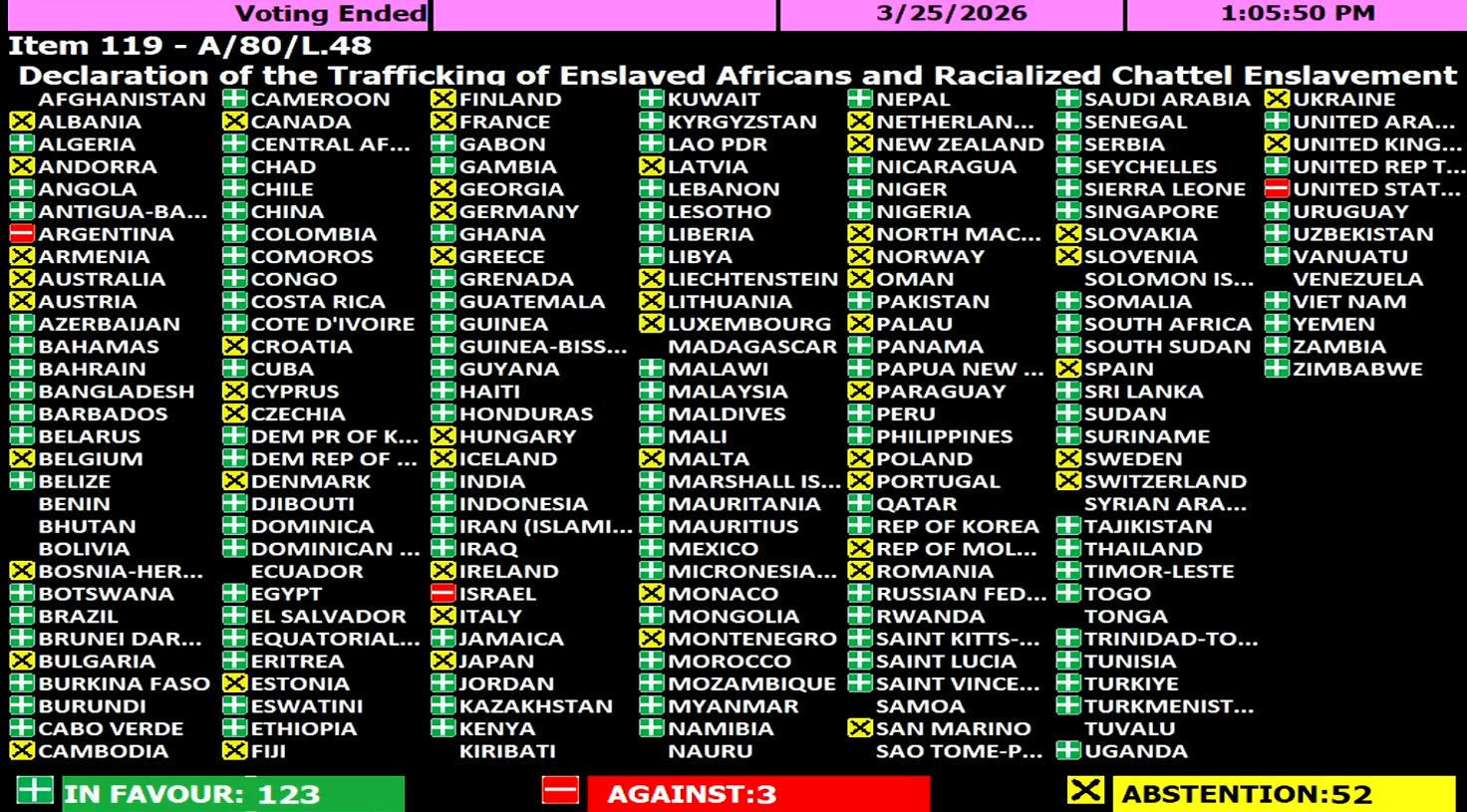
On 25 March 2026, the United Nations General Assembly adopted Resolution 80/250, declaring the trafficking of enslaved Africans and the racialized chattel enslavement of Africans to be “the gravest crime against humanity.” The resolution passed with 123 votes in favour, three against and 52 abstentions. Argentina, Israel and the United States voted against it. The United Kingdom and every member of the European Union abstained.
The resolution extended beyond historical recognition. It identified reparatory justice as a means of addressing historical wrongs and referred to measures including formal apologies, restitution, compensation, institutional reform, guarantees against repetition and the return of cultural objects, archives and human remains without charge. Yet General Assembly resolutions are not legally binding. Recognition and enforcement remain fundamentally different forms of power.
The states that opposed or abstained raised legal and political objections concerning the hierarchy of crimes against humanity, the retroactive application of international law and the implications for reparations. Those arguments reveal the system rather than weaken the case.
It is possible to condemn slavery morally while resisting the institutional consequences of that condemnation. States can support remembrance, education and symbolic recognition while rejecting legal responsibility, financial transfers, restitution and structural redistribution.
The resolution was historically significant. Reuters described it as the furthest the United Nations has gone in recognizing transatlantic slavery as a crime against humanity while explicitly calling for reparations. It establishes an important normative reference point for future diplomacy, scholarship, litigation and political advocacy.
Recognition and power, however, remain different variables.
Recognition determines what the international community is prepared to describe as legitimate or illegitimate. Power determines who possesses the capacity to alter incentives, redistribute resources, enforce obligations and reshape institutions. The resolution secured substantial recognition. It did not secure binding reparations, enforceable transfers, formal apologies from opposing states or a redistribution of global economic authority.
The vote also illustrates why moral clarity alone rarely determines international outcomes. The international community proved capable of recognizing one of history’s greatest crimes while many of the states most capable of financing meaningful repair declined to support the resolution. Moral legitimacy and institutional leverage remain distinct.
Africans and people of African descent have not lacked historical evidence, persuasive arguments or moral clarity. The history is well documented. The violence is indisputable. The inequalities remain visible. What has been missing is leverage.
International institutions amplify voice. They do not eliminate asymmetries of power.
The resistance to reparations persists because those asked to repair the consequences of a historical system continue to exercise considerable influence over the legal, political and financial rules through which responsibility would be established, valued and enforced. Recognition therefore advances further than redistribution.
In my book Systemic Nonsense – the third book in the Lessons series, we get describe systems that appear irrational from the perspective of public welfare while functioning exactly as intended for those whose interests they protect.
Douglass North defined institutions as the rules and constraints that structure human interaction. They shape political and economic incentives and, through those incentives, influence long-run development. Institutions persist not because they are necessarily efficient or just, but because organizations, investments and distributions of power become organized around them.
Path dependence adds a historical dimension. Early institutional choices create infrastructure, skills, expectations and constituencies that make some futures easier and others more costly. Positive feedback reinforces the existing path. Once tea estates, railways, commercial law, labour systems, export relationships and consumer habits have been organized around a commodity, the arrangement can continue long after the political authority that established it has disappeared.
This explains why colonial institutions often survive political independence. Successor states inherit borders, ministries, legal systems, administrative cultures, languages, school curricula, commodity dependencies, transport corridors and professional hierarchies. Many remain because replacing them is expensive, because influential actors benefit from them or because alternatives have not yet been constructed.
Eventually, institutional history disappears behind ordinary behaviour. Tea becomes simply what one drinks. English becomes the language of professional competence. International organizations become where ambitious Africans build careers. Exporting raw commodities becomes what the economy does. Seeking representation within institutions designed elsewhere becomes what international politics is.
A system becomes most powerful when it no longer needs to justify itself.
The analytical task is therefore not simply to identify injustice. It is to identify reproduction. Who benefits? Who bears the cost? Who controls productive assets? Which institutions preserve the arrangement? Which alternatives exist? Which rules make transition expensive? Which organizations would lose influence if the system changed? Which everyday habits continue regenerating demand for the larger structure?
This perspective also changes how agency is understood. Agency is not pretending that individuals can overturn global political economy through ethical consumption. Agency lies in recognizing which decisions exist at each level and coordinating them into structural change. A household redirects demand. An entrepreneur builds a company. A bank finances processing. A university educates engineers. A government invests in infrastructure. Regional markets create scale. Together they form a development system.
Africa’s demographic future makes the institutional question urgent. Earlier UN projections placed Africa at approximately one quarter of the world’s population by 2050. More recent UN projections estimate that the population of sub-Saharan Africa alone will rise by 79 per cent to roughly 2.2 billion by 2054. UNICEF projects that four in ten children in the world will live in Africa by 2050.
The continent’s youth population is projected to exceed 830 million by 2050. Its working-age population is expected to rise from approximately 849 million in 2024 to 1.56 billion in 2050, accounting for an estimated 85 per cent of the global increase in working-age people over that period.
These figures are often presented as an opportunity or a crisis, as though demography produces one automatically. It produces neither. Population is not power by itself. A large population without health, education, productive employment, infrastructure and institutional coordination can increase pressure on fragile systems. A large population with capabilities, capital and functioning organizations can expand production, markets, innovation and strategic influence.
The relevant question is not simply whether one in four people will be African. It is what those people will know how to do, what institutions will employ their capabilities and who will own the systems through which their work creates value.
A child born in 2026 will be 24 in 2050. The population structure of 2050 is therefore not an abstract future cohort. It is already entering homes, clinics and education systems. What the continent becomes by mid-century will depend substantially on the quality and orientation of the education provided now.
Education organized primarily around exit from African economies creates a particular institutional outcome. When the most capable students are trained to become administrators of externally financed development, suppliers of labour to foreign firms or migrants into more productive systems elsewhere, education may improve individual livelihoods while weakening domestic institutional formation.
The World Bank has cited an estimated need for 2.5 million additional engineers in sub-Saharan Africa to address the region’s development challenges. UNESCO similarly identifies severe regional engineering-capacity gaps affecting infrastructure, water, energy and industrial development. The issue is not that engineering is inherently more valuable than law, diplomacy or development practice. It is that material systems must be designed, constructed, operated and repaired. Political arguments cannot by themselves produce electricity, irrigation, manufacturing equipment, transport networks, pharmaceutical plants, data centres or autonomous machines.
Economic emancipation must therefore be understood as productive capability. It includes ownership of assets, but also the organizational knowledge required to use them. It includes access to capital, but also the ability to identify viable projects. It includes natural resources, but also the technical capability to process them. It includes markets, but also firms capable of supplying those markets competitively.
This is the relationship between economic capability and international power. States negotiate differently when they control essential technologies, production networks, financial resources, strategic infrastructure or large integrated markets. Diplomacy is not replaced by production, but diplomacy acquires leverage from it.
Security Council reform and productive capability are therefore complementary rather than competing projects. One concerns institutional representation. The other concerns the material capabilities from which durable representation ultimately derives its influence.
The distinction becomes clearer outside international politics. A young Black woman recently spoke to me about exclusion from the global beauty industry. The exclusion is real. Black women’s needs have frequently been treated as marginal even while their spending, labour and cultural influence generate value for the sector.
Inclusion seeks fair access to an existing system. It asks companies, investors, retailers and institutions to recognize a previously excluded group. Representation matters because exclusion within existing markets imposes real costs and shapes whose needs are reflected in products, investment and decision-making.
Ownership asks a different question. Who controls the company, product architecture, patents, manufacturing relationships, data, distribution channels and capital allocation? A Black woman occupying an executive position within a multinational beauty company may influence a large institution. A Black woman building an enduring beauty company creates a new asset, new organizational capability and potentially a different distribution of value.
The two should not be confused. Inclusion changes who participates in an institution. Ownership changes who determines its purpose, retains its returns and reproduces it across generations.
The distinction extends well beyond the beauty industry. It applies equally to banks, technology firms, universities, manufacturers, media companies and international organizations. Participation changes the composition of a system. Ownership changes the system’s productive capacity and the distribution of authority within it.
This is why economic liberation cannot consist only of being seen by systems owned by others. To be “othered” is to exist in relation to a centre someone else controls. The deeper transformation lies in building centres of production, capital and knowledge from which participation in the wider economy no longer depends exclusively on admission into institutions created elsewhere.
Productive capacity is not limited to physical industry. Knowledge is also infrastructure. The stories we get to tell about ourselves and others: histories, concepts, datasets, technical standards, languages, books, archives and research determine what a society can know about itself and what future systems can know about it.
I have written seven books in approximately four years. I mention this because the process illustrates what I believe artificial intelligence presently does best. I do not delegate my thinking or my storytelling to AI. I read research. I read books. I form arguments. I use the voice feature to speak through ideas in my own language and cadence. I use AI as an editor, researcher, brainstorming partner and intellectual interlocutor. I retrieve the material, examine it, correct it, restructure it and decide what is eventually published.
My first book was written in 2018 using Microsoft Word [I still use this in present day] and submitted to a human editor. Years later, it still contained typographical and grammatical errors. During my summer at Microsoft in 2025, I took the manuscript chapter by chapter into ChatGPT with one instruction: remove only grammatical errors and typographical mistakes. Do not change the ideas, voice or substance. I then reviewed every correction. The technology did not become the author. It reduced the cost of quality control.
This is the most useful relationship I have found between a storyteller and AI. Judgment remains human. The technology reduces the friction between an idea and its finished expression.
That distinction matters because efficiency can easily become intellectual dependency. A person who asks a model to generate an opinion before developing one may receive fluent language without having formed a position. A person who conducts inquiry, supplies evidence, speaks through an argument, challenges the model’s assumptions and edits the result is using computation to extend an existing cognitive process.
AI can accelerate research discovery, transcription, translation, comparison, structural editing and error identification. It can also fabricate facts, flatten cultural specificity, reproduce bias and conceal uncertainty beneath confident prose. The technology therefore increases both the speed of knowledge production and the importance of verification.
The appropriate response is neither rejection nor surrender. It is institutional literacy: understanding what the system does, what data it depends upon, where it is unreliable, what human responsibility remains and how its capabilities can be integrated into rigorous knowledge work.
The most consequential implication of AI may not be that it helps individuals publish faster. It is that machine intelligence is shaped, in part, by the knowledge humans have made digitally available. Large language models are trained on extensive collections of text, including web data, books, articles and other corpora. The composition of those datasets influences which languages, narratives and forms of knowledge the models can represent effectively.
African languages and knowledge systems remain severely underrepresented. A 2025 review examining large, small and specialized language models identified support for only about 42 of Africa’s more than 2,000 languages and found extensive gaps in datasets, scripts, tokenization and evaluation. Separate comparative research across 60 African languages found that prominent models generally performed substantially worse on African languages than on high-resource languages such as English, particularly on generative tasks.
Publishing more material is not, by itself, a solution. Questions of copyright, consent, access, licensing, data extraction and community control remain unresolved and important. African knowledge should not become another raw material exported without governance or compensation.
What remains true is that undocumented knowledge is difficult for both humans and machines to retrieve. Histories that remain oral without preservation, archives that remain inaccessible, research that is never digitized, technical work that is never published and African-language texts that are never developed are all less likely to shape future knowledge systems.
The problem is therefore larger than whether artificial intelligence misunderstands Africa. Many African societies have not yet built sufficient infrastructure through which knowledge can accumulate, be challenged and survive. Academic publishing systems are expensive. Archives are underfunded. Government records are fragmented. Local innovations frequently remain undocumented. Researchers publish through institutions elsewhere. Newspapers disappear. Websites go offline. Languages with millions of speakers possess limited machine-readable text.
Africa therefore needs millions of writers, but “writer” must be understood broadly. It needs historians who open archives, economists who construct datasets, engineers who document designs, scientists who publish findings, entrepreneurs who record institutional knowledge, teachers who develop materials in African languages, farmers who preserve agronomic practice, novelists who capture social worlds and evaluators who document what programmes actually achieve.
Writing is not secondary to building systems. It is one of the mechanisms through which systems learn. Institutions without records repeatedly forget. Countries without accessible evidence repeatedly import explanations of themselves. Civilizations that do not document their choices make it easier for future generations to mistake inheritance for nature.
My seven books cannot carry that burden. They should not. No individual should become the authorized interpreter of an entire continent. The objective is not to create one definitive African narrative but to expand the volume, diversity, contestability and technical quality of African knowledge.
The available tools reduce some of the costs. A person can dictate, transcribe, search, compare sources, identify errors, translate drafts and prepare manuscripts more efficiently than was possible even a decade ago. They do not eliminate inequalities of internet access, time, education, publishing finance or computational infrastructure. They do, however, change the scale at which knowledge can be produced.
The instruction is therefore not to let artificial intelligence think on our behalf. It is to think more deeply, investigate more rigorously, verify more carefully and use every available tool to ensure that rigorous work enters the historical record.
Tea, to me, is now a household-level manifestation of a larger system.
My mother’s habit shaped mine. Our household demand sat inside a national culture of consumption. That culture existed alongside a colonial commodity economy. The commodity economy depended on land, labour, transport, law and international markets. Similar imperial arrangements made tea a source of corporate profit and state revenue elsewhere. Disputes over taxation and sovereignty helped produce the American Revolution. Industrial and military power later determined which states designed the post-war order. That order now contains 193 member states but reserves permanent veto authority for five.
In 2026, the General Assembly was able to declare the enslavement and trafficking of Africans the gravest crime against humanity. It could not compel the states that opposed the resolution to apologize, pay reparations or return assets. The difference between these outcomes is not a failure of language. It is the distance between legitimacy and enforceable power.
The same distance appears in economic life. Malawi can produce tea while retaining limited control over processing and global branding. Africans can staff international organizations without African states possessing equivalent authority over the institutions’ design. Black women can be included in global industries without controlling the capital and productive assets that organize them. African histories can exist without being sufficiently documented to shape global knowledge systems.
These are not separate injustices connected only by rhetoric. They are variations of one institutional problem: participation without proportional control over the systems through which value and authority are allocated.
Ordinary behaviours become deeply embedded systems when repetition is reinforced by infrastructure, law, markets, organizations and power. Societies eventually mistake those systems for natural reality because the originating choices disappear while the routines remain. Tea becomes a Tumbuka habit. Commodity dependence becomes an economy. Institutional employment becomes ambition. Five vetoes become international order.
A small act cannot dismantle this architecture. My hibiscus tea does not do that. It does something analytically prior: it makes one inherited routine visible and allows me to decide, within the narrow space I control, which productive system receives my demand.
The wider work is institutional. It requires firms that retain value, states that develop productive capability, schools that educate builders, financial institutions that fund industry, regional markets that create scale, researchers who preserve evidence and citizens who understand that systems are historical constructions rather than permanent features of nature.
Tea did not cause the world wars. It shows how the world that caused them was built: through ordinary demand joined to organized capital, state revenue, coercive authority and institutions capable of projecting power far beyond the household in which the commodity was consumed.
That is the systemic nonsense. The systems shaping our lives often appear distant, abstract and immovable even while they are continually reproduced through transactions, aspirations and routines occurring close enough to hold in one hand.
If you’d like to go deeper into my journey — from Malawi, through the United Nations and Microsoft to now building my own companies in Detroit, you can find it in my books.



Nthanda Manduwi is a Malawian storyteller, entrepreneur, digital transformation advocate, and community builder driven by the mission to empower Africa’s economic landscape through innovation and technology.