This week, I graduate with my MBA from Michigan State University.
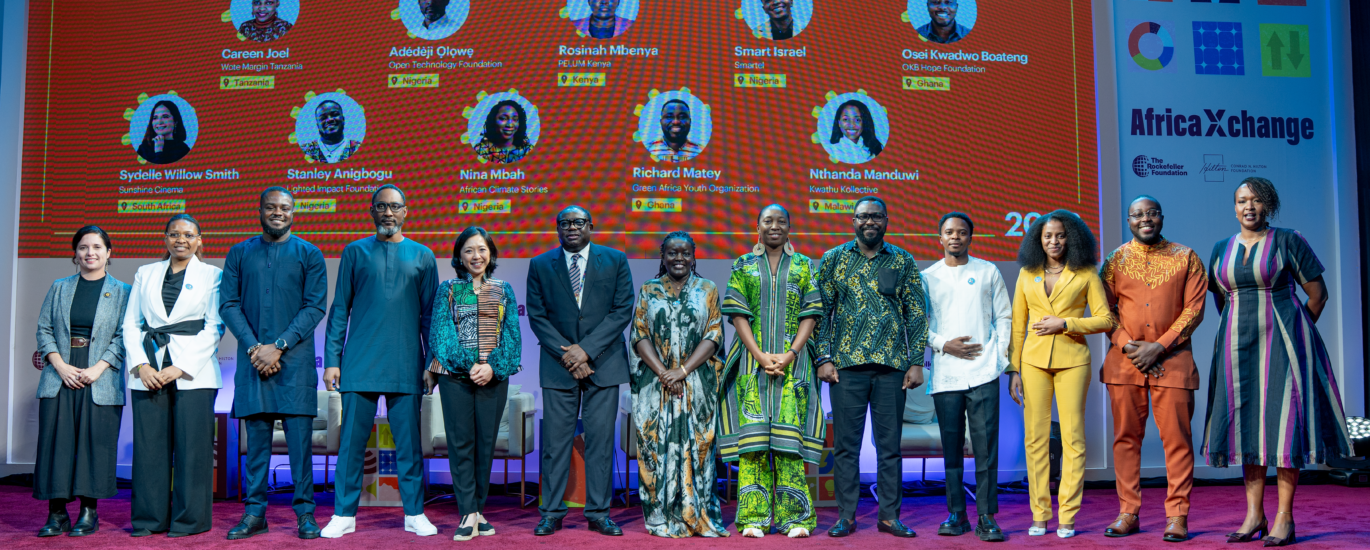
I am marking that moment in Nairobi, where I have been selected as one of ten leaders in the inaugural Africa cohort of the Rockefeller Foundation’s Big Bets Fellowship. The fellowship brings together leaders from Ghana, Kenya, Malawi, Nigeria, South Africa, and Tanzania, selected from more than 2,000 applicants, and is designed to support bold solutions across food security, energy access, climate resilience, healthcare, financial inclusion, migration, and economic opportunity.
For me, this moment is a timestamp. The larger story is the work.
My big bet is that Africa’s next phase of development will depend on our ability to build integrated systems: systems that connect production, infrastructure, data, talent, and decision-making. I am building toward that through the Kwathu Kollective, Kwathu Smart Innovation Farms, and Q2 Systems.
Now that I am opening up my business[es] to the public, I get to share with [a lot of] people about my entrepreneurship journey, as way to get them to understand why I do what I do; and why we do it in the ways that we do.
My work began with storytelling via this blog [byntha.com], and eventually published books.; This work later transitioned to education, and specifically digital skills.
Through Ntha Foundation and what later evolved into Kwathu Kollective, we trained thousands of young Africans across more than twenty countries, through our online learning management system: digitalskillsforafrica.com. We built digital platforms, ran programs, and established an innovation hub in Lilongwe. Across this work, we raised more than $400,000 in partnership with impact-focused institutions, including support connected to the World Bank.
This was meaningful work. This was also hard work to sustain.
The EdTech model had reach, but it did not have a strong enough revenue engine.
That experience, I was to eventually learn, fits a broader pattern. Across Africa, digital education remains a priority, but sustainable transformation depends on more than platforms. The Africa EdTech 2030 Vision emphasizes power, connectivity, educator capacity, financing, partnerships, and data governance as necessary conditions for scalable digital learning systems.
The same was true for the innovation hub. The hub created value, but the coworking model required a level of ecosystem maturity that was not yet present locally. AfriLabs’ ecosystem reporting notes that funders and donors continue to play a major role in guaranteeing the financial sustainability of African hubs, with many still depending on external funding for day-to-day operations.
That was the lesson. The issue was not effort. The issue was system fit.
After working with the United Nations in New York as an Evaluation Analyst for two years, I returned to Malawi. As soon as I arrived, I opened the hub and invited people to come and talk. Development partners, policy-makers, public officials, founders, students, and young builders came through. Again and again, the conversation returned to agriculture and food systems.
That signal mattered because it reflected the structure of the economy. Agriculture remains one of the largest employment engines in Sub-Saharan Africa. The World Bank tracks agriculture as a major share of employment across the region, and a 2025 World Bank analysis notes that 70 to 80 percent of rural employment in Sub-Saharan Africa remains tied to agriculture.
At the same time, agriculture remains constrained by productivity, infrastructure, logistics, and access to technology. This is where my thinking shifted.
I had spent years building digital skills. I had built platforms. I had worked on systems of training and coordination. The question became sharper:
what does it mean to build meaningful technology for farmers, not as a few disconnected apps, but as part of a production system?
During my MBA, I spent time with the Burgess Institute at Michigan State University, learning how to structure and communicate business ideas while also coaching other young founders. I also spent a summer with Microsoft Xbox, where I worked as a Business Development Manager [read Analyst]; assessing game performance and began thinking more seriously about simulation.
All these experiences were pivotal in my thinking.
Games are not just entertainment products. They are modeled environments with rules, performance constraints, feedback loops, and behavior under conditions. That gave me a new way to think about agriculture.
The first idea was simulation for farming. I had seen how the game Farming Simulator 2025 was performing revenue-wise, and I was interested.
As the simulation work became more immersive, the system expanded. If we could model farming environments, we could test decisions before deploying them physically. If we could simulate machines and field conditions, we could improve autonomous systems before placing them in real environments.
Q2 Systems emerged from that logic.
Through Q2 Systems, I am building a cyber-physical infrastructure ecosystem that connects simulation, autonomous systems, and real-world deployment. Through the Kwathu Smart Innovation Farms, I am grounding that work in agriculture, training, and production.
The official description of my Big Bet reflects this direction:
enabling the next generation of farmers and innovators by combining autonomous farming technologies, AI-powered simulation tools, and hands-on training to increase productivity, strengthen food security, and build climate-resilient production systems.
Deep technology does not mature on short timelines.
Autonomous systems, biotechnology, advanced manufacturing, semiconductors, and energy infrastructure all require years of research, testing, iteration, and capital before results are visible. Even in better-funded markets, these systems take time.
That matters for Africa.
If we want African entrepreneurs to build in deep technology, robotics, agricultural infrastructure, simulation, and autonomous systems, we must create capital structures that match the nature of the work. Short funding cycles and early pressure for quick returns are poorly suited to infrastructure-level innovation.
The issue is not whether Africa has talent. The issue is whether we are willing to support the kind of work that takes years before it becomes obvious.
This is why the Rockefeller Big Bets Fellowship matters to me. The fellowship is explicitly focused on leaders creating the systems, policies, and innovations that can support a prosperous and sustainable future.
That language matters because systems require patience. They require belief before the market fully understands what is being built.
A major part of my work now is talent.
I know the kinds of engineers, operators, and builders this work requires. We need people who can move across software and physical environments. We need builders who can understand simulation, robotics, agriculture, infrastructure, and deployment as connected layers.
I have spent the past half decade training and working with engineers [Computer Science and Applied Sciences]. I understand a lot bit about how they think, and how they work.
This is one of the reasons AfricaXchange has mattered for me. I am here not only as a fellow, but also as a founder looking for partners, funders, and [African] builders who can help bring this system into operation.
We cannot build world-class systems without world-class teams.
My big bet is that Africa will not solve its most urgent production challenges through isolated products alone.
We need systems that connect farms, data, machines, training, financing, and markets. We need infrastructure that allows decisions to be tested, improved, and deployed. We need to build environments where young people do not only learn digital skills, but apply those skills to production systems that matter.
This is the work I am building through Kwathu Smart Innovation Farms and Q2 Systems.
It began with education. It moved through ecosystem building. It now sits at the intersection of agriculture, simulation, autonomy, and infrastructure.
The next phase is execution.
I will be working directly with farmers, industry partners, engineers, funders, and institutions to refine the unit economics, build the systems, and test deployment pathways. This will require venture capital, philanthropic capital, technical partnerships, and long-term institutional support.
By the time you finish reading this, I will likely have just graduated from my MBA. I am deeply grateful that this transition begins in Nairobi, with the Rockefeller Foundation, among people thinking seriously about systems, capital, and execution.
The work ahead is clear.
We build.
If you’d like to go deeper into my journey — from Malawi, through the United Nations to Microsoft, you can find it in my books.
P.S. for 2026, you can get any of my books via Kindle for only $2.99.
This offer is valid till the end of the year.
Links to purchase are as below:



Nthanda Manduwi is a Malawian storyteller, entrepreneur, digital transformation advocate, and community builder driven by the mission to empower Africa’s economic landscape through innovation and technology.