
On the 4th of September 2026, the United Nations General Assembly adopted resolution A/80/L.104, an African-led initiative encouraging the wider use of map projections that represent the relative sizes of continents more accurately.
The resolution, championed by Togo with the support of the African Union, received 164 votes in favour, one against and six abstentions. This resolution does not abolish the Mercator projection. Rather, it encourages governments, educational institutions, international organisations and technology companies to use equal-area projections, including Equal Earth, where comparative size matters, and to teach the limitations inherent in projecting a spherical planet onto a flat surface.
The campaign addresses a legitimate problem of representation.

Delve into Business and International Development with Nthanda Manduwi
Systems Don’t Have to Be Broken to Produce Bad Outcomes
I contemplated not publishing an episode this week [I explain why in the podcast], and then ended up recording my longest episode yet.
And to make up for publishing a little late the past two weeks, I am publishing this a day early. You’re welcome, or I am sorry?
I woke up to a message from a friend sharing a video of President William Ruto demanding Veto power for African nations at the 80th United Nations General Assembly [I happened to be in attendance], and I jumped out of bed and got to writing about my favorite beverage: tea! I also got to pen about slave trade, and colonization, and war [I know, what does any of this have to do with Hibiscus tea??!]
This week’s episode explores one of the central ideas behind the third book in the Lessons Book series – Systemic Nonsense: what if many of the frustrations we experience in institutions are not accidents or failures, but predictable outcomes of how those systems were designed?
It often feels like bureaucracy feels so resistant to change, and that reforms often produce more process than progress. It also seems that good intentions so rarely translate into meaningful outcomes. If you’ve pondered on these thoughts before, then these conversations are for you.
This Week’s Book
📖 Systemic Nonsense [Book 3]
This week only, from 27–31 July, the Kindle edition of Systemic Nonsense is available free as part of its Founders Edition launch.
Systemic Nonsense explores several ideas on international development in much greater depth. It asks a simple question:
What if the system isn’t failing? What if it’s doing exactly what it was designed to do?
Whether you listen, read, or dive into the book, I hope it leaves you asking better questions about the systems we inherit—and the ones we choose to build next.
How to Read
To receive your free Kindle copy:
* Click the Amazon link below.
* Select the Kindle edition while the promotion is active.
* Add it to your Kindle library.
You do not need a Kindle device. The free Kindle app works on iPhone, Android, tablets, Macs, and PCs, allowing you to build your digital library wherever you read.
Helpful Links
📚 Read this week’s book for free [search on Amazon or in Kindle for the book that is free for the week, and feel free to purchase the others]:http://amazon.com/dp/B0FQNJ61SB
📰 Subscribe to The Lessons Conversation:
Africa paperback pre-orders:https://forms.office.com/r/RMRMKTNd1M
Enjoyed listening to the Lessons Conversation? This post is public so feel free to share it.
This is a public episode. If you would like to discuss this with other subscribers or get access to bonus episodes, visit podcast.lessonsconversation.com
![Book 3: Systemic Nonsense [lessonsbooks.com]](https://byntha.com/wp-content/uploads/2026/07/podcast-episode-image-5a3bbb435029c89d668c5fa2682893ef-768x768.jpg)

The Mercator projection was developed in the sixteenth century for navigation, where preserving angles and direction was useful. Its geometry substantially enlarges land masses as one moves toward the poles. Africa, which covers roughly 30 million square kilometres, consequently occupies less visual space relative to Europe, North America and Greenland than it does on the globe. The political resonance of correcting that distortion is unsurprising.
The 1569 map by Gerardus Mercator (1512-1594) has remained the global standard. Photograph: Stock Montage/Getty Images
The African Union has explicitly situated the campaign within a wider project of African agency, continental integration and representation in global affairs.
Togo’s government is planning an event in Lomé, the Togolese capital, with Unesco, the African Union and tech brands such as Google Maps during the
The debate coincided with the circulation of another map that poses a more difficult question.
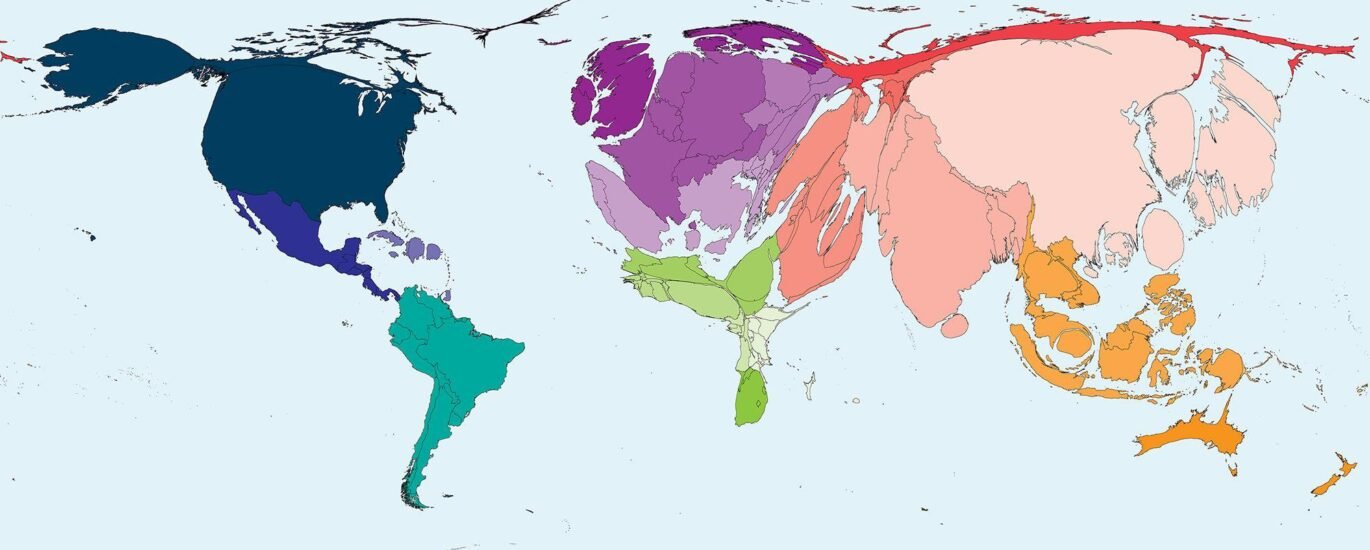
Worldmapper produces cartograms in which countries and territories are resized according to variables other than physical area. Its 2018 GDP cartogram redraws the world according to estimated purchasing-power-adjusted output. North America expands dramatically. Europe remains large. China and other parts of Asia occupy a considerable share of the map. Africa contracts. A second cartogram attempts to reconstruct the distribution of world GDP in 1500, producing a markedly different geography of economic weight. Worldmapper derives the historical map from Angus Maddison’s estimates and supplements gaps from regional data; the 2018 map uses IMF data.
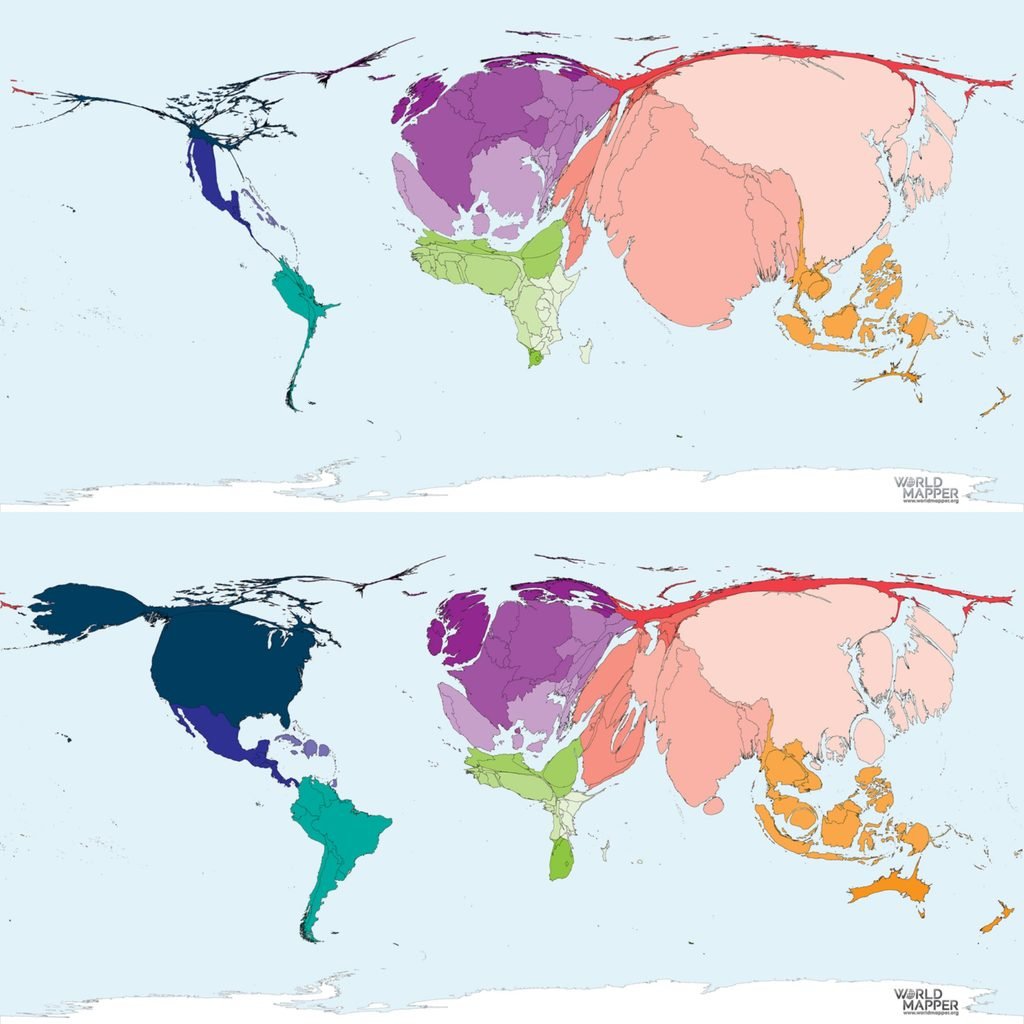
The juxtaposition is provocative, but it requires care. The two maps are not straightforward photographs of economic reality separated by five centuries. They are representations produced from very different kinds of evidence. Contemporary GDP, notwithstanding its well-known conceptual limitations, is generated from national accounting systems built to measure modern economies. GDP in 1500 is an ex-post reconstruction of production and population in political formations that did not correspond neatly to present-day states. As one observer noted rather neatly in response to the image, Ming tax collectors would have been surprised to discover themselves retrospectively compared with the Republic of Venice under a common international accounting framework.
The precise dimensions of each territory on the historical cartogram are less important than the broader question it raises. The distribution of global economic activity changed profoundly between the early modern period and the twenty-first century. Western Europe and, later, North America accumulated extraordinary productive and financial capacity. East Asia, whose economic weight had been substantial before Western industrialisation, experienced decline relative to the West and subsequently a major recovery. Africa entered the modern global economy through a series of commercial, demographic and political transformations that profoundly altered its position within it.
The question is therefore larger than whether Africa once occupied more space on one reconstructed GDP map. It is how a continent of Africa’s physical scale, resource endowment and growing population came to account for such a modest share of global productive output, and what would be required to change that position.
That is the economic map worth redrawing.
Any serious answer has to begin before colonial rule.
One of the important contributions of Howard W. French’s Born in Blackness is his challenge to the conventional chronology through which the emergence of the modern world is often narrated. Africa frequently appears in those accounts as a peripheral theatre encountered during European expansion. French instead traces how European commercial interest in sub-Saharan Africa, particularly in West African gold, preceded and materially influenced some of the better-known movements of Iberian expansion. He notes that historians have often treated early European engagement with Africa as an “aside in the formation of the West”, despite evidence that access to African resources occupied a substantial place in Portuguese strategy.
The geography of medieval European cartography itself offers evidence of that interest. The Catalan Atlas of 1375 famously depicted Mansa Musa, ruler of Mali, holding a golden orb. The representation tells us less about precise African geography than about European understandings of economic power. Mali was associated with substantial gold production and with trans-Saharan commercial networks linking West Africa to North Africa and the Mediterranean. French describes the empire at its height as controlling important parts of the Senegal, Gambia and Niger river systems while drawing wealth from multiple gold-producing regions.
Portuguese expansion down the Atlantic coast in the fifteenth century was closely connected to efforts to access those sources of wealth more directly. The establishment of Elmina on the Gold Coast was commercially significant enough to become entangled in the strategic competition between Portugal and Castile. French recounts contemporary claims that revenues from African gold helped finance Portuguese military ambitions in Iberia, while naval conflict over access to the West African trade became part of the wider struggle between the two crowns.
None of this should be turned into a romantic account of a uniformly prosperous precolonial Africa. The continent contained considerable political, economic and ecological variation. Wealth was unevenly distributed. States rose and collapsed. Warfare, hierarchy and slavery existed within African societies. Ghana, Mali and Songhai participated in slave trading alongside other forms of commerce. The point is narrower and more important: Africa did not enter the global economy as an empty economic space. Political institutions existed. Long-distance trade existed. African rulers exercised authority over commercial access. French describes coastal societies gathering information on European cargoes and prices, using competition among foreign traders to strengthen their own bargaining position.
Africa’s current position in the world economy is therefore historically contingent. It should not be read backwards as evidence that the continent was always economically marginal, nor that institutional weakness is a primordial African condition.
The modern divergence has a history.
The transatlantic slave trade changed that history through several mechanisms at once. The most obvious was demographic. Millions of people were forcibly removed from African societies over several centuries, with additional mortality arising from capture, forced marches, conflict and the Middle Passage. The consequences were not uniform across the continent, but heavily affected regions experienced population losses and political disruption at the same time that other parts of the world were undergoing substantial demographic and commercial expansion.
Population matters economically in ways that extend well beyond the number of available workers. Larger and denser populations can support deeper markets, more specialised production, more complex fiscal systems and more extensive state institutions. They provide consumers as well as labour. They create the conditions under which transport, irrigation and other infrastructure become economically viable. Howard French’s work draws attention to research linking the slave trade not only to direct population losses but to longer-term institutional consequences, including the erosion of interpersonal and political trust in areas that experienced particularly intensive slave raiding.
The second mechanism was the relocation of productive labour. Africans removed from the continent became central to plantation production in the Americas, particularly in sugar and cotton. The historical debate over the precise contribution of slave-derived profits to the financing of the British Industrial Revolution remains contested. Eric Williams’s original thesis in Capitalism and Slavery produced decades of scholarship both supporting and challenging the scale of that direct financial relationship.
https://glc.yale.edu/sites/default/files/pdf/capatlism_and_slavery.pdf
French’s broader argument is harder to reduce to a dispute over whether a given Lancashire mill was financed with plantation profits. African labour was fundamental to the economic viability and expansion of the Atlantic system itself. Plantation commodities altered European consumption, expanded trade, deepened financial activity and contributed to the formation of an Atlantic economy linking Europe, Africa and the Americas.
John Cassidy’s Capitalism and Its Critics places these debates within the longer intellectual history of capitalism. From Williams through post-war dependency theory, a recurring question was whether the development of the industrial “core” and the underdevelopment of the “periphery” could be understood as separate processes. Andre Gunder Frank famously rejected that separation. He argued that underdevelopment could itself be produced through incorporation into an unequal international economic structure rather than simply representing a prior condition awaiting development.
Samir Amin subsequently located this hierarchy partly in control over strategic capabilities, including finance, technology and communications. His analysis was more radical than much contemporary development economics, and several of his political judgements proved deeply problematic. Yet the underlying question remains relevant: a country’s participation in international markets does not tell us how much productive capability, technological learning or bargaining power that participation generates domestically.
That distinction is particularly important for resource-rich African economies. The extraction and export of a commodity can add substantially to GDP and government revenue while producing relatively little structural transformation. The relevant economic questions concern the wider production system: the location of processing, the ownership of machinery, the development of local suppliers, the acquisition of technical skills, the reinvestment of profits, the creation of domestic firms and the fiscal arrangements through which the public captures part of the rent.
Resource ownership and productive capability are not equivalent.
This is one reason Africa’s contemporary mineral endowment, impressive though it is, should not automatically be read as evidence of future economic power. Natural resources create an opportunity to build capability. Whether they do so depends on institutions, infrastructure, bargaining power, investment and industrial policy.
Dependency theory was strongest when explaining why international economic relationships could reproduce asymmetry. Its more deterministic variants encountered a difficulty when economies in East Asia began to transform their position within the international system.
Japan industrialised earlier. South Korea and Taiwan subsequently moved from low-income economies into sophisticated manufacturing powers. China later undertook a transformation of unprecedented scale, integrating deeply into global trade while developing industrial capabilities across an increasingly broad range of sectors.
Cassidy notes that these experiences complicated Amin’s framework. The East Asian economies did not follow the policy prescriptions associated with laissez-faire liberalism, yet neither did they withdraw from global markets. Their industrial strategies depended heavily on exports, foreign technology and participation in international commerce.
The more useful development question consequently became less ideological: under what conditions can a relatively poor economy enter the global system while upgrading its own productive capabilities?
Joe Studwell’s How Asia Works offers one influential answer. His account emphasises the interaction of three policy areas: agricultural productivity, manufacturing development and financial systems oriented toward productive investment. The specific institutional arrangements varied across Japan, South Korea, Taiwan and, later, China, but Studwell argues that these states created mechanisms that pushed capital and firms toward activities capable of generating technological learning and productivity growth.
Manufacturing was central to this process because it offered unusually strong opportunities for learning, scale economies and productivity improvement. Governments supported firms through credit, protection, procurement and other instruments. The more successful cases also developed mechanisms for disciplining that support. Firms protected in domestic markets were required to export, exposing them to international standards of price, quality and delivery. Export performance provided governments and financial institutions with information about which firms were actually becoming competitive.
Studwell’s distinction between “picking winners” and “weeding out losers” is useful here. Industrial policy inevitably involves uncertainty. Governments do not possess perfect information about which firm or technology will succeed. A more realistic institutional requirement is therefore the capacity to withdraw support from firms that repeatedly fail to meet clearly defined performance conditions.
This is also where comparisons within Asia become analytically useful. Studwell contrasts the evolution of South Korea and Malaysia. Both inherited economic structures in which commercially connected elites played important roles, but South Korea increasingly tied state support to manufacturing and export performance. Malaysia pursued industrialisation as well, including through state enterprises and foreign investment, but imposed less consistent performance discipline on domestic capital. Studwell attributes part of the subsequent divergence in indigenous industrial capability to this difference.
The lesson is not that African states should reproduce Korean policy in institutional environments that differ profoundly from 1960s East Asia. It is that public support to firms is not development policy by virtue of being public support. The developmental content lies in whether the policy generates learning, productivity, exports, technological capability and firms capable of surviving without permanent protection.
This distinction is important because contemporary Africa is already experiencing a revival of industrial policy. The World Bank’s 2026 Africa Economic Update is devoted explicitly to making industrial policy work on the continent. Its analysis emphasises the need for implementation capacity, performance monitoring, export orientation and the ability to withdraw support when firms fail to meet agreed benchmarks. The conversation is therefore no longer about whether industrial policy exists. It exists in African countries and elsewhere. The relevant question is institutional quality.
Industrialisation is often discussed as though its central feature were the construction of factories. The more consequential issue is capital allocation.
Every economy allocates capital. Market-based systems do not remove that allocation function; they distribute it among banks, firms, investors, households, governments and financial markets. Each actor responds to a particular set of incentives. Those incentives do not necessarily lead capital toward activities with the highest long-term social return.
A commercial bank can rationally prefer government securities, real estate or consumer credit to a manufacturer that requires long-maturity financing and may spend years acquiring new capabilities. An investor can rationally prefer the immediate cash flow generated by raw-mineral exports to the uncertainty of downstream processing. A politician facing a short electoral horizon can rationally prefer visible projects whose benefits appear quickly over investments in technical institutions, transmission networks or maintenance systems whose economic returns unfold over decades.
Development therefore involves institutions capable of lengthening the time horizon over which some investment decisions are made.
Studwell shows how East Asian states used banking systems as instruments of industrial policy during their earlier development phases. Credit was often directed toward priority sectors at below-market rates, while firms were required to demonstrate production and export performance. Taiwan combined export credit with public research institutions that licensed foreign technology and supported domestic firms entering electronics, petrochemicals, machinery and other sectors. Across the region, finance, industrial policy and technological upgrading were treated as connected systems rather than isolated policy portfolios.
This has direct implications for African fiscal policy.
Sub-Saharan African governments are attempting structural transformation under considerably tighter financing conditions than many earlier industrialisers faced. Public debt has risen, concessional resources have become scarcer, and interest costs absorb growing shares of government revenue. The World Bank reports that the ratio of external public debt service to revenue in the region doubled from approximately 9 per cent in 2017 to 18 per cent in 2025. Public capital investment remains roughly 20 per cent below its 2014 level.
Under these conditions, industrial policy cannot simply mean larger public expenditure.
It requires greater selectivity in the use of scarce fiscal space.
The relevant question is which public investments expand future productive and fiscal capacity. A road that reduces the cost of moving agricultural output to processors can generate a different economic return from a road selected primarily for political visibility. A transmission line that unlocks industrial production can expand the tax base and foreign-exchange earnings. A standards laboratory can allow domestic producers to reach export markets. A public guarantee can make a productive private investment financeable without requiring the state to fund the entire project.
The fiscal constraint therefore strengthens the case for disciplined industrial policy rather than weakening it. Governments cannot afford indiscriminate intervention precisely because they do not possess unlimited capital.
In A New Normal, I described production as the material basis of a more ambitious social contract. Public services, redistribution and social protection ultimately depend on an economy capable of generating sufficient surplus. A narrow tax base built on informality, donor-financed consumption and low-productivity activity limits the state regardless of the generosity of its intentions.
The sequence matters. Stronger productive systems create formal firms, wages, exports and profits. Those, in turn, create a broader domestic revenue base. Fiscal capacity and productive capacity can reinforce each other.
Where that sequence fails, the state repeatedly finances its obligations through debt, taxation of a narrow formal sector or external transfers.
The significance of production extends beyond output.
Patrick McGee’s Apple in China demonstrates this through the evolution of the Chinese electronics ecosystem. Apple entered China because Chinese suppliers could increasingly deliver the scale, cost and production flexibility the company required. But the relationship did more than transfer orders. Apple engineers worked closely with suppliers to solve technical problems, refine production systems, improve quality and deploy increasingly sophisticated machinery.
The knowledge generated through those relationships did not remain perfectly confined within Apple. Engineers moved between firms. Suppliers developed new capabilities. Tooling and component companies expanded. Firms that had acquired expertise while supplying foreign multinationals began serving Chinese technology companies. McGee traces links between the capabilities accumulated around Apple production and the wider supplier ecosystems that later supported companies including Huawei, Xiaomi, Oppo and Vivo.
China’s contemporary manufacturing advantage is therefore poorly explained by wages alone. McGee describes an ecosystem in which relatively experienced labour operates alongside high levels of automation and dense networks of specialised suppliers. One formulation in the book captures the transition succinctly: the Chinese worker increasingly “comes with a robot.”
The deeper economic point is that production creates cumulative capability.
A factory produces goods, but it also produces engineers who have solved production problems, managers who understand complex supply chains, banks that learn how to finance industrial firms, regulators familiar with technical standards, local companies able to supply components, and workers whose knowledge can migrate across firms. Once these capabilities exist, subsequent investment enters a very different economy from the one that received the first factory.
This matters for current discussions of Africa’s participation in the Fourth Industrial Revolution.
It is possible for African firms to build valuable businesses at the application layer of artificial intelligence without manufacturing advanced semiconductors. It is possible for African countries to develop globally competitive services. Industrial policy should not become an exercise in forcing every economy through the exact sectoral sequence followed by Britain, the United States, Japan or China.
But services and digital production are not immaterial. Data centres require electricity. AI systems require compute. Robotics requires motors, sensors, batteries, control systems and engineering capacity. Digital services depend on telecommunications infrastructure, devices, payments, cybersecurity and skilled workers. Advanced agriculture requires irrigation, logistics, storage, processing and energy.
The technological frontier changes the composition of production. It does not abolish the material systems on which production depends.
This is the sense in which A New Normal argues for a production-first doctrine rather than a nostalgic return to twentieth-century industrialisation. The relevant productive economy now includes advanced agriculture, digital services, creative exports, distributed energy, automation and cyber-physical systems alongside manufacturing. The common characteristic is the creation and retention of capability rather than the passive circulation of value generated elsewhere.
The question, then, is why structural transformation has proceeded so slowly across much of Africa.
There is no single answer. Any explanation that relies exclusively on either colonial legacy or post-independence governance is analytically inadequate.
The institutional inheritance at independence was difficult. Joe Studwell’s How Africa Works notes the speed with which colonial powers assembled territorial states and then withdrew. European rule had consolidated thousands of political communities into a much smaller number of colonial territories. In many countries, genuinely national electoral politics existed for only a short period before independence. These states entered sovereignty while confronting weak political cohesion, limited administrative capacity, low levels of education and infrastructure designed principally around colonial economic priorities. They then became theatres of Cold War competition.
External powers materially worsened those conditions in a number of states. French’s A Continent for the Taking documents the extent to which Western governments supported African rulers according to strategic interests rather than developmental or democratic performance. Mobutu’s Zaire provides perhaps the most familiar example, but the broader pattern extended across several Cold War relationships.
At the same time, African governments exercised agency. Policy choices varied, and their consequences varied.
Some states built effective planning institutions. Some developed export sectors. Some preserved macroeconomic stability while failing to diversify production. Others pursued poorly disciplined state industrialisation, accumulated debt or allowed state enterprises to become vehicles for patronage. Import-substitution strategies often protected domestic production without imposing the export and technological discipline seen in the more successful East Asian cases.
Resource wealth frequently magnified these difficulties. The availability of mineral or petroleum rents reduced the immediate pressure to build a broad productive tax base. French’s reporting from Nigeria illustrates the disjunction starkly. Decades after the discovery of oil at Oloibiri, enormous petroleum revenues had flowed through the Nigerian economy while communities in producing regions remained poor and environmentally degraded.
There were also counterexamples. Botswana built relatively capable institutions and managed mineral revenues more prudently than many resource-rich peers. Mauritius pursued export-oriented manufacturing and diversification. Ethiopia and Rwanda later experimented with more interventionist industrial strategies. None constitutes a simple model for the continent, and each has significant political and economic limitations.
The comparative evidence is nevertheless useful because it establishes that African economic performance has never been uniform.
History structured the field of choices. It did not eliminate choice.
That distinction is important for contemporary debate. A serious account of African development has to hold the effects of slavery, colonial rule, external intervention and unequal international economic structures alongside the decisions made by African governments, firms and elites after independence.
Responsibility is distributed through history.
Agency must be distributed through the future.
Africa’s current industrial position demonstrates the scale of the challenge.
The African Development Bank estimates that manufacturing value added increased from US$285 billion in 2020 to approximately US$351 billion in 2025. Manufacturing represented 10.8 per cent of African GDP in 2025, compared with a global average of 16.5 per cent. The continent generated roughly 2 per cent of global manufacturing output and 1.4 per cent of manufacturing exports. Perhaps most tellingly, manufacturing value added per capita remained below its 2014 peak despite the increase in aggregate output.
These data require some qualification. Manufacturing is not the only route to productivity growth, and the twenty-first-century global economy includes services capable of generating substantial export earnings and technological sophistication. The appropriate sectoral mix will differ across countries.
The importance of manufacturing lies less in an ideological preference for factories than in what it can do when embedded in wider productive systems: absorb labour, generate exports, deepen technological learning, create supplier networks and raise productivity.
Studwell’s recent How Africa Works is cautiously optimistic on this point. He argues that the demographic, urban and market conditions for African industrialisation are becoming more favourable. Labour costs in parts of Asia have risen, African cities have grown substantially, and several countries are developing larger domestic and regional markets. Yet he repeatedly returns to the difference between attracting isolated assembly operations and building industrial ecosystems.
Ghana’s automotive strategy offers an example. Global manufacturers have established assembly operations, but Studwell questions whether those plants will generate deep industrial capability without a substantial domestic supplier base and a clear strategy for increasing local content. Assembly can be a first stage of learning. It can also remain indefinitely shallow.
The policy objective is therefore not simply to increase the number of factories.
It is to increase the depth of productive capability.
This industrial challenge now coincides with a significant change in the international development environment.
Net official development assistance from OECD Development Assistance Committee members declined by roughly 23 per cent in 2025, the largest annual contraction on record. The OECD projects a further decline of 6.9 per cent in 2026. Bilateral ODA to sub-Saharan Africa fell by 26.3 per cent in 2025 and is projected to decline by a further 11.6 per cent in 2026, potentially returning support to levels last seen in the early 2000s.
This retrenchment is not a theoretical opportunity to celebrate.
Aid has financed vaccination, disease control, humanitarian relief, education, institutional reform and infrastructure across the continent. Abrupt reductions impose real welfare costs, particularly in aid-dependent low-income and fragile states. The IMF describes the current shock as unusually large in speed, scale and uncertainty and notes that the countries most affected often possess the least fiscal space to compensate.
Studwell makes a similarly important historical point. Foreign assistance was present in several celebrated development successes. South Korea and Taiwan received very large volumes of U.S. assistance during formative stages of their development. China borrowed from the World Bank and drew on external technical expertise during its reform process.
External finance is therefore not inherently inconsistent with national development.
The institutional question is who sets the development strategy.
Countries that used external resources successfully tended to integrate them into domestic programmes of transformation rather than allowing the availability of external programmes to define the development agenda. The distinction is subtle but consequential. Technical assistance can strengthen domestic capability or substitute for it. Project finance can build institutions that survive the project or construct parallel systems that disappear when funding ends.
A useful test of international development is therefore what remains after the intervention.
Does domestic capability increase?
Does the state collect more revenue?
Do local firms learn?
Do engineers acquire expertise?
Does infrastructure persist?
Does a ministry become more capable of executing the next programme without the same external architecture?
Where those effects occur, external cooperation can accelerate structural transformation. Where they do not, a country may become highly proficient at implementing projects without substantially changing the economy that produces the need for them.
The contraction in aid consequently creates an urgent adjustment problem, but it also exposes the fragility of development systems whose recurrent functions became dependent on discretionary political decisions made in donor capitals.
The appropriate response is neither anti-aid romanticism nor an attempt to restore the old settlement unchanged.
It is the gradual construction of greater domestic productive and fiscal capacity.
Time matters because Africa’s population structure is changing rapidly.
The United Nations projects that the population of sub-Saharan Africa will rise by approximately 79 per cent between 2024 and 2054, reaching about 2.2 billion people. By the end of the century, the region could contain approximately 3.3 billion people under the UN’s central projection.
The World Bank estimates that more than 620 million additional people will enter Africa’s labour force by 2050.
These figures are often presented under the language of a demographic dividend. The dividend is conditional.
A young population becomes economically advantageous when the economy can productively employ it. Without sufficient job creation and productivity growth, the same demographic structure places pressure on schools, housing, transport, food systems, public finances and labour markets.
This makes industrial policy fundamentally a labour-absorption question.
Where will hundreds of millions of additional workers become productive?
Some will enter manufacturing.
Many will remain in agriculture, which increases the importance of agricultural productivity and processing.
Others will work in construction, logistics, healthcare, tourism, digital services, creative sectors, energy and a wide range of locally traded services.
The strategic objective is not to fit all African economies into one sectoral model. It is to shift labour progressively from low-productivity activity into increasingly productive firms and systems.
That shift requires firms capable of growing beyond subsistence scale.
The World Bank’s recent work on employment in Africa reaches a related conclusion: the region’s current growth model is producing too little wage employment, and medium-sized and large firms are particularly important for productivity and job creation.
This is where the language of entrepreneurship can obscure as much as it reveals.
High rates of self-employment often coexist with weak formal labour markets. Entrepreneurship may represent opportunity, but it may equally represent the absence of salaried alternatives. The developmental objective cannot simply be to maximise the number of people running businesses.
It must include building firms that survive, increase productivity, accumulate institutional knowledge, employ others, export and generate tax revenue.
Productive transformation eventually becomes a question of physical systems.
In A New Normal, I acknowledge energy and infrastructure as the material grammar of development because almost every productive ambition eventually meets these constraints. Manufacturing requires electricity and transport. Agro-processing requires power, storage and logistics. Digital services require reliable energy and connectivity. Mining and industrial processing require large-scale generation and transport systems. Healthcare, research and education depend on the same infrastructure even when they are not themselves traded sectors.
Energy is particularly important because unreliability functions as an economy-wide tax. Firms purchase generators, fuel and batteries; production is interrupted; capital equipment sits idle; small enterprises face costs that larger firms can spread across much greater output.
The result is not simply inconvenience.
The viable structure of the economy adjusts downward to what the power system can support.
Fiscal constraints therefore make infrastructure prioritisation more important. African governments cannot build every desirable asset simultaneously. Industrial strategy requires identifying the infrastructure whose absence is binding on productive sectors and sequencing investment accordingly.
The World Bank’s 2026 Africa Economic Update makes a related argument: Africa’s growth problem is structural, reflecting low investment, weak productivity and insufficient job creation, while debt service and declining external finance are constraining governments’ ability to fund foundational infrastructure.
The policy implication is not austerity in productive investment.
It is greater discipline over which investments are treated as productive.
Africa’s physical size also creates a paradox.
The true-size map shows an enormous continent. For firms, however, Africa does not yet function as a correspondingly large economic space.
National borders fragment markets. Firms navigate different currencies, customs systems, product standards, regulatory regimes, payment networks and tax systems. Transport infrastructure frequently remains oriented toward national ports rather than regional production networks.
A manufacturer operating in a country of 20 million people may therefore confront a domestic demand constraint even though hundreds of millions of potential consumers live within the wider region.
This is where the African Continental Free Trade Area becomes central to industrial policy rather than merely trade policy.
The economic significance of regional integration lies in scale. Larger markets change the economics of investment. They allow fixed costs in machinery, certification, research and logistics to be spread across more consumers. They make specialised suppliers viable. They can justify larger power projects and regional transport corridors.
The World Bank’s August 2026 report on African integration makes this shift explicit, arguing that the next gains from integration will require moving from trade connections toward regional production hubs and reducing regulatory and infrastructure frictions across borders.
Financial integration matters as well.
In A New Normal, I argue that trade integration remains incomplete when value cannot move as efficiently as goods. Fragmented payments, capital markets and standards constrain firms even where tariffs have fallen.
Continental integration therefore has to become physical and institutional.
Electricity must cross borders.
Payments must settle.
Standards must be mutually recognised.
Trucks must move.
Capital must find productive opportunities across national boundaries.
A continental market exists only to the extent that firms can actually operate within it.
The policy agenda described above is demanding because almost every element eventually encounters the same constraint: implementation.
Africa is not short of development strategies.
National development plans are common. Industrialisation targets appear repeatedly in regional and continental frameworks. Agenda 2063 already articulates ambitions around industrialisation, infrastructure, regional integration, technological capability and human development.
The scarcity lies more often in the institutional capacity to turn priorities into sustained execution.
Industrial policy is unusually demanding of the state because it requires continuous judgement under uncertainty. Officials must understand sectors sufficiently well to identify genuine bottlenecks without becoming captured by firms seeking rents. They need data to measure whether supported firms are learning. They must coordinate infrastructure, skills, finance and regulation. They must withdraw benefits from politically connected firms that fail.
This is precisely the issue emphasised in the World Bank’s 2026 industrial-policy analysis. The difficult part is not selecting an instrument such as a tariff, export ban or industrial park. It is building the institutional systems capable of learning whether the intervention is producing the intended outcome and changing course when it is not.
The distinction between a developmental state and a merely interventionist state lies partly here.
Both intervene.
Only one learns.
State capacity should therefore be treated as productive infrastructure in its own right.
A capable procurement agency affects the cost and quality of every public investment it touches.
A competent revenue authority affects fiscal capacity.
An effective standards body affects export competitiveness.
A professional energy regulator shapes billions of dollars in investment.
A development bank capable of assessing industrial risk can change the allocation of capital.
Civil-service capability is not administrative overhead sitting outside the economy. It is one of the systems through which the economy operates.
This returns us to the two maps.
Correcting the Mercator distortion matters because representation shapes perception.
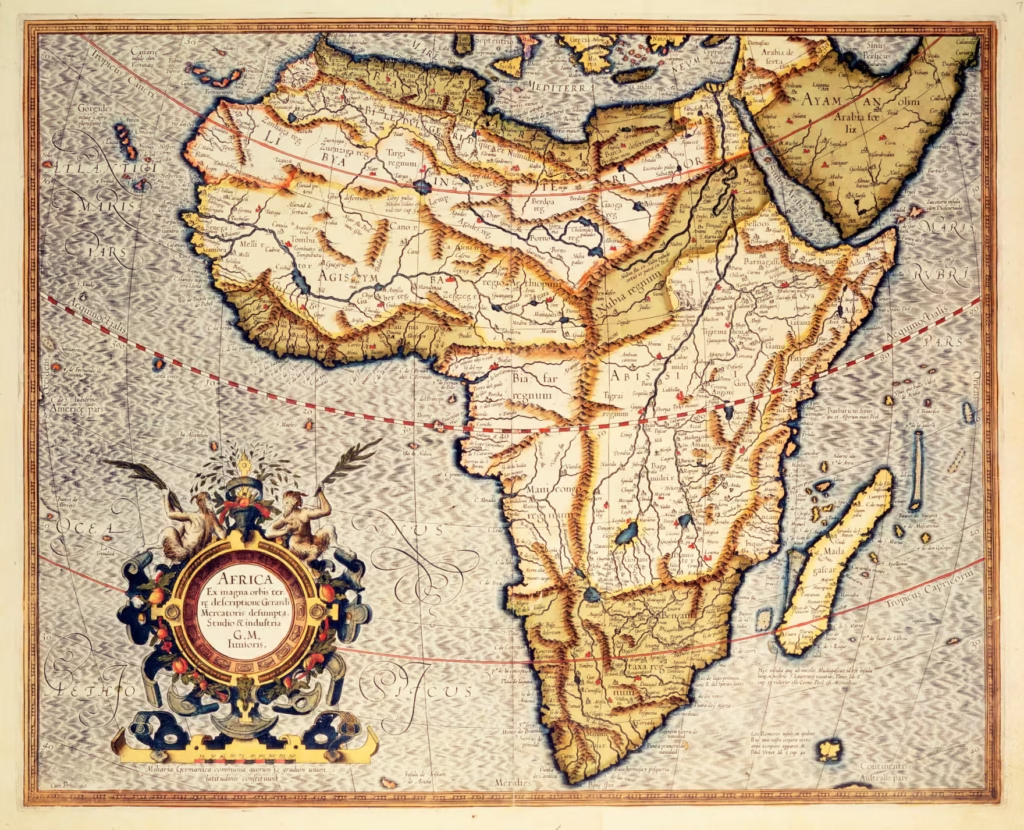
A map of Africa from Mercator’s atlas dating from between 1595 and 1602.
Photograph: Royal Geographical Society/Getty Images
The map through which children first encounter the world should not systematically exaggerate some regions at the expense of others without making that distortion clear.
But geographic scale creates possibility, not economic power.
A continent can possess land without productive agriculture.
It can possess minerals without domestic processing.
It can possess young people without productive employment.
It can possess entrepreneurs without scalable firms.
It can possess universities without industries capable of absorbing graduates.
It can possess a trade agreement without a functioning continental market.
It can possess technology users without becoming a technology producer.
The cartogram makes that distinction visible.
The task is therefore not to restore some imagined economic order from 1500. Historical GDP estimates do not justify nostalgia, and precolonial African societies should not be reconstructed into an idealised counterfactual simply because later history was violent.
The useful conclusion is more modest.
Africa’s present economic weight is neither geographically predetermined nor historically immutable.
Other regions have altered their place in the international economic system through sustained increases in productivity, industrial and technological learning, infrastructure investment, regional or national market formation and institutional development. Their experiences cannot simply be transplanted to Africa, but they demonstrate that productive capability can be accumulated.
Africa now confronts that task under conditions particular to the twenty-first century: high debt burdens, climate change, digital technologies, automation, geopolitical competition, a retreat in traditional development assistance, fragmented domestic markets and the fastest labour-force growth in the world.
That makes sequencing essential.
The starting point is production. Production establishes the tax base, foreign-exchange earnings and organisational capabilities on which other ambitions depend.
Energy and infrastructure determine the scale at which that production can operate.
Firms retain and compound learning.
Finance determines which capabilities receive the capital to grow.
Regional integration expands the market over which those capabilities can achieve scale.
And competent public institutions coordinate the parts that individual firms cannot build alone.
None of these is sufficient independently.
Together they begin to describe an economic strategy.
The African campaign to correct the world map asks others to recognise the continent’s physical scale more accurately.
The economic project is more demanding.
It requires African states, firms and institutions to build the productive weight that no projection can supply for us.
That map will have to be earned.
If you’d like to go deeper into my journey — from Malawi, through the United Nations and Microsoft to now building my own companies in Detroit, you can find it in my books.



Nthanda Manduwi is a Malawian storyteller, entrepreneur, digital transformation advocate, and community builder driven by the mission to empower Africa’s economic landscape through innovation and technology.