At 10:03 a.m. on the 17th of April, 2026, Malawi experienced a national system shutdown.
My dad via our family WhatsApp group shared a brief notice from ESCOM, that came flagged as “forwarded many times”: loss of power supply, cause under investigation, updates to follow.
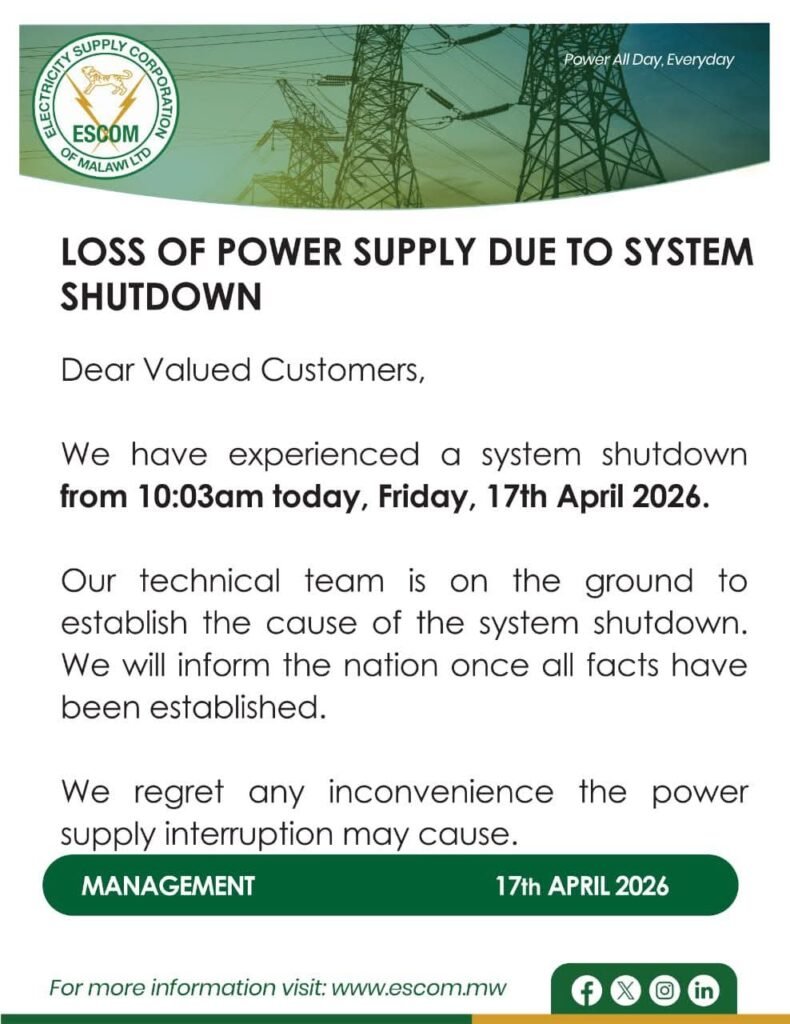
These ‘Escom Updates’ are nothing out of the ordinary in Malawi. Often appreciated, in fact, as oppossed to the standard blackouts without explanation.
At one level, the impact in my company was immediate and ordinary. My team alerted me that planned meetings would disrupted. Expected. Their coordination shifted to mobile devices, on devices that could hardly last without power. Work ideally immediately came to a halt.
At another level, the event exposed something more fundamental. A system designed to supply electricity across a country could not maintain continuity. It has never really been able to do so.
I believe this matters because modern economic activity is built on the assumption that energy will not only be available, but also predictable. When that assumption fails, the issue is not the outage itself. It is the underlying capacity of the system to support production, coordination, and planning.
Delve into Business and International Development with Nthanda Manduwi
Systems Don’t Have to Be Broken to Produce Bad Outcomes
I contemplated not publishing an episode this week [I explain why in the podcast], and then ended up recording my longest episode yet.
And to make up for publishing a little late the past two weeks, I am publishing this a day early. You’re welcome, or I am sorry?
I woke up to a message from a friend sharing a video of President William Ruto demanding Veto power for African nations at the 80th United Nations General Assembly [I happened to be in attendance], and I jumped out of bed and got to writing about my favorite beverage: tea! I also got to pen about slave trade, and colonization, and war [I know, what does any of this have to do with Hibiscus tea??!]
This week’s episode explores one of the central ideas behind the third book in the Lessons Book series – Systemic Nonsense: what if many of the frustrations we experience in institutions are not accidents or failures, but predictable outcomes of how those systems were designed?
It often feels like bureaucracy feels so resistant to change, and that reforms often produce more process than progress. It also seems that good intentions so rarely translate into meaningful outcomes. If you’ve pondered on these thoughts before, then these conversations are for you.
This Week’s Book
📖 Systemic Nonsense [Book 3]
This week only, from 27–31 July, the Kindle edition of Systemic Nonsense is available free as part of its Founders Edition launch.
Systemic Nonsense explores several ideas on international development in much greater depth. It asks a simple question:
What if the system isn’t failing? What if it’s doing exactly what it was designed to do?
Whether you listen, read, or dive into the book, I hope it leaves you asking better questions about the systems we inherit—and the ones we choose to build next.
How to Read
To receive your free Kindle copy:
* Click the Amazon link below.
* Select the Kindle edition while the promotion is active.
* Add it to your Kindle library.
You do not need a Kindle device. The free Kindle app works on iPhone, Android, tablets, Macs, and PCs, allowing you to build your digital library wherever you read.
Helpful Links
📚 Read this week’s book for free [search on Amazon or in Kindle for the book that is free for the week, and feel free to purchase the others]:http://amazon.com/dp/B0FQNJ61SB
📰 Subscribe to The Lessons Conversation:
Africa paperback pre-orders:https://forms.office.com/r/RMRMKTNd1M
Enjoyed listening to the Lessons Conversation? This post is public so feel free to share it.
This is a public episode. If you would like to discuss this with other subscribers or get access to bonus episodes, visit podcast.lessonsconversation.com
![Book 3: Systemic Nonsense [lessonsbooks.com]](https://byntha.com/wp-content/uploads/2026/07/podcast-episode-image-5a3bbb435029c89d668c5fa2682893ef-768x768.jpg)
The relationship between energy and economic transformation is structural.
The first industrial revolution was defined by the existence of energy, and by the ability to control it. The steam engine allowed production to be located independently of natural energy sources, enabling scale and repeatability. Electrification extended this further, allowing for continuous operation of factories, urban expansion, and coordinated industrial systems.
By the time the assembly line emerged, introduced by Henry Ford at his Highland Park plant in Michigan on December 1, 1913, reliability had become a baseline condition. Industrial production depends on synchronization. Interruptions do not only reduce output; they disrupt the entire system of coordination.
This is the historical standard against which modern energy systems must be evaluated. Access alone is insufficient. The system must support continuity.
Africa’s relationship to this trajectory was structurally different.
During the period in which Europe and parts of Asia were building energy-backed industrial systems, much of Africa was integrated into the global economy through extraction. Infrastructure—rail, ports, and logistics—was designed to move raw materials outward rather than support domestic production. Energy systems, where they existed, were not built to power industrial ecosystems at scale.
At independence, many countries inherited limited generation capacity, fragmented grids, and economies not structured around industrial production. The starting point was not a partially completed system, but a different kind of system entirely.
That initial condition continues to shape outcomes that we experience to present day.
My home country, Malawi, provides a clear case of how these constraints persist.
Total installed generation capacity remains under 500 MW, with approximately 390 MW derived from hydropower. This concentration creates structural vulnerability. Hydrological variability, seasonal changes, and environmental shocks directly affect generation. Diversification remains limited.
Electricity access has improved in recent years, rising from roughly 19% to just over 20%, with off-grid solar contributing to incremental gains. However, access levels remain far below what is required for industrial-scale activity. More importantly, reliability remains uneven. Load shedding and system outages continue to affect both households and businesses.
The result is a system that can extend connection, but struggles to sustain continuous supply. That distinction is critical. Connection enables use. Reliability enables production.
Energy development across the continent has often been approached through discrete projects: dams, transmission lines, solar installations, and donor-funded programs.
These interventions matter. They expand capacity. They increase access. But they do not automatically produce integrated systems.
In many cases, energy expansion has not been tightly coupled with industrial growth. Generation increases without corresponding growth in manufacturing or large-scale production. Infrastructure is added without consistent alignment across policy, financing, and market demand. Institutional coordination remains uneven.
This creates a pattern in which progress occurs, but does not compound. Systems move forward in parts, rather than as a whole.
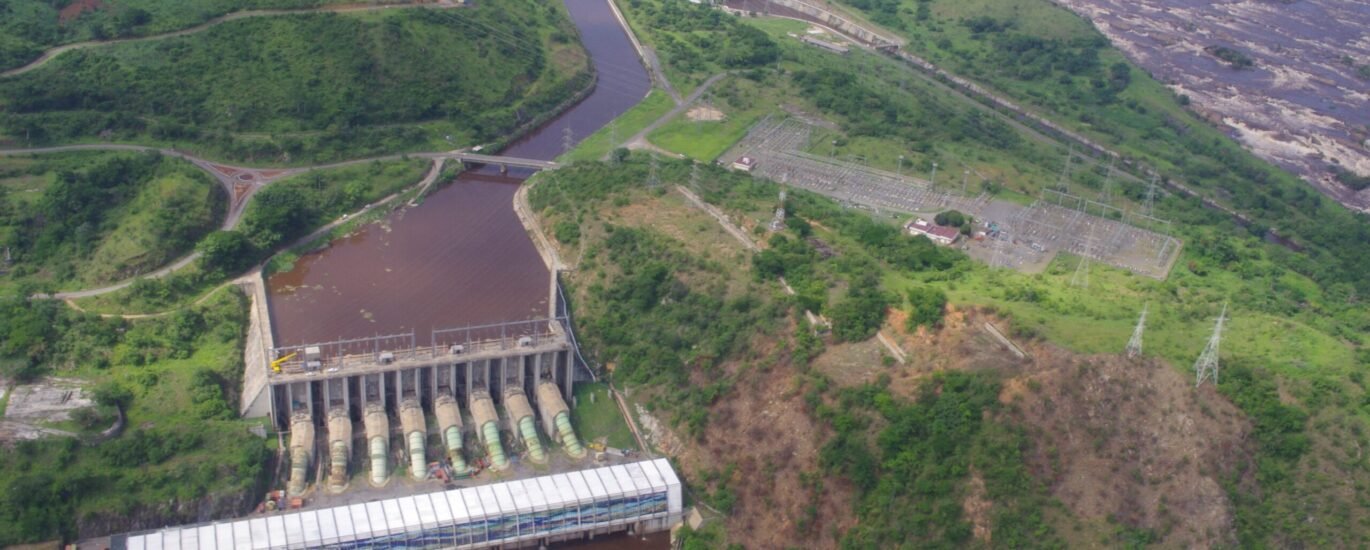
The discussion around Inga 3, as Dr. Rajiv Shah speaks about it in Big Bets, captures this challenge directly.
The project was not constrained by technical feasibility alone. Its scale was well understood. The constraint lied in the broader system required to support it: governance structures, financing models, demand certainty, regulatory frameworks, and institutional coordination across multiple actors.
Recent programmatic approaches to Inga 3 reflect this shift in thinking. Emphasis has moved toward strengthening local infrastructure, improving public financial management, building investment conditions, and ensuring that energy generation is tied to real economic use.
This is a critical insight.
Large-scale energy infrastructure does not produce transformation in isolation. It must be embedded within systems that can absorb and utilize it.
Mission 300 represents a recognition of the scale of the energy gap. The initiative aims to connect 300 million people across Africa to electricity by 2030, backed by multilateral institutions, governments, and private-sector participation.
The ambition is appropriate. The gap is large. Current trajectories are insufficient.
However, the key question is not whether access will expand. It is what that access will enable.
The continent has already experienced a version of this dynamic with digital infrastructure. Connectivity increased significantly, but the translation into broad-based economic transformation has been uneven. Access did not automatically produce capability at scale.
Energy risks following a similar path if it is not integrated into production systems.
Energy sits at the base of a broader system.
It enables production.
Production enables firms.
Firms create employment and absorb skills.
Skills, in turn, drive productivity and growth.
If energy is inconsistent, the system above it cannot stabilize. If energy is expanded without integration into production, the system does not fully activate.
This reframes the role of energy in development.
It is not the endpoint. It is a condition.
The system shutdown I experienced while visiting Malawi is not an isolated event. It is a signal of the current state of the system.
At the same time, initiatives like Mission 300 indicate a clear intent to address foundational constraints at scale.
The question is whether these efforts will move beyond expanding access to building integrated systems capable of sustaining production, coordination, and growth.
This is not a question with a simple answer.
It is a question of design, execution, and continuity.
And it remains open.
If you’d like to go deeper into my journey — from Malawi, through the United Nations to Microsoft, you can find it in my books.
P.S. for 2026, you can get any of my books via Kindle for only $2.99.
This offer is valid till the end of the year.
Links to purchase are as below:



Nthanda Manduwi is a Malawian storyteller, entrepreneur, digital transformation advocate, and community builder driven by the mission to empower Africa’s economic landscape through innovation and technology.