
I’ve just finished reading the book Big Bets by Dr. Rajiv Shah, the president of the The Rockefeller Foundation.
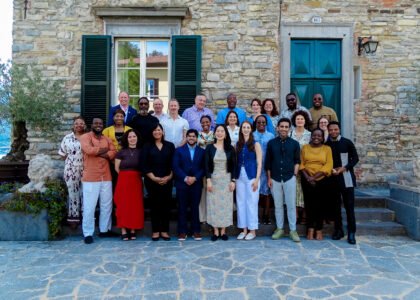
I started reading the book because I was selected for the Rockefeller Foundation Big Bets Fellowship and wanted to understand what the fellowship is about and align myself with it. Well, one, understand why I was selected, but also align myself with what is expected from me out of this process.
I find it is one of the more clearer articulations of what it takes to create large-scale change.
Delve into Business and International Development with Nthanda Manduwi
Systems Don’t Have to Be Broken to Produce Bad Outcomes
I contemplated not publishing an episode this week [I explain why in the podcast], and then ended up recording my longest episode yet.
And to make up for publishing a little late the past two weeks, I am publishing this a day early. You’re welcome, or I am sorry?
I woke up to a message from a friend sharing a video of President William Ruto demanding Veto power for African nations at the 80th United Nations General Assembly [I happened to be in attendance], and I jumped out of bed and got to writing about my favorite beverage: tea! I also got to pen about slave trade, and colonization, and war [I know, what does any of this have to do with Hibiscus tea??!]
This week’s episode explores one of the central ideas behind the third book in the Lessons Book series – Systemic Nonsense: what if many of the frustrations we experience in institutions are not accidents or failures, but predictable outcomes of how those systems were designed?
It often feels like bureaucracy feels so resistant to change, and that reforms often produce more process than progress. It also seems that good intentions so rarely translate into meaningful outcomes. If you’ve pondered on these thoughts before, then these conversations are for you.
This Week’s Book
📖 Systemic Nonsense [Book 3]
This week only, from 27–31 July, the Kindle edition of Systemic Nonsense is available free as part of its Founders Edition launch.
Systemic Nonsense explores several ideas on international development in much greater depth. It asks a simple question:
What if the system isn’t failing? What if it’s doing exactly what it was designed to do?
Whether you listen, read, or dive into the book, I hope it leaves you asking better questions about the systems we inherit—and the ones we choose to build next.
How to Read
To receive your free Kindle copy:
* Click the Amazon link below.
* Select the Kindle edition while the promotion is active.
* Add it to your Kindle library.
You do not need a Kindle device. The free Kindle app works on iPhone, Android, tablets, Macs, and PCs, allowing you to build your digital library wherever you read.
Helpful Links
📚 Read this week’s book for free [search on Amazon or in Kindle for the book that is free for the week, and feel free to purchase the others]:http://amazon.com/dp/B0FQNJ61SB
📰 Subscribe to The Lessons Conversation:
Africa paperback pre-orders:https://forms.office.com/r/RMRMKTNd1M
Enjoyed listening to the Lessons Conversation? This post is public so feel free to share it.
This is a public episode. If you would like to discuss this with other subscribers or get access to bonus episodes, visit podcast.lessonsconversation.com
![Book 3: Systemic Nonsense [lessonsbooks.com]](https://byntha.com/wp-content/uploads/2026/07/podcast-episode-image-5a3bbb435029c89d668c5fa2682893ef-768x768.jpg)
I specifically like the fact that Dr. Shah is not theorizing from the sidelines, so he is talking about actual systems change. He gets to reflect on his work in international development, from working with the Gates Foundation and making bets around immunization, moving on to lead USAID, and now the Rockefeller Foundation.
He talks about the Ebola crisis, COVID-19 vaccines, food security, international development, and this is all at a scale that most of us do not really get the insight to see.
So the structure of the book is actually quite simple, which I liked.
The introduction talks about avoiding the aspiration trap.
Then there are eight chapters:
And in each chapter, there are multiple arguments about institutions, incentives, execution, and human behavior.
The core thesis of the book is that many institutions fall into what Shah calls the aspiration trap.
They become so consumed by complexity, politics, and incrementalism that they stop trying to solve problems altogether.
I talk about this a lot in my own book series, Lessons Conversation, where I dissect international development as a whole, but more specifically also my work with the UN and my own specific work within my nonprofits.
It is a space where the system trains you into a specific way of acting, so much so that you kind of lose focus on what you should really be focusing on.
I cover this a lot in my third book in the series, Systemic Nonsense.
You start treating symptoms instead of actually solving the problems.
I have come to really appreciate this and understand it in my own experiences working in international development and systems building.
One of the more powerful sections of the book is when Shah reflects on working on global vaccine distribution efforts at the Gates Foundation.
In a room full of public health experts debating the complexity of global immunization systems, Bill Gates asks a simple question:
“What does it cost to immunize one child?”
It sounds like a naïve question.
But this question actually took me back to my summer at Microsoft, when I was talking to Sarah Bond and she said that in running a big business, I had to understand the unit economics.
I had to understand what it costs to acquire one customer and what the lifetime value of that customer is to the business.
Every business must come down to that.
So that question in the room forced everyone to stop defending complexity and instead start tracing the system backwards from the outcomes.
You are no longer looking at evaluation from the big picture perspective of “we stopped hunger in Malawi” as a broad statement. You are trying to get granular and actually get to the people.
It forces you to quantify constraints, identify inefficiencies, and understand root causes.
Eventually, they discovered that the challenge was not simply vaccines themselves, but broken delivery systems, weak government infrastructure, poor supply chains, refrigeration gaps, procurement inefficiencies, and institutional fragmentation.
These distinctions matter enormously.
Because when we look at things only from the big picture and say “we are going to fix hunger,” without asking what is actually wrong, we remain stuck fixing symptoms.
Why is there no irrigation in Malawi?
Why did the Green Belt Initiative not work?
Why is hunger still a thing in a country that is one-third water?
You start to stop asking, “How do we improve this?” and instead ask, “What would it take to solve this?”
And the nature of the conversation changes entirely.
For me, when I started building systems, it was initially very simple.
I got a tech hub. I was given a grant from the World Bank. We spent years working with universities in Malawi trying to create education solutions.
But eventually we realized there was no market there.
So I stepped back from Malawi and asked myself: what problem do I actually want to solve for Malawi?
And the answer was hunger.
Every single year there is a declaration of hunger in Malawi.
And I kept asking myself, why?
Why is hunger still a reality?
It genuinely did not make sense to me.
So when I stepped back and started looking into agriculture, I asked myself: where are Malawian farmers today, and how do we create systems that actually solve the hunger problem?
Because if we only frame the issue as hunger, we immediately jump to symptom management.
We say:
we need maize donations,
we need aid,
we need emergency relief.
But if we zoom out and ask why Malawi cannot sustainably produce enough food, the conversation changes.
Is it an irrigation problem?
Is it a logistics problem?
Is it a market access problem?
Because Malawi is literally one-third water.
Drought should not even be the thing collapsing the country’s food systems.
For me, it is this line of thinking that eventually pulled me into simulation systems, agricultural systems modeling, autonomous infrastructure, and eventually cyber-physical systems.
Which is honestly how I ended up in Detroit building Q2 Systems.
Many of the world’s hardest problems are not isolated problems.
They are systems problems.
And this is one of the veins of my existence as an entrepreneur, because I constantly have to zoom in and zoom out.
Agriculture is not just agriculture.
There is logistics, energy, climate, mobility, finance, market access, simulation, and infrastructure.
Education is not just education.
There is labor markets, digital access, incentives, institutions, and economic participation.
Development itself is often less constrained by intelligence or ambition than coordination failure.
Actually, there is a comment made by Mustafa Suleyman that I think about often, where he talks about intelligence multiplied by energy.
Energy access is something the Rockefeller Foundation is heavily focused on, and it is actually crucial to moving the developing world forward.
Another concept in the book that stayed with me was Shah’s focus on starting with a blank sheet of paper.
It is deceptively radical.
Most institutions inherit assumptions from previous generations.
We inherit governance structures from colonial systems.
Funding models from Bretton Woods institutions.
Reporting structures from the IMF and the UN.
And entire versions of logic designed for completely different economies and realities.
We often assume that because something worked elsewhere, it should work for us too.
But many of today’s challenges require fundamentally new architectures.
This is 2026, and some countries are still operating under systems designed for 1926.
We need to rethink all of it.
We either improve old systems radically, or we create entirely new ones.
And this struck me the most reading Big Bets because of how closely it aligns with the technological shift we are currently living through.
Simulation systems.
Artificial intelligence.
Autonomous infrastructure.
Digital twins.
Predictive logistics.
Distributed intelligence systems.
This is the exact space I am focused on with Q2 Systems.
The future increasingly belongs to organizations capable of continuously learning, adapting, measuring, and reconfiguring systems in real time.
And of course, Mustafa Suleyman touches on this extensively in The Coming Wave.
Another powerful lesson from the book is that money alone does not create outcomes.
You cannot simply throw money at problems and assume they will be solved.
We have seen this even in the aid architecture across Africa, where money has often expanded inefficiency, strengthened political capture, widened inequality, and failed to fundamentally transform systems.
It is an uncomfortable truth in development spaces.
Funding matters enormously.
I say this as an entrepreneur actively raising capital.
Capital matters.
But capital without execution architecture simply amplifies inefficiency.
The book demonstrates repeatedly that transformative change requires unusual coalitions.
Governments.
Researchers.
Engineers.
Operators.
Communities.
Philanthropists.
Private sector actors.
All moving toward a measurable objective simultaneously.
And honestly, one of the biggest things I learned while working as a knowledge coordinator at United Nations Development Programme in New York is that coordination itself may actually be the work.
Perhaps that is why I found this book so grounding at this stage of my own journey.
Increasingly, I am realizing that meaningful systems change requires a different level of patience, rigor, experimentation, and courage than I probably initially understood.
And now, as I am wrapping up writing my own book series, Lessons, all of this is starting to come full circle for me.
So if I was to say anything to young people from the Global South, young people from Africa, young people from Malawi, it would be this:
Have the courage not just to dream big.
Have the courage to measure honestly.
Have the courage to rethink assumptions.
Have the courage to build institutions differently.
Have the courage to keep experimenting.
And perhaps most importantly, have the courage to continue believing that large-scale change is still possible.
I still struggle with this myself.
I was speaking to a philosopher friend from Nigeria yesterday at the University of Michigan, and I told him that as an entrepreneur, I feel like I zoom in and out of giving up constantly.
I give up every day.
And then I start again every single day.
There is one line from the book that stayed with me throughout:
“Big bets for humanity start with betting on yourself.”
I am making a big bet that hunger must not remain a reality by the end of my lifetime.
And maybe I will fail.
But I am going to give it my best damn effort to make sure this work comes to life.
That may ultimately be the hardest part of it all.
Big bets for humanity start with betting on yourself.
If you’d like to go deeper into my journey — from Malawi, through the United Nations to Microsoft, you can find it in my books.
P.S. for 2026, you can get any of my books via Kindle for only $2.99.
This offer is valid till the end of the year.
Links to purchase are as below:



Nthanda Manduwi is a Malawian storyteller, entrepreneur, digital transformation advocate, and community builder driven by the mission to empower Africa’s economic landscape through innovation and technology.