
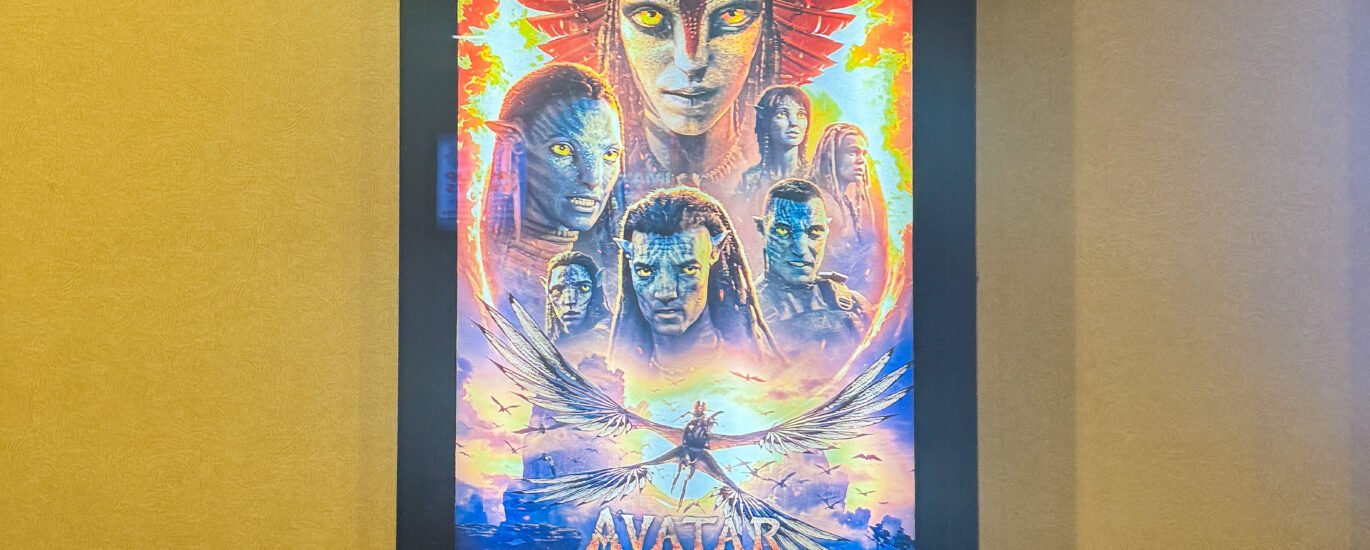
Note: there are spoilers in this review
I have spent the last few weeks building the Kwathu Innovation Smart Farms game.
As my team and I are developing the world, shaping the characters, and trying to understand how people would move through it, I keep circling the same questions:
How do you build a world that can sustain itself?
How do you make something people want to return to, not because it surprises them every time, but because it feels familiar in the right ways?
As I was brainstorming character arcs with my AI, it told me to check out the Avatar franchise.
You need to watch Avatar. The world you’re describing lives in that lineage.
While I was talking the game through with one of my mentors and the co-chair of my company, Leo, I told him I was just from watching Avatar 1, and about to start watching 2. He said he had watched 1, but found 2 just a whole drag. I was still invested in 2 as I am a water baby, and insisted I would watch it still. I did not tell him, yet, that I was watching the film for inspiration.
As I started describing the characters and the environment I was imagining, at some point, the conversation paused, and he said that what I was describing felt very Avatar. Leo is brilliant at connecting the dots, perhaps in ways most humans I have met are not. I love this about him.
I hadn’t seen Avatar before. I keep saying I feel like people need to tell women (especially those of us from my generation AKA millenials who grew up watching Disney Princess slop) that these sci-fi movies have AMAZING love plots. I feel like there’s a whole market these franchises are missing out on there. I feel like a lot of women from my generation hear ‘sci-fi’ and decide ‘not for me!’
I watched the earlier films in my home on my nebula projector, filling the room with color and movement. It was immersive and beautiful in a way that immediately made sense to me as a builder. I could see the systems at work. The rules of the world. The way relationships were doing as much labor as the plot itself.
I personally fell in love with Avatar: The Way of the Water, because… well… I am a water baby. I was amazed by the water dynamics, and the combat was also quite fascinating to me.
It also happened that I got into the franchise JUST as the third film was coming out, and I put it on my calendar. I bought two tickets, and Alvaro and I went to see it in the theater.
As I was prepping for this movie, I had my expectations quite cleanly set. Having seen two movies thus far, I knew what to expect. I didn’t go looking for a new story. I went looking for continuity. I wanted to see how the world held itself together as it expanded, how characters carried memory forward, and how a franchise sustains emotional investment over time.
From that perspective, Avatar works.
As someone building a game world of my own, this is exactly the kind of storytelling I’m drawn to. Sustainable, continuous, and intentional. You bring something new into the world, but not so much that it fractures what already exists. You allow people to know what to expect, and you trust that familiarity is not the enemy of depth.
I am new to the Avatar franchise. I never watched it when it first came out, so I’m not carrying years of anticipation or fatigue. I watched the earlier films recently, close together, and I walked into this one less interested in whether the story would surprise me and more interested in how the world would continue to unfold. I’m building a game franchise of my own through Kwathu Games via Unreal, and I wanted to study Avatar as a system.
Because of that, my experience was overwhelmingly positive. To me, the story did exactly what I expected it to do, and did it well.
By the time the film starts, you already know the rhythm. You know there will be a challenge. You know the family will fracture under pressure. You know who the weak links are. You know who is likely to be hurt, and who might not make it out this time. That predictability didn’t bother me in the ways it might bother most people. It actually made the experience more comfortable.
This is how I think about Avatar. In real life, people meet me, and they are curious know what degree I’m studying or what business I’m building. They expect continuity. They expect progression, not reinvention. That is how I approach this franchise. I don’t go in expecting a new story. I go in expecting to revisit relationships I care about, and to see how they’ve changed under new stress.
If you’ve watched one Avatar film, you do know what you’re getting with the next. I think that’s true. I just don’t think it’s a flaw.
Watching Jake Sully and Neytiri in this film felt different from the previous ones. This time, they are not just fighting an external threat. They are grieving.
They are grieving their first son. You can feel how deeply he was loved, how central he was to the family, and how his absence sits heavily in every interaction that follows. The grief changes the temperature of the household. It sharpens emotions. It leaks into places it does not belong.
We see Neytiri carry that grief in ways that are raw and unfiltered. She resents the Water People because that is where her son died. She turns that pain toward Spider, not because he is responsible, but because he becomes a symbol of everything that feels out of place, unresolved, and human. Her anger is not logical. It is grief looking for somewhere to land.
Jake, in his own way, is also searching for footing. There is a moment where he asks Neytiri if she is embarrassed that their children are half human. That question lands heavily, and it opens a door the franchise has not fully walked through before. Race. Lineage. Belonging. It’s no longer abstract. It’s inside the family now. That exchange has sparked a lot of conversation online, and rightly so, because it shows how loss can strip away politeness and expose fears people didn’t even know they were carrying.
What struck me most, though, was how their love holds through all of this.
Even in their most heated moments, even when the anger is visible in their eyes, there is still tenderness. There is still the way they call each other baby. There is still a sense that they are choosing each other, even while hurting. You can see two people who love each other deeply, and who are willing to sit inside discomfort rather than abandon the bond.
That love is tested most sharply in the Spider arc. At the beginning of the film, there is a clear decision to send him away with the air traders, to create distance, to remove risk. Later, when events escalate and the threat becomes immediate, we reach the moment where Spider’s life is truly on the line. Jake is prepared to kill him. Not out of cruelty, but out of exhaustion and fear and a desire to protect what remains.
Before the blade ever falls, Jake has already made the decision not to do it. Neytiri steps in anyway. They stop. They hold each other. They choose to stay aligned.
That moment mattered to me. It showed that even in grief, even in anger, even in moral collapse, this relationship remains the center. Everything else in the story moves outward from that bond.
What genuinely surprised me was not just the introduction of a new villain, but the relationship that came with her.
The dynamic between Varang and Colonel Miles Quaritch is one of the most unsettling things the franchise has done so far. Not because it redeems either of them, but because it doesn’t try to.
They aren’t there to make each other better. They aren’t there to soften each other’s edges. They meet and immediately recognize something familiar. Power. Resentment. A shared sense of having been wronged. There’s a moment where you realize this isn’t a romance arc or a redemptive arc. It’s closer to that joke everyone keeps making online. When the worst person you know finds the love of their life, and instead of growth, they decide to make each other worse.
That’s the energy they bring into the film.
What makes Varang especially disturbing is what she represents within the Na’vi world. This is the first time we are not watching Na’vi resist an external threat or protect themselves from outsiders. This is not forest people versus reef people tension. This is not cultural misunderstanding. This is ideological fracture.
The Ash People feel betrayed by Eywa. They reject her. They don’t center spirituality. They value force, weapons, domination. They are willing to collaborate with imperial power rather than resist it. Watching them embrace guns, aggression, and control feels jarring precisely because it violates everything we’ve been taught to associate with Na’vi life.
There’s a dark humor to it that people have already picked up on. Someone described them as the Reddit atheist Na’vi. Anti-god, pro-guns, pro-empire, aggressively certain, and completely detached from the idea of balance. I laughed when I read that, but it also stuck, because it’s not wrong.
For the first time, the conflict isn’t just about humans killing Na’vi. We are watching Na’vi kill other Na’vi. That matters. It changes the moral terrain of the story. It suggests that Pandora itself is no longer unified under a single worldview, and that belief, not just survival, is now at stake.
From a worldbuilding perspective, this was one of the most important shifts in the franchise for me. It opens the universe in a way that repetition never could. It introduces internal collapse, ideological betrayal, and the idea that harmony is not guaranteed by shared origin.
Varang doesn’t replace Quaritch. She sharpens him. And together, they make the future of this world feel far more dangerous than it ever has before.
There was never any suspense for me about where the tension would sit. It was always going to sit with Spider and Kiri.
In different ways, both of them are asking the same question. Who am I, and where do I come from.
For Kiri, the tension isn’t about explaining herself to anyone else. It’s about trying to understand herself. Her history is unclear. Her origin is unresolved. She feels more connected, more spiritual, more powerful, and she doesn’t fully know why. That uncertainty follows her. It’s internal. She is navigating something she doesn’t yet have language for.
What grounds her is not answers, but family. Again and again, she is taken in. You are one of us. You are ours. You are loved. The family doesn’t require her to explain her difference in order to belong.
Spider carries a parallel weight. He is orphaned young. He grows up inside the family, even though he is not of it by blood. He belongs emotionally, practically, relationally, but never without friction. His presence is always slightly exposed. Always conditional in ways that are never spoken aloud.
Together, they become quite central to the story because they are not blood, yet they are family. That makes them vulnerable. It also makes them indispensable. They are the ones who absorb tension first. They are the ones whose choices hurt the most. They are the weak points in the structure, not because they lack strength, but because they carry the weight of belonging without the protection of lineage.
I also… for my personal inclinations… appreciate that they are romantically involved.
What I appreciated the most was that the film didn’t try to soften these tensions. It leaned into them. It allowed them to be uncomfortable, conflicted, and exposed. That felt honest. That felt earned.
Their dynamics felt deeply intentional to me. It mirrors how families actually work. Love expands faster than certainty. Belonging often arrives before explanation.
One of the reasons I love this franchise is the way it handles combat and loss.
As a writer and as someone newly working in entertainment, I struggle with combat. I struggle with harming or killing characters. I struggle with deciding who pays the price and whether that price feels real. Avatar does not shy away from that discomfort. When it hurts, it hurts on purpose.
The death of Neteyam stayed with me. It didn’t feel like a plot device. It felt like a wound the story was willing to carry forward. That matters to me. Too many franchises treat death as temporary or reversible, and Avatar doesn’t fully do that. Even when the character returns in memory or dream, the absence remains.
The combat itself was beautifully done. Not just visually, but emotionally. You always understand what is at stake for each character. You feel the cost before the cost arrives.
One of my favourite scenes was when Payakan tore off the arm of Captain Mick Scoresby. That was poetic justice to me!
I loved that film 3 opened with Neteyam present.
Because I watched Avatar 2 so recently, that moment caught me off guard. I remember turning to Alvaro and saying, wait, he’s dead. He had watched it nearly 4 years ago when it came out, so we were operating on different timelines. For me, the loss was still fresh. I realized almost immediately that this was memory, or dream, or grief made visible.
That choice mattered. It acknowledged that loss doesn’t disappear just because time passes. It lingers. It shows up unexpectedly. It shapes behavior.
The film gave us closure without erasing pain, and that is not easy to do, and I felt that was a BRILLIANT choice.
What I enjoy the most about the Avatar franchise is the relationships. Like if you know humans at length, you will appreciate that the characters in the Avatar films are some emotionally intelligent beings; from the kids to the adults. There was just so much maturity that I personally do not get to experience as well in the real world.
Every relationship felt developed. You could see the shifts between parents and children, between siblings, between partners, between the family and the larger community. Nothing felt rushed. Nothing felt ornamental.
I remember joking to Alvaro that we were all quite invested in Ronal’s pregnancy at this point, because Ronal was introduced to us already pregnant, and she had never, to the end, not been pregnant. Carrying that pregnancy across films made the moment of birth feel inevitable and deeply personal.
The film wrapping up with Ronal giving birth was especially moving to me. She is mortally wounded, fully aware of what is happening to her body, and still insists on bringing the child into the world. Her words land with devastating clarity. She knows she is dying, and she chooses to push the baby out anyway. It is a moment of pure maternal sacrifice, stripped of spectacle, stripped of heroics.
After her death, she asks of Neytiri to protect the baby, and indeed she does. Neytiri takes on the baby as her own. In active combat, life does not pause for grief, and love expands to make room for one more child. She carried the baby on her chest, as she is, yet again, taken by Colonel Miles Quaritch as bait to lure Jake Sully in.
I also somehow loved that they did not, in this moment make the baby additional bait. I felt they could have chosen to, but they did not. I loved this.
That ending sat in sharp contrast to the losses we had already absorbed. It reminded me why these characters keep fighting, even when the cost feels unbearable.
This is where Avatar shines for me. It understands that people don’t stay because of spectacle alone.
The Avatar movies are long. Very long. 222 minutes long, for the third one.
I remember sitting there realizing I had forgotten to go to the bathroom before it started, and there was no graceful exit once you were in.
This is not a casual watch. You need to be comfortable. You need to prepare. We managed to get our Food and Drinks before the film started. They really do help.
Once I surrendered to the length, it stopped feeling indulgent and started feeling immersive. The runtime gave the relationships space to breathe. It let moments land without rushing to the next beat.
I do want to say that I understand why some people feel the film falls flat. If you’re expecting novelty, if you’re grading it on surprise alone, this isn’t the franchise that’s going to reward you.
But if you’re watching Avatar the way you revisit a world you already care about, the repetition doesn’t feel lazy. It feels intentional. It feels like checking in on people whose lives continue whether or not you’re watching.
I wouldn’t trust myself as a traditional film critic. I’m not looking to tear stories apart. I’m looking to understand how they’re built and why they endure.
From that perspective, the Avatar franchise works. The third film delivered continuity. It respected its own history. It allowed loss to matter and love to persist. It didn’t try to be clever for the sake of it.
I didn’t leave thinking I’d seen something radically new. I left feeling connected, invested, and curious to return.
For me, that’s enough. I am aware, that I am deeply biased, as a [fellow] creator.
If you’d like to go deeper into my journey — from Malawi, through the United Nations to Microsoft, you can find it in my books.
P.S. till the end of 2025, you can get any of my books via Kindle for only $2.99.
This offer is only valid till the end of the year.
Links to purchase are as below:



Nthanda Manduwi is a Malawian storyteller, entrepreneur, digital transformation advocate, and community builder driven by the mission to empower Africa’s economic landscape through innovation and technology.