
I moved to Detroit for a one-year residency fellowship that, by design, turns “building here” from a slogan into a constraint.
The program is explicit about structure: a year-long commitment, a monthly stipend meant to cover living expenses, and memberships at the city’s flagship innovation spaces—TechTown Detroit[1], Bamboo[2], and Newlab Detroit[3] at Michigan Central[4]. The funding came through a state talent-attraction grant from the Michigan Growth Office[5], administered by Detroit Economic Growth Corporation[6]. The logic is simple enough to be almost blunt: if Detroit wants more companies, it is subsidizing proximity. [7]
By the time I attended my first major ecosystem event—after living in the city for about a month—it was late winter edging into early spring. That cusp-of-spring feeling matters because it’s a Detroit-specific texture: a city that still looks like it’s remembering winter, while the people are visibly preparing for something else.
The event was hosted at MaryGrove Conservancy – what I was to learn was a College was founded in 1905 by the Sisters, Servants of the Immaculate Heart of Mary and later relocated to Detroit in 1927, embedding itself in a city that was then expanding through industrial growth and migration. Its mission was to train teachers, educated women and working-class students, and fed directly into Detroit’s public systems.
Over the decades, Marygrove graduates populated classrooms across the city, and its campus functioned as both an academic and community space. But like many small liberal arts colleges, it was eventually caught in structural shifts—declining enrollment, rising costs, and a higher education model that increasingly favored scale. In 2019, the college closed, marking the end of a nearly century-long institutional presence.
What followed, however, is more instructive than the closure itself. The campus did not disappear; it was reorganized. Through the Marygrove Conservancy, and in partnership with entities like the University of Michigan School of Education and Detroit Public Schools Community District, the site was reconstituted into a P–20 educational campus—spanning early childhood through graduate-level teacher training. This transition reflects a different kind of rebuilding: not the preservation of an institution for its own sake, but the restructuring of its function to meet current needs. Where Marygrove once operated as a college, it now operates as a pipeline. The physical space remains, but the system it serves has been redefined.
The room had founders, civic leadership, and the intermediaries that translate public intent into private action. The city has been explicit about what it is doing in this layer: it is deploying money—small by venture standards, consequential by founder standards—through municipal grant mechanisms like the Detroit Startup Fund (seed grants and scale grants) and through programs that reduce the cost of living long enough for a founder to iterate. [8]
Detroit’s newest mayor, Mary Sheffield[9], was part of that institutional presence—an elected official very publicly framing Detroit as a place that intends to compete for builders. She was sworn in on January 1, 2026 as the city’s 76th mayor, the first woman to hold that office in Detroit’s history. [10]
Jerjuan was also in that room. Jerjuan Howard is one of the few people I encountered who exists simultaneously in the civic layer and the neighborhood layer—someone who can speak the language of municipal coordination, then drive you a few miles and show you the physical reality that coordination still hasn’t reached.
Rebuilding, I suppose, looks coherent from inside a room like that. It looks different when you move through the city with someone whose entire work is built around the places you do not see from that room.
Institutional rebuilding in Detroit has become unusually legible. The city is making the mechanisms visible.
Read more on what exactly happened to the once great Detroit
One of those mechanisms is the Detroit Startup Fund, structured explicitly as municipal grants, with seed-level awards and larger scale awards. The program’s public framing ties “startup support” to civic outcomes: technologies that improve quality of life, strengthen city operations, create jobs, and retain talent. [11]
The initial design, announced in 2025, set a total pool of $700,000 across two rounds and defined two grant sizes—$15,000 seed grants and $50,000 scale grants—with eligibility requirements that intentionally push companies toward venture-scale ambition and measurable progress. [12]
The first 13 recipients, announced in late 2025, illustrate what the city considers “the next economy”: biotechnology, environmental monitoring, education technology, infrastructure inspection, and other categories that sit adjacent to Detroit’s legacy manufacturing base without being reducible to it. The city also emphasized the residency signal: 11 of the 13 Round 1 recipients were Detroit residents. [13]
This isn’t a large fund. That’s the wrong comparison class. The correct comparison is: what does $15,000 or $50,000 do to a company in the phase where the primary constraint is often runway, not intelligence? In that phase, non-dilutive capital changes behavior. It buys an extra month of iteration, a slightly better hire, the ability to pay for a pilot, the ability to run your product through one more cycle before you hit a cliff.
That is why municipal grants can matter even when they’re not “big money.” They change the probability distribution of survival at the margin.
This same logic underlies the residency fellowship that brought me here: Detroit is using a monthly stipend plus workspace access as a tool to create founder density in city limits. This is explicitly funded through a “Make MI Home” grant from the Michigan Growth Office and administered through DEGC, with workspace anchored at TechTown, Bamboo, and Newlab. [14]
The key policy lever is not “support founders” in the abstract. It is: reduce the cost of staying in Detroit long enough for the founder and the city to become mutually invested. That is a retention strategy disguised as a fellowship, one that as a program builder myself, quite respect. [7]
The leadership in the room reflected that design philosophy.
At the civic executive layer, Mayor Sheffield has framed Detroit’s strategy in explicitly economic terms—jobs, neighborhoods, and making Detroit a place to start and scale. [15]
At the implementation layer, DEGC represents a very specific type of organizational function: the translation between public priorities and the operational devices—funds, incentives, pipelines—that make those priorities real. In the City/DEGC announcement of Round 2 of the Startup Fund, DEGC is described as Detroit’s lead implementing agency for business retention, attraction, and economic development, and as the manager for initiatives supporting small businesses and neighborhood corridors. [16]
And then there are individuals whose job is to make the bureaucracy less abstract for founders.
Justin Onwenu[17] was appointed in 2024 as Detroit’s first Director of Entrepreneurship and Economic Opportunity—explicitly tasked with driving investment to startups, streamlining city processes, and identifying “burdensome” policies that slow business formation. [18]
This role is functionally about friction.
Founders learn quickly that “the city” can be supportive as rhetoric while being obstruction as process. A job like Onwenu’s exists to reduce the distance between a founder’s operating cadence and municipal cadence—which are usually mismatched. In the city’s own announcement, the mayor framed Detroit as a fast-growing startup magnet and positioned Onwenu’s work as making city approvals and support more navigable. [19]
In short: the institutional layer is building a scaffold where founders can be processed more quickly—through grants, through coworking memberships, through dedicated staff, through public messaging that signals “we want you here.” [20]
It is worth naming what this is economically.
Detroit is trying to regenerate density—of founders, of capital, of activity—inside city limits. It is doing it the way governments can do it: by paying to change incentives, by underwriting coordination, and by building platforms that private actors can climb.
That is why the room felt coherent.
And it’s also why leaving the room matters.
Ecosystems are not built by grants alone. They’re built by repeated convenings that turn a city into a place where people expect to meet collaborators.
Detroit’s ecosystem has a few institutions that do this formally—incubators, accelerators, coworking hubs. Then it has a few movements that do this culturally, which is often more powerful.
Black Tech Saturdays[21] is one of those cultural mechanisms that became structural.
If you want to see how a community movement becomes an ecosystem lever, the Michigan Central partnership announcement is unusually direct: Michigan Central and Black Tech Saturdays expanded their partnership in late 2024, with Black Tech Saturdays establishing its headquarters at Michigan Central and expanding programming that includes workshops, pitch competitions, leadership development, and networking events. [22]
Two details in that announcement matter economically.
First, the movement describes itself as starting with five people and scaling to more than 15,000 participants. That is an attention and density claim, which is one of the highest-value assets in a startup ecosystem. [22]
Second, the partnership describes a physical infrastructure commitment: dedicated office suite, coworking, classrooms, conference rooms. That is not a brand partnership. It is an institutionalization of what was originally informal. [22]
The founders—Johnnie Turnage[23] and Alexa Turnage[24]—frame the work as building entrepreneurs through stages of development, and they also describe outcomes in business terms: contracts, company growth, and measurable expansion. [22]
The philanthropic money behind this movement is equally legible—meaning the ecosystem is not only social; it is capitalized.
In 2024, the Gilbert Family Foundation[25] announced a $1.2 million, two-year investment in Black Tech Saturdays, explicitly framed as expanding access to capital, mentorship, and resources, and scaling pitch competitions, training, and matchmaking for entrepreneurs and partners. [26]
In 2025, the Knight Foundation[27] announced $19.8 million in new Detroit investments, including $2 million specifically for Black Tech Saturdays. Knight’s own release describes the organization’s Detroit work as expanding beyond downtown into inner-ring neighborhoods, and it frames Black Tech Saturdays as building a “self-sustaining tech economy rooted in equity and community,” with more than 20,000 unique visitors and $4 million in early funding to date. [28]
I’m not emphasizing these numbers because this is what ecosystem formation looks like: a community movement becomes a repeatable convening; the convening becomes a pipeline; funders then treat the pipeline as investable infrastructure. [29]
This ecosystem layer interacts directly with the institutional layer. DEGC’s Round 2 Startup Fund announcement explicitly lists leaders from Newlab, TechTown, and Black Tech Saturdays as part of the press ecosystem around municipal support for startups. [30]
That kind of co-presence is not cosmetic. It signals that the city is attempting alignment—government money, philanthropic money, physical innovation infrastructure, and founder communities in the same rooms. [31]
Then there is a different kind of ecosystem organization: founder-to-founder networks that cultivate peer capital.
Michigan Founders Fund[32] positions itself as a statewide network of founders and investors supporting both company-building and community impact. In its 2022 launch announcement, it describes a 1% equity/carry/profit pledge mechanism to fund Michigan-based grantmaking, while building “founders for founders and founders for community” infrastructure. [33]
The co-founding and leadership story is part of why this matters.
Trista Van Tine[34] is identified as a co-founder and executive director in MFF’s early communications and public-facing materials. [35]
Dug Song[36] is described by MFF as a co-founder and board co-chair, and in the same launch announcement he frames technology as a wealth-generation mechanism with low traditional asset requirements—then pivots to the idea that community wealth requires intentionality. [37]
You can read those as values statements. I read them as design choices: MFF is building a social architecture where founders share resources with each other and then convert part of the upside into local reinvestment. That is a private-sector financing model for civic capacity.
Put differently: Detroit’s rebuilding is not only a city story. It is a Michigan story, with Detroit as the most visible testbed for building founder density through policy, philanthropy, and place.
But none of those systems explain what happens after the event ends.
That is where Jerjuan becomes less of a “person I met” and more of a lens I needed.
I met Jerjuan Howard[38] through a warm introduction. As soon as I knew I was moving to Detroit, Evodie insisted I make it a point to meet him. By the time I saw him, it was inside one of Detroit’s most visible rebuilding rooms—an ecosystem event built around capital and coordination.
There is a temptation to flatten Jerjuan into one category: nonprofit leader, youth advocate, bookstore founder, city official. His value is the way he refuses to live in only one layer.
In early 2026, Mayor Sheffield named Jerjuan as Director of the city’s new Office of Youth Affairs under a broader youth and education leadership structure, explicitly framed as tightening coordination and embedding youth considerations into city policy and decision-making. [39]
That appointment matters because it places a neighborhood-rooted actor inside municipal machinery. The Michigan Chronicle report ties his selection to his work history: founder of the Umoja Debate League, roles connected to Detroit Public Schools Community District and Detroit City Council, and a personal grounding in the westside Puritan Avenue corridor. [39]
Jerjuan’s own language in that report is consistent with what I’ve seen in his work: a focus on youth voice as part of the city-building process, and an insistence that Detroit’s young people should be embedded into how Detroit grows. [39]
To understand him, it helps to start with the organization he built before he had a city title.
Umoja Debate League[40] describes itself as a 501(c)(3) using debate to teach Detroit youth (ages 11–18) transferable life skills: critical thinking, confidence, conflict resolution, literacy, and self-expression. [41]
On Umoja’s website, Jerjuan is described as the founder and board chair, a product of Detroit Public Schools, and the builder behind both Umoja Village and the Howard Family Bookstore—with Umoja positioned as a “pipeline for future lawyers, leaders, and changemakers.” [42]
Jerjuan’s work is not primarily “services.” It is capacity formation.
Debate is a tool that transfers directly into labor-market outcomes: communication skills, argumentation, confidence under scrutiny, structured thinking. Those are foundational skills for almost any high-wage pathway, including entrepreneurship. If you strip the romance out, debate is human capital development with unusually high spillover.
Then there is the second artifact he built—a physical one.
Umoja Village[43] is described as an outdoor community space built “for and by the community,” created after Umoja purchased three blighted lots in 2022. The space includes a community garden, art, a free little library, and a stage for community meetings and debate practice. [44]
Local reporting adds texture: WXYZ described the space as a transformation from an abandoned lot into a maintained community site, built with volunteer labor, with benches and a stage, and anchored near Stansbury and Puritan—close to where Jerjuan grew up. [45]
You can call that a “community project.” I treat it as a micro-infrastructure intervention: changing what the neighborhood signals to itself.
When we left the ecosystem event together, Jerjuan did what I’ve seen effective local builders do. He moved me through space.
Because rebuilding is spatial. It’s visible. The systems change depending on where you stand.
The most precise way to describe Jerjuan’s bookstore project is not “a bookstore.” It is an attempt to turn a vacant asset into a multi-purpose node—economic, cultural, educational, and civic—within a neighborhood that has been structurally overexposed to vacancy.
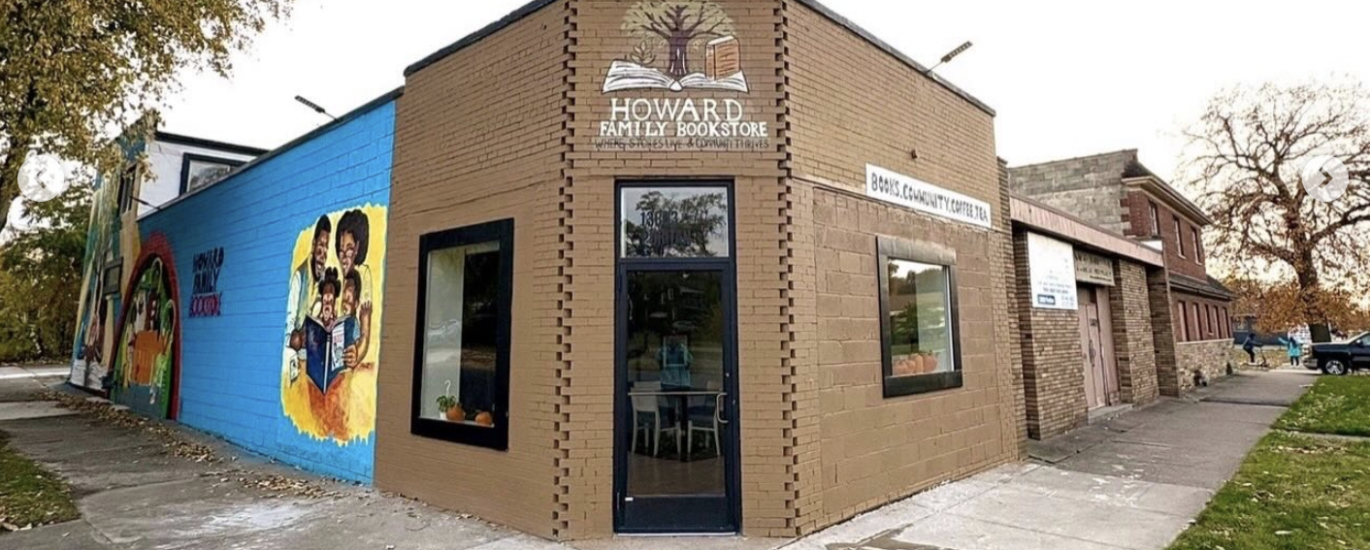
Howard Family Bookstore[46] is being built inside a long-vacant building on Puritan Avenue on Detroit’s west side, blocks from Jerjuan’s childhood home and schools. Local reporting describes the bookstore as envisioned as a hub for books, coffee, and connection, with an explicit mission around literacy, local history, and community gathering. [47]
Those are the high-level claims. The details are why the project matters.
The Metro Times report offers a specific design intent: Jerjuan envisioned a gallery-like atmosphere, brightened by books and local art, with details like bookshelves and counters made from a repurposed tree outside. [48]
The bookstore is also planned as an events platform: adult spelling bees, poetry nights, comic book workshops—activities that create repeating reasons for people to show up, which is how you build neighborhood density without pretending the market will do it automatically. [47]
There is an intended feature: a virtual reality room intended to show what Puritan Avenue looked like in the 1950s, when Detroit was booming. I am particularly interested in this as a simulation builder – spatial memory as a tool: the idea that showing what “was” can alter what people imagine “could be” in the same geography. [49]
Axios adds additional realism: the building Jerjuan purchased is roughly 2,201 square feet, and it previously belonged to the late judge and former deputy mayor Adam Shakoor[50], a civil rights attorney who represented Rosa Parks[51]. Jerjuan told Axios he wanted to add a commemorative plaque honoring Shakoor’s legacy, and that he was talking with community members about what they felt the area was missing while turning the bookstore into a viable business. [52]
This is where the bookstore stops being an idea and becomes a ledger.
A viable neighborhood bookstore has constraints that sound mundane until you try to do it: foot traffic, safety perception, product mix, margins, vendor terms, operating hours, staffing, seasonal variation, and the basic challenge of staying open long enough to become part of a neighborhood routine.
Jerjuan’s response is to broaden the base: coffee, tea, juices, flowers, rooftop seating—multiple reasons to enter the space and spend time there. Shelf Awareness summarizes this model directly, describing the bookstore as an all-ages bookstore, coffee shop, and community space, with flowers sourced from a local flower garden and a rooftop seating area. [53]
The literacy component is not symbolic. Jerjuan has anchored the bookstore in the geographic reality of schools.
The Metro Times piece notes there are five schools within a mile and a half of the bookstore and describes making reading accessible for local youth as a central mission. [48]
Jerjuan has also framed the location choice in his own words. In a LinkedIn post, he describes the Puritan/Schaefer corridor as “Harmony Village,” cites that there are five K–12 schools within a 1.5-mile radius, and ties neighborhood demographic realities to literacy, referencing local data sources. [54]
This is the opposite of abstraction.
In the institutional layer, “improving literacy” shows up as a program category. In Jerjuan’s layer, literacy shows up as a building you can walk into.
Walking through the space with him, I kept uttering the word ‘cute’. I saw intent made physical: a shell being converted into a place where people are meant to gather.
Local reporting also ties the project to a family timeline. Metro Times notes that Jerjuan’s grandparents purchased his childhood home in 1939 and that the bookstore is blocks from that home and from his middle school. [48]
That is the point where rebuilding becomes deeply personal without becoming sentimental. It’s a continuity claim: anchoring new infrastructure in old roots.
It also clarifies why Jerjuan can move between rooms.
In the ecosystem event room, people talk about how to keep founders in Detroit.
On Puritan, Jerjuan’s work is about how to keep belief in Detroit alive long enough for any capital program to matter.
Every city has multiple Detroits inside it.
If you stay in the innovation district long enough, you can start to believe the rebuilding is complete. The built environment reinforces that belief: restored spaces, programmed events, high-signal convenings, visible partnership announcements.
Newlab’s building is itself a metaphor for Detroit’s current rebuilding strategy: a formerly abandoned, historically loaded structure repurposed into a high-tech venue for company formation and prototyping. Michigan Central’s own press release describes Newlab’s Detroit headquarters inside the restored Book Depository as a 270,000-square-foot workplace with purpose-built labs, attracting more than 150 members from more than 25 companies and emphasizing that companies in the space have collectively raised more than $500 million in venture capital. [55]
The design and scale matter because they illustrate the city’s bet: that advanced manufacturing, mobility, and applied technology can become part of Detroit’s next economic base. [56]
Then you drive away from that corridor.
In Jerjuan’s neighborhood, the physical environment simply changes—vacant buildings, underutilized lots, stretches where commercial density is thin. The city begins to look like a place still waiting for investment to arrive.
In our conversation, Jerjuan described the ‘broken mirror’ effect: a psychological state where a person’s [or I suppose in this case city] self-image is severely distorted by shame, trauma, or past criticisms, causing them to focus only on perceived flaws despite evidence to the contrary. The way visible neglect becomes a mirror you grow up inside. The built environment communicates expectations back to you. If your daily scenery is vacancy, boarded windows, and decaying infrastructure, those signals shape what you believe is normal—and what you believe is possible.
This is why the bookstore matters as a mechanism. It is designed to interrupt that signal environment.
WXYZ captured this logic in a different form when describing Umoja Village: neighbors describing the emotional difference between seeing “boarded up windows and trash” and seeing a cleaned-up space that feels like a “breath of fresh air.” [45]
I don’t interpret those statements as inspiration. I interpret them as information about neighborhood equilibrium.
Signs of investment alter behavior. They increase willingness to show up. They change informal norms about care and abandonment. They are small shifts that aggregate into different trajectories.
This is where Detroit’s rebuilding becomes fragmented but still active.
The institutional layer can build programs, funds, and incentives.
The ecosystem layer can build networks and pipelines.
The neighborhood layer has to build the physical and psychological substrate that allows people to participate in those pipelines.
The same city. Different constraints.
Detroit’s rebuilding is not a single story. It is multiple stories operating in parallel, occasionally aligning.
One connecting tissue is capital deliberately routed toward founder activity inside city limits.
The Startup Fund is explicitly backed by the city’s general fund through a partnership with DEGC, and the city describes the fund as building an “innovation pipeline” that grows early-stage companies into job-creating, capital-attracting ventures. [57]
A second connecting tissue is philanthropic capital explicitly moving into neighborhood-adjacent economic infrastructure.
The Gilbert Family Foundation and Knight Foundation investments into Black Tech Saturdays are not only “support.” They are an implicit diagnosis that connecting Black talent to tech pathways—through convenings, training, pitch competitions, and storytelling—can produce income opportunities and new forms of local wealth-building. [58]
A third connecting tissue is civic governance intentionally recruiting operators to reduce bureaucratic friction for entrepreneurs.
Justin Onwenu’s role exists because Detroit is trying to make itself navigable for founders—particularly those who do not fit into traditional funding pipelines. The city’s hiring announcement and subsequent reporting both emphasize the function: streamline city processes, identify and remove policy barriers, and connect entrepreneurs to financial support. [18]
Then there is Jerjuan, whose work implies something more basic than any of these.
A city cannot rebuild only by supporting companies. It also has to rebuild participation.
Participation requires:
1) a reason to believe your neighborhood is worth investing in,
2) a place to gather,
3) a pathway for youth to acquire skills that translate into opportunity.
His projects create those elements in physical form: debate programs, public space, and now a bookstore designed as a community anchor. [59]
This is where the layers don’t fully overlap.
A municipal startup fund can exist while a neighborhood remains dominated by vacancy.
A thriving founder meetup can exist while youth in the city are carrying structural poverty burdens that constrain the baseline conditions for learning and stability.
That claim is not abstract in Detroit. The Michigan Chronicle’s reporting on Jerjuan’s appointment to the Office of Youth Affairs foregrounds an uncomfortable indicator: it cites federal data showing about 51% of Detroit children living in poverty in 2024, and positions the city’s youth governance changes as a response to citywide conditions. [39]
I’m not importing that fact to moralize anything. I’m naming it because it clarifies why Jerjuan’s role is structurally important: he is building youth capacity while also being placed inside city governance that allocates resources.
That is a rare bridge.
It suggests a specific model of rebuilding that I find economically coherent:
Detroit is attempting pieces of all three.
It is incomplete.
But it is active.
“Will You Stay?”
At the end of our day moving through Detroit, Jerjuan asked me a simple question: Do you plan to stay?
It’s the kind of question that sounds friendly until you realize what it contains.
In Detroit, staying is not passive. It is a decision about where you will place your effort, your patience, your risk tolerance, and your credibility.
The ecosystem event I attended was full of people making that bet in different ways.
Mayor Sheffield represents the political layer of the bet: the promise that Detroit will be governed as a city that intends to compete. [15]
DEGC represents the implementation layer of the bet: program design, capital deployment, and the practical work of attracting and retaining businesses while supporting neighborhood corridors. [16]
Justin Onwenu represents the friction-reduction layer: making it easier for entrepreneurs to move from intention to operation inside the city. [18]
Black Tech Saturdays represents the community-to-ecosystem layer: a mechanism that turns isolated talent into a visible pipeline and then attracts philanthropic and institutional capital into that pipeline. [60]
Michigan Founders Fund represents the statewide founder-fellowship layer: a private network that reinforces founders while designing a giving mechanism tied to venture upside. [37]
Jerjuan represents something else entirely: a person who stayed before it was funded, stayed before it was fashionable, stayed long enough to build physical artifacts that prove to the neighborhood that change can be constructed from inside the zip code. [61]
That is why his question lands.
My presence in Detroit is currently structured by a fellowship—by a stipend, by workspace access, by a designed incentive mechanism meant to increase the probability that founders build here. [62]
Jerjuan’s presence is structured by something older: family roots, neighborhood memory, and the daily practice of turning vacant spaces into places that can hold people again. [63]
Rebuilding, from this vantage point, looks like a city moving in multiple layers at once.
The layers don’t naturally synchronize. They require translation.
That translation happens through people.
On my first full day inside Detroit’s rebuilding machinery, Jerjuan was the person who made the machinery legible by leaving it, driving somewhere else, and walking me through the part of the city the machinery still hasn’t fully reached.
When he asked if I planned to stay, the question wasn’t really about me.
It was about whether I understood what rebuilding demands from the people who live inside it.
I suppose I too wonder, if I will stay.
The Lessons book series, releases on July 6, 2026.
Each book expands on the themes introduced here—examining systems, history, and the human behaviors that continue to shape our world.
Pre-orders are now open at bienbooks.com, and your early support means more than you know as I bring this body of work to life.
If you’d like to go deeper into my journey — from Malawi, through the United Nations to Microsoft, you can find it in my books.
P.S. for 2026, you can read any of my books via Kindle for only $2.99.
This offer is valid till the end of the year.
Links to the books are as below:
[1] [41] [51] [59]
Umoja Debate Team. (n.d.). Home. https://www.umojadebate.org/
[2] [45]
WXYZ. (n.d.). Nonprofit working to bring unity to Detroit neighborhood with community space. https://www.wxyz.com/news/nonprofit-working-to-bring-unity-to-detroit-neighborhood-with-community-space
[3] [5] [6] [23] [43] [47] [48] [61] [63]
Metro Times. (n.d.). Young Detroiter transforms westside building into a community bookstore. https://www.metrotimes.com/news/young-detroiter-transforms-westside-building-into-a-community-bookstore-37824981/
[4] [36] [44]
Umoja Debate League. (n.d.). Umoja Village. https://www.umojadebate.org/umojavillage
[7] [14] [40] [62]
City of Detroit. (n.d.). Detroit launches Tech Founder Residency Fellowship to retain and attract startup founders. https://detroitmi.gov/news/detroit-launches-tech-founder-residency-fellowship-retain-and-attract-startup-founders
[8] [11] [12] [20] [24]
City of Detroit. (n.d.). Detroit launches first-of-its-kind $700,000 Startup Fund to fuel job creation and talent retention. https://detroitmi.gov/news/detroit-launches-first-its-kind-700000-startup-fund-fuel-job-creation-and-talent-retention
[9] [55] [56]
Michigan Central. (n.d.). Michigan Central launches with Newlab opening in reimagined book depository. https://michigancentral.com/michigan-central-launches-with-newlab-opening-in-reimagined-book-depository/
[10]
City of Detroit. (n.d.). It’s official: Mary Sheffield is Detroit’s 76th mayor, making history as Detroit’s first woman mayor. https://detroitmi.gov/news/its-official-mary-sheffield-detroits-76th-mayor-making-history-detroits-first-woman-mayor
[13] [21]
City of Detroit. (n.d.). Detroit’s first tech startup fund awards $300,000 to companies building solutions for city challenges. https://detroitmi.gov/news/detroits-first-tech-startup-fund-awards-300000-companies-building-solutions-city-challenges
[15] [16] [30] [31] [38] [46] [57]
Detroit Economic Growth Corporation. (n.d.). Detroit launches Round 2 of Detroit Startup Fund to fuel job creation and startup growth. https://www.degc.org/post/detroit-launches-round-2-of-detroit-startup-fund-to-fuel-job-creation-and-startup-growth
[17] [27] [33] [35] [37] [50]
Business Wire. (2022). Michigan Founders Fund launches to support high-growth entrepreneurs and local communities throughout the state of Michigan. https://www.businesswire.com/news/home/20220324005955/en/Michigan-Founders-Fund-Launches-to-Support-High-Growth-Entrepreneurs-and-Local-Communities-Throughout-the-State-of-Michigan
[18] [19] [25] [34]
City of Detroit. (n.d.). Mayor names Detroiter Justin Onwenu city’s first Director of Entrepreneurship and Economic Opportunity. https://detroitmi.gov/news/mayor-names-detroiter-justin-onwenu-citys-first-director-entrepreneurship-and-economic-opportunity
[22] [29] [32] [60]
Michigan Central. (n.d.). Michigan Central and Black Tech Saturdays expand partnership to support Detroit’s thriving ecosystem. https://michigancentral.com/michigan-central-and-black-tech-saturdays-expand-partnership-to-support-detroits-thriving-ecosystem/
[26] [58]
Gilbert Family Foundation. (n.d.). Gilbert Family Foundation invests $1.2 million in Black Tech Saturdays to foster innovation and economic growth in Detroit’s tech community. https://gilbertfamilyfoundation.org/news-and-stories/gilbert-family-foundation-invests-1-2-million-in-black-tech-saturdays-to-foster-innovation-and-economic-growth-in-detroits-tech-community/
[28]
Knight Foundation. (n.d.). Knight Foundation announces nearly $20 million in new investments to fuel Detroit’s economic growth and cultural vitality. https://knightfoundation.org/articles/releases/knight-foundation-invests-nearly-20m-in-detroits-growth/
[39]
The Michigan Chronicle. (n.d.). Sheffield names Jerjuan Howard to lead Detroit’s new Office of Youth Affairs. https://michiganchronicle.com/sheffield-names-jerjuan-howard-to-lead-detroits-new-office-of-youth-affairs/
[42]
Umoja Debate League. (n.d.). Meet the team. https://www.umojadebate.org/meet-the-team
[49] [53]
Shelf Awareness. (2024). Howard Family Bookstore coming to Detroit, Mich. https://www.shelf-awareness.com/theshelf/2024-11-14/howard_family_bookstore_coming_to_detroit_mich..html
[52]
Axios Detroit. (2024). West-sider turning empty Puritan building into bookstore. https://www.axios.com/local/detroit/2024/07/11/west-sider-turning-empty-puritan-building-into-bookstore
[54]
Howard, J. (n.d.). Why a bookstore on Puritan? [LinkedIn post]. https://www.linkedin.com/posts/jerjuan-h-b71a0799_why-a-bookstore-on-puritan-the-howard-family-activity-7255223715636875266-Qh-n



Nthanda Manduwi is a Malawian storyteller, entrepreneur, digital transformation advocate, and community builder driven by the mission to empower Africa’s economic landscape through innovation and technology.