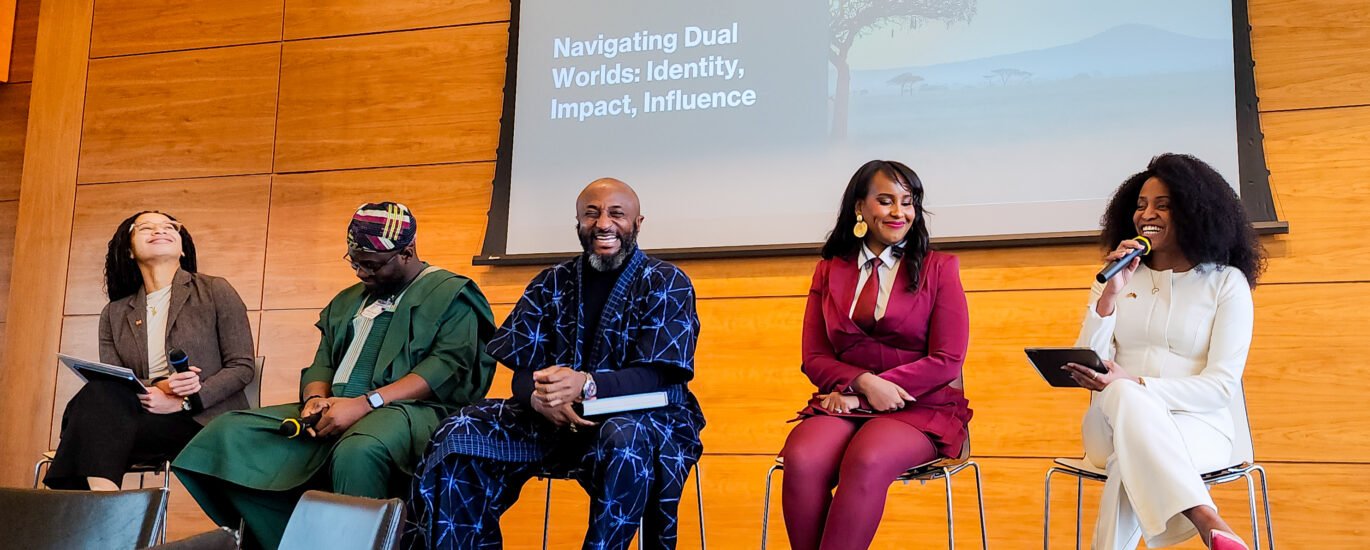
We kicked off 2026 in Ann Arbor on the 6th of February with the African Business Conference at the Stephen M. Ross School of Business.
The conference brought together students, founders, professionals, and builders from across disciplines and geographies — all in one room, thinking seriously about Africa, diaspora, and what comes next.
It was thoughtfully organized by the Africa Business Club, and the energy throughout the day felt intentional. Real conversations. Real questions. Real people doing the work.
I was grateful to share the panel with Oghoghosa Igbineweka (Facilitator – Ross MBA ’26), Ernest Danjuma Enebi, Dayo Adesanya, and Faisa Ali — and thankful to Efosa Omoregie, Michael Olabisi, and the broader UoM team for the coordination and care that went into the program.
It felt good to be in that space — especially coming from Michigan State University, where I’m finishing up my MBA and serving as President of the Black MBA Association. These cross-campus conversations have been overdue, and I hope we get to do more.
My contributions in a way centered on decolonizing entrepreneurship; as a systems question. I have been watching a lot of speeched by Prof. P.L.O. Lumumba, and he has me seeing it and thinking about it all much much differently!
Being inside the U.S. education system, particularly in an MBA program on the other hand, teaches you a lot about how markets are evaluated and how opportunity is framed. Africa rarely appears in core business conversations. When it does, it’s often through risk or uncertainty rather than potential.
My summer at Microsoft deepened that awareness. I spent time observing how leadership thinks about investment, scale, and strategic markets. Africa still sits at the margins of those conversations.
That experience pushed me back into history.
Precolonial Africa had systems of education, governance, and production. Colonial education replaced those systems and trained people to operate inside someone else’s framework. Independence changed flags, but many intellectual and institutional structures remained intact. Over time, intelligence became something validated externally — through language, credentials, and recognition.
That residue still shows up today in classrooms, boardrooms, and policy rooms.
Identity in dual worlds isn’t cultural branding.
It’s epistemic.
Who defines value.
Who defines legitimacy.
Who decides what scales.
I’ve spent about twenty-five years of my life in Malawi and almost five in the United States. At this point, both places feel like home. I’ve made a deliberate choice to contribute meaningfully to both.
Between my work at the UN, partnerships with institutions like the World Bank Group and the EU, and now my MBA journey, I’ve had a front-row seat to how development and entrepreneurship are structured.
After independence, most African countries didn’t go through the kind of industrialization that builds domestic capacity. What followed was a long period of management. Structural challenges were broken down into projects, pilots, and programs.
Over time, that logic evolved.
NGO-ization turned systemic problems into permanent interventions. Today, startup culture risks doing something similar — turning survival into innovation and positioning entrepreneurship alongside power rather than as power itself.
We’ve moved through three phases without resetting the underlying logic:
Africa’s demographic dividend only matters if there are environments that can absorb it. Otherwise, we keep training talent for export and celebrating resilience while losing builders.
Education still prioritizes credentials over production.
Young people learn how to pitch before they learn how to build institutions.
Founders are optimized for funding rounds rather than foundational companies.
This is less about ambition, and more about structural absorption.
This is where I spoke about leadership — and responsibility.
I often use the phrase the next generation of idiots in charge. Less as an insult and more as a warning.
Every generation eventually inherits power. The real question is whether we inherit it consciously.
Right now, many of us are being trained to enter institutions that were never designed for our liberation. We’re learning how to navigate broken systems without being taught how to rebuild them. We’re being credentialed into comfort while structural problems deepen.
That’s how cycles repeat.
Colonial administrators were once young professionals. Post-independence elites were once promising graduates. Every era had its “next generation.”
If we’re not careful, we become highly educated caretakers of the same extractive structures we claim to oppose.
Business school makes this painfully clear. You learn frameworks. You learn optimization. You learn scale. Unless you actively interrogate purpose, you also learn how to reproduce inequality very efficiently.
So the question isn’t whether we’ll lead. We will. The question is what we’ll do with it.
Whether we’ll prioritize titles over transformation.
Whether we’ll chase proximity to power instead of responsibility for outcomes.
Whether we’ll confuse visibility with impact.
Africa doesn’t just need more leaders.
It needs leaders willing to redesign systems.
A big personal update: I’ll be staying in Michigan after completing my MBA through the Detroit Tech Fellowship, and scaling Q2 Systems as a new subsidiary of Bien Corporation from Detroit. Q2 is incorporated in both Michigan and South Africa.
I see this as a bridge — geographically and economically. Michigan is in a many ways a longstanding partner of Malawi, and I hope to build that bridge event further. As I take the work of my companies global, I am most thrilled to build them from what has become my base in the U.S.: Michigan.
Detroit is giving me space, infrastructure, and institutional backing to build.
When I reflect on this, I cannot help but wish deeply that similar pathways existed back home. Founders need real ecosystems: capital, networks, physical space, and policy alignment. I think of how African governments have to rethink how they engage entrepreneurs.
Entrepreneurship has to move from the margins to the center of national development strategy. Entrepreneurs have been seen and supported as nation-builders, not beneficiaries or program participants.
Over the years, I’ve been boxed into many narratives — non-profit leader, inspirational African founder, impact entrepreneur.
At some point, I stopped trying to fit into narratives, and simply focused on designing systems.
At Kwathu, we operate as a business first — profitless, but revenue generating. Every single thing we do must make money before it makes impact. That’s how we fund our work, pay our teams, and avoid donor dependency.
My first question, when presented with any idea, is always simple: who is paying for this?
Howard W. French in his various books describes Africa as “a continent for the taking,” and reminds us that African outcomes have repeatedly been shaped by external powers who then insist Africans bear responsibility for the results.
Africa has always been globally connected. The issue has always been the terms of engagement.
Across eras:
The actors change. The logic stays.
Entrepreneurship risks becoming another extraction layer if we don’t interrogate how value moves.
So when I talk about ownership, I don’t just mean equity.
I mean ownership of value chains.
Foundational businesses, not endless startups.
Talent return treated as state strategy.
Entrepreneurship understood as economic architecture.
Africa has always been for the taking.
I believe we are the generation that takes it back — through institutions that generate revenue, leaders who think in systems, and governments that treat entrepreneurs as builders of nations.
Influence isn’t representation. It is the ability to set the rules.
Grateful for the room yesterday. Grateful for the conversations. And excited for what comes next.
If we connected in Ann Arbor — or if you’d like to continue the conversation — you can always reach me at:
manduwin@msu.edu / nthanda@biencorp.com
Onward.
If you’d like to go deeper into my journey — from Malawi, through the United Nations to Microsoft, you can find it in my books.
P.S. for the new year, you can get any of my books via Kindle for only $2.99.
This offer is valid till the end of the year.
Links to purchase are as below:



Nthanda Manduwi is a Malawian storyteller, entrepreneur, digital transformation advocate, and community builder driven by the mission to empower Africa’s economic landscape through innovation and technology.