Four weeks from now, I’ll be completing the requirements to graduate for my MBA.
Somewhere between coursework and group projects, I was invited by the Multicultural Association to present about my home country, Malawi, to my classmates.
100% of them had never heard of where exactly Malawi is before.
The invitation forced me to pause— because I needed to decide how to introduce a country that is often misunderstood, overlooked, or reduced to headlines that miss its essence entirely.
I realized quickly that I didn’t want to explain Malawi through statistics or development narratives. I wanted to introduce it the way people often encounter a place for the first time: through tourism, culture, and lived experience.
That instinct took me back to where my own journey began.
I started out as a travel and lifestyle content creator while I was still an undergraduate. What began as storytelling—capturing places, people, food, and movement—eventually grew into byntha, a digital space where I explored identity, place, and perspective.
From that work, Bien Corporation Africa was born.
At the time, I didn’t have the language for it, but I was already doing narrative work—challenging how Malawi was seen, and by whom. Tourism became a powerful entry point, less because it is the whole story of Malawi, but because it is often the first door people walk through.
So when I stood in front of my classmates and peers, I chose to introduce Malawi through the same framework used by the Department of Tourism: six core areas that together offer a holistic view of the country.
If you’ve never heard of Malawi, this is where I’d begin.
Malawi is defined by water.
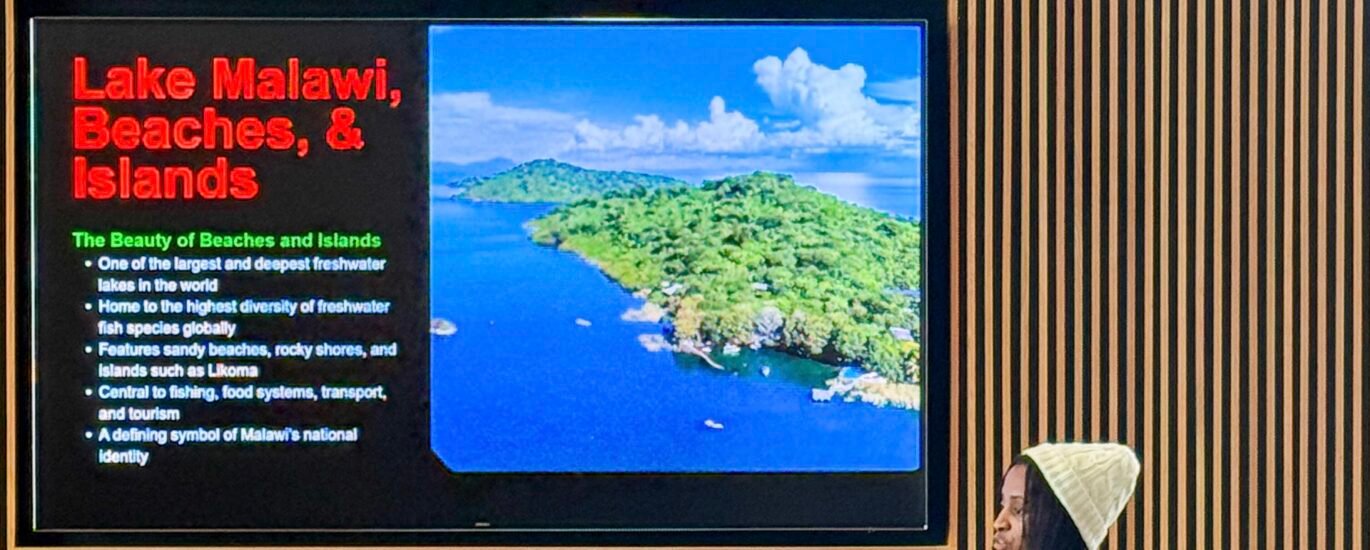
Nearly 30% of the country is covered by water, anchored by Lake Malawi—the third largest lake in Africa and one of the deepest freshwater lakes in the world. The lake is globally significant, home to over 1,000 species of freshwater fish, many found nowhere else on Earth. Because of this extraordinary biodiversity, parts of the lake are recognized as a UNESCO World Heritage Site.
But Lake Malawi is not just a natural wonder. It is a food system, a transport route, a workplace, and a place of leisure. Its sandy beaches, rocky shores, and islands—such as Likoma and Chizumulu—are lived landscapes, not curated attractions.
Beyond Lake Malawi, the country is also home to other important water bodies, including Lake Chilwa, a shallow, seasonal lake surrounded by wetlands that sustain fishing communities and migratory birdlife.
Water in Malawi is not scenery. It is infrastructure.
Flowing south from Lake Malawi is the Shire River, the country’s largest river and its only outlet into the Zambezi River system. Stretching approximately 400 kilometers, the Shire connects Malawi to the wider region, both ecologically and economically.
Along its course, the river supports irrigated agriculture, hydropower generation, and extensive wetlands. Features such as Kapachira Falls highlight the dramatic elevation changes that give the river its energy potential.
The Shire also anchors key wildlife habitats and protected areas, making river-based tourism—such as boat safaris—a defining experience in parts of the country. Smaller rivers and tributaries, including the Bua River, feed Lake Malawi and sustain inland communities.
Together, Malawi’s rivers and streams form the connective tissue between land, water, and people.
For a country its size, Malawi’s terrain is remarkably diverse.
The landscape ranges from highlands and plateaus—such as the Mulanje Massif, Zomba Plateau, and Nyika Plateau—to valleys and lowlands, including the Shire Valley and the floor of the African Rift Valley.
These elevation shifts create varied climates and ecosystems within short distances. Cool, misty highlands give way to warmer lowlands and lakeshore plains, shaping agriculture, settlement patterns, and biodiversity.
Malawi surprises people not with scale, but with density: so much variation in so little space.
Malawi is also quietly one of Africa’s conservation success stories.
The country is home to national parks and wildlife reserves such as Nyika, Liwonde, Majete, and Vwaza, many of which have undergone significant restoration in recent decades. Through partnerships and community-centered conservation models, species such as elephants, rhinos, and lions have been successfully reintroduced.
Wildlife conservation in Malawi emphasizes sustainability and local involvement. Parks are not isolated from surrounding communities; they are integrated into livelihoods, tourism, and long-term ecological planning.
This approach has helped reposition Malawi as a destination for responsible, experience-driven wildlife tourism.
Malawi’s cities and towns reflect its character: functional, human-scale, and closely tied to their surroundings.
These urban centers are not megacities. Life here remains relational, with strong connections between urban spaces and nearby rural landscapes.
Malawi’s cultural fabric is shaped by multiple ethnic groups, including the Chewa, Yao, Lomwe, Tumbuka, and Ngoni. Chichewa serves as the national language, alongside many local languages spoken across the country.
Culture here is not preserved for display—it is practiced daily. Respect, community, and hospitality shape social interaction. Music, dance, storytelling, and food are woven into everyday life, not reserved for festivals alone.
This is where the phrase “The Warm Heart of Africa” finds its meaning. It is not branding; it is behavior.
Tourism is not Malawi’s entire story. But it is an honest beginning.
It allows people to encounter Malawi through water, land, culture, and human connection—before assumptions take root. It invites curiosity instead of explanation, experience instead of abstraction.
Standing in front of my classmates, four weeks from graduation, I realized that introducing Malawi wasn’t about covering everything. It was about opening the door correctly.
And if someone walks away remembering clear water, layered landscapes, living culture, and quiet warmth—that is a very good place to start.
Welcome to Malawi.
The Warm Heart of Africa.
If you’d like to go deeper into my journey — from Malawi, through the United Nations to Microsoft, you can find it in my books.
P.S. till the end of 2026, you can get any of my books via Kindle for only $2.99.
This offer is only valid till the end of the year.
Links to purchase are as below:



Nthanda Manduwi is a Malawian storyteller, entrepreneur, digital transformation advocate, and community builder driven by the mission to empower Africa’s economic landscape through innovation and technology.