I actually was not sure if I was going to write today.
Between you and I, I am amazed at how well I took not making it to the top 5 of the Burgess New Venture Challenge.
Surprised? No. Not at all, but as an entrepreneur, you put it all on the line, and… yeah… it can feel like a punch to the gut.
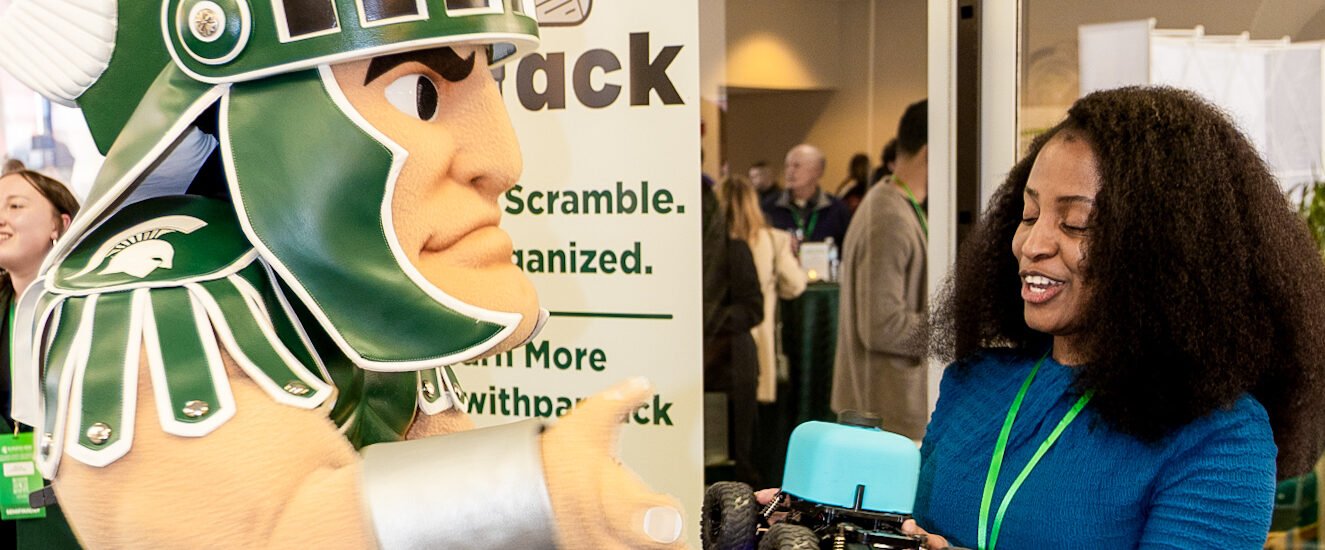
It felt quite full-circle to step into the Marriott Hotel in East Lansing—the very first place I ever came to, during my diversity preview day at Michigan State University, then exploring their MBA program.
It was during that event that I was to meet Elliot Smith, who I shared with my aspirations to build my company during my MBA. He made me aware he was building his company too, and that the Burgess Institute for Entrepreneurship and Innovation was an incredible resource to him, and would be to me, too.
I have worked closely with Burgess in my time at MSU: as a mentor, as a judge during pitch competitions, building my own company, and eventually, pitching too.
When I decided to do the Burgess New Venture Challenge this year, I had to set it clear in my head why I was doing this.
In 2024, I had just finished my mission with the United Nations in New York, and went home to rethink my Technology Business. I love my business deeply. I know it is my northstar.
In just a few weeks of being back home, it was terribly clear to me that Education Technologies were nice to make, but if we wanted to play as a real business, we had to go above and beyond it: I had to think of more industries, and I did.
I spoke at length with various entrepreneurs and business men and women in my country, and it was clear that Agriculture was an incredible opportunity. The only problem: I knew not very much about Agriculture, beyond the garden I had in my parents’ home, and our family farms.
I had not farmed at a largescale before in my personal capacity, and here I was declaring that I wish to get into mega farming.
I remember telling my team that we were pivoting to Agriculture, and I recall receiving a resounding no from several individuals.
I did not study computer science to become a farmer.
At the time, I had an offer to pursue an MBA at the Broad College of Business at Michigan State University. I had yet to commit, as I was unsure I was ready to pursue a second Master’s Degree. I eventually committed, and have spent the past 19 months fully-embedded in a rigourous business program, and being incubated in one of the best innovation hubs: Burgess.
Over the past year, I can say I managed to pivot my company into AgTech. That much I did, and well.
What I didn’t fully anticipate was how difficult it would be to translate what we’re building into something that fits neatly into a five-minute pitch.
Pitch competitions are structured environments. They reward clarity, speed, and familiarity. I have been on varying ends of this: as a mentor, as a judge, and newly, as a participant. I understand how all the sides of it work.
A strong pitch answers a few questions almost immediately:
The best pitches remove friction. You understand them quickly, and you know where they sit in the market.
That works incredibly well when the product itself is simple. It helps when you understand that judges are also humans with personal biases: they are thinking ‘how does this solve MY painpoint’?
“I am making a banana protein energy bar that has uncomplicated ingredients” ✅
A winning pitch. It solves nearly everyone’s painpoint. As by last night’s outcomes: a $15,000 pitch.
My first pitch competition was in 2021. I pitched Digital Skills for Africa. It was clean, direct, easy to understand. We won first place. We executed a $250,000 digital skills grant with the World Bank. We were the EdTech innovation of the year in Malawi.
That was the first and likely last time I pitched something that could be explained in a single line.
The showcase at BNVC was, surprising to me, my favorite part of the day. As an introvert, it takes quite a bit to make space for conversing with people; and let alone about my business[es].
The people were interested in two stories:
As a storyteller, that was fun for me to tell.
When I decided to pivot into agriculture, I wanted to build a solution for farmers. I wanted to build a solution for me. I wanted to become a farmer.
Here was my painpoint: I live and work in the United States. My businesses operate mostly out of Malawi. Most of my team, by way of education, has moved to various continents, and we all work together online.
My team and I have tried different tools—Slack, different workflows—until we eventually landed on Microsoft Teams. This works VERY WELL when you are building Educational Technologies. It gave us a way to coordinate, communicate, and operate across borders.
Farming, however, I quickly realized was to be different. Teams didn’t solve the real problem. If I was to manage mega farms virtually, I would be needing visibility into the ENTIRE FARM, ALL THE TIME.
That is how Kwathu Smart Innovation Farms came to be.
The plan was Large-scale farming. Mechanized, IoT enabled, structured, intentional. From day one, I knew I would be managing across distance. I was thinking of what 4IR solutions would work for us.
One of my closest friends, Raj, manages farms in Malawi, Zambia, and Angola. Incredible farms: but he is ALWAYS flying around to monitor them. That comes at a cost. Financially, yes. But also in time, in energy, in physical strain. I knew that would be a strain on me. I knew that I didn’t want to build systems that depended on that.
So the question became: how do you see your farm without being there?
I immediately started thinking of how give myself, and other farmers, complete visibility into their farming systems.
That was the starting point.
That’s how we landed on digital twins.
A digital twin, at its simplest, is a real-time representation of a physical system. It allows you to see, monitor, and understand what is happening without being physically present.
For me, this was operational. If I’m managing farms across geographies, I need to know:
And I need to know that without flying across continents.
That was the first layer.
The journey was perhaps more long and winded than it could have otherwise been. The Universe is intentional in all its ways.
I somehow got to reflect a lot, as I spoke to people during the showcase about why Q2 Systems exists. In November of 2024, I was hired my Microsoft, to work with Xbox on the Developer Acceleration Programme. The gaming industry seemed just too far-fetched: I came to MSU to build an AgTech company, and suddenly was drawn into the gaming world.
As principle: I decided to lean in anyway. If I was going to work in this industry, I was going to understand it. Fully.
What I learned was simple: gaming is massive. It is the most profitable entertainment industry in the world [generating more revenue than all the entertainment industries in the world combined], sitting at over $330 billion. As an entrepreneur that got my attention. I started thinking about building games alongside the farm—something that could generate revenue, something that could sustain the farming business as I wanted it.
At the same time, I was still designing the farm. Mapping it out. Thinking through what it looks like in five years, ten years. How it scales. How it operates. My vision was to build cities… different kinds of cities, from basic farms.
One day, after laying all of that out, standing in my hotel room in Redmond, it clicked. This is a simulation. Not in theory. In practice.
I had already built the world. The logic. The systems. The progression. The question was whether people would play it. I asked my friend, Alvaro—an avid gamer, and he looked at me like it was obvious. Of course people play simulations. Farming simulations exist.
I went into the Xbox database and looked at the numbers. Farming Simulator had sold 2 million of copies within the first week of its launch. At $49.99 per copy, that is $100,000,000. 100 million dollars. Easy.
That was my lightbulb moment.
The simulation idea grew from being just a teaching tool for me. It was a product. A way to build, test, and even fund the system.
That is how we got into simulation.
The next shift for me happened in San Francisco. We had just finished representing MSU at TechCrunch Disrupt. After the conference, we decided to explore the city. We wanted to see the Golden Gate Bridge.
On our way there, we kept seeing Waymos everywhere. I at the moment did not even know what a Waymo was, or that fully self-driving cars were a possibility. I knew of hybrids: Teslas. Waymos were alien to me.
I remember commenting that the new Jaguar design was rather pelicular; to which Alvaro made me aware those were sensors, and that these were self-driving cars. I was fascinated.
On our way back, I immediately suggested that we take one. Everyone hesitated. I didn’t.
The onboarding took seconds. Logged in with my Gmail, payment already connected via my Apple Pay, car on the way, and cheaper than Uber! Seamless.
And then we got in.
The interesting thing about autonomous vehicles is that people are skeptical until they experience them. Once you’re inside, the trust builds quickly.
That was the moment.
Sitting in that car, it was clear: autonomy is here. And it will scale, fast. Immediately, I connected it back. Farmers will need autonomous systems. I would need autonomous systems.
With the speed at which technology is advancing, my projection was that this would be soon.
I went deep into the autonomous mobility space. It was all I did during my 2025 winter break. I researched the industry end-to-end. I looked at what companies like John Deere were doing, what robotics looked like in agriculture, where the gaps were. What stood out was simple: there are not many people building autonomous systems for agriculture from the ground up. That became the next layer. We were going to do this, both in our commercial simulation, and in real life. An actual digital twin, simulated. A close-loop.
Everything started to connect, and it was all falling into place. If you have autonomous systems, they are already moving through the environment. They are already interacting with the field. Which means they are already collecting the data you need to build digital twins.
The data feeds into the digital twin.
The digital twin feeds into the simulation.
The simulation improves decision-making.
The simulation gives a new kind of visibility to the data collected by autonomous systems.
At that point, it stopped being separate ideas.
It became one single adaptive system.
I thought I had done something novel: that I had created a new category—come up with something new. I shared my pitchdeck with Aubrey at Burgess, and I remember her writing to me a description of my company: “Q2 Systems is building cyber-physical infrastructure: a single adaptive ecosystem.”
It was the first time I heard the term cyber-physical infrastructure.
I went back and looked it up. That was exactly it. Not a farming company. Not a robotics company. Not a simulation company. A systems company. I had arrived where most people building seriously in the 4th Industrial Revolution end up: it all needs to work, and it needs to work together.
I was quick to realize how incredibly difficult it would be to make what I was building land in a pitch.
It doesn’t reduce easily. It can. You can choose to pick a wedge: to focus on communicating just the one thing, and say you are building just that one company. I consider however, that flattening my company for the sake of winning a pitch serves noone. I’d miss out on all the people that truly need to see what we are actually building here. It is not just one farmers painpoint. We want a wholistic supply-chain solution.
Agriculture is not one problem. It is logistics, climate, labor, data, infrastructure, and decision-making all interacting at once. Trying to isolate one part without understanding the rest felt, for me, who needed an end-to-end solution, incomplete.
We could choose to build for only one of these things; but I am truly comfortable with building across layers.
So we are building across layers:
My strength—and my curse—is that I see systems, not products.
The common advice in entrepreneurship is to do one thing and do it really well. Build a product, generate revenue, and scale.
I understand that advice. I have done it plenty-a-times. I give this advice to first-time entrepreneurs, too.
At the same time, I am unwilling to break the system into something smaller just to make it easier to explain. We will start with a wedge: Agriculture IoT systems, but we are building with the full system in mind from day one. As founder, it is important that vision stays with me.
I was always clear we are never going to win a pitch competition, especially on a collegiate stage that rewards easier-to-launch and scale CPG products. As my AI asked me during our debrief last night:
Then why were you trying to win on that stage?
The truth? I was never trying to win. I had a lot to learn, and I knew this was the precise process I needed.
What’s been interesting is that each part of the system is validated in its own way.
Our first game idea got us into Microsoft Xbox Game Camp Africa. I do not have a doubt in my bones that that game will succeed.
We took the simulation concept into a very competitive AI challenge. We made it to the finalist round.
We conceptualized the autonomous systems, and were selected for the inaugural Detroit Tech Residency Fellowship.
Across different environments, different parts of the system have been validated.
The challenge has never been whether this is necessary, or if it works. The challenge has been presenting it as one coherent thing. It is an extremely difficult thing to do, and I carry this burden with pride.
I know one thing for sure: it will be WAY easier to show, that tell. I’m committed to building towards that.
In the private pitching room at BNVC, the tension showed up clearly. I could see by the faces that some judges struggled with it.
Two of the judges however understood immediately. They already invest in mobility. They know the gaps. I was fitting right into the gaps they already saw.
One of them was nearly explaining the company on my behalf during my questions session. They were asking specific questions about the system, about deployment, about how this scales. They came up to me after and said we should talk further. This was a win: I walked away with two potential investors.
In conversation later with one of the judges who eventually told me he loves what we are building: he described the system as hard to understand. It didn’t fit into a familiar category. It wasn’t CPG.
He told me that my pitch was strong, and that he only had one piece of advice for me: he said that I was aiming too small. He said I shouldn’t be raising $1M. I should be raising $5M, and I should be having those conversations in San Francisco, where deep tech and systems-level companies are better understood.
The room wasn’t split on value. It was split on legibility. What won that night was easy to understand, and easy to scale companies.
We are not in this for easy.
The most useful part of the day was for me the showcase.
I, for the first time ever, was having conversations about the company I spent near one and a half years building in my Lansing home. I was speaking with people across completely different levels of familiarity with technology. Some understood what a digital twin was. Others had never heard the term. I spoke to people who had grown up on farms, and people who had never stepped onto one.
I found myself translating constantly. At some point it clicked.
I wasn’t pitching a product. I was introducing a possibility of a future. A future that most people in deep tech are betting on. A future where systems talk to each other. Where data is not an afterthought. Where decisions are made with visibility before resources are committed in the real world.
People responded to that.
One of the people said, “My dad is a farmer. This would change everything.”
Two computer science students were deeply fascinated with the company. They immediately were able to say “This is where technology is going,” and asked how they can work with Q2 over their summer.
In communication, I say the product is simulation. But in ernst, the product is not simulation. The product is better decisions before you commit. I need that knowledge. I’d like to make better decisions. I know many of us do.
As we wrapped up the day, a student walked up to me and asked a simple question.
What keeps you going when you fail?
I told him I fail every day. That’s the job. I failed last night.
The heart of entrepreneurship is continuing anyway. You sit down, you build, you refine, you try again.
He asked me another question.
If you were to die tomorrow, what advice would you give to an entrepreneur starting out?
My response was simple: be real.
There’s a lot of performance in the world. In this space. People trying to sound like what they think a founder should sound like. The only thing that has worked for me is being grounded in what I actually believe and building from there.
I was the only company pitching mobility at the 2026 BNVC.
Not pure software, not consumer goods, not a packaged product. Robotics, mobility, and infrastructure. It is a difficult category to compress.
I could split this into three companies. Raise smaller rounds, build each piece independently, and make each one easier to explain.
That path exists. Perhaps I will cave and take it someday, but I acknowledge it would be caving.
The bet I am taking is that this only works as one vertically integrated company.
A system where simulation, data, and autonomy are designed together, not retrofitted later.
Long term, I see separate leadership across each vertical. A CEO for every company, I only as founder. The architecture forever unified.
I suppose, I am trying to communicate my 50 year vision, from the beginning. I suppose, this is where I lose the audience.
I’m also aware of where I am.
I’m a solo founder. When I embarked on the Q2 vision, I shared it with Alvaro, and he assisted me best he could. However, he stepped away to build his own dream – something as a builder myself I am fully respectful on.
With knowing this, I know that execution takes longer. I know that it requires more coordination, more capital, and more patience.
At the same time, I’m not a first-time founder. I’ve built before. I’ve managed teams of 60+. I’ve operated across different environments. I understand what it takes to move something from idea to reality.
I remain open to on-boarding mission-aligned co-founders, though I am not in a rush to get there.
This is a different level of problem. This is my life’s work. This is an economic model. This is a big bet. This is my big bet.
I’m stepping back from pitch competitions for the foreseeable future. Mostly because I have to carefully choose what to optimize for.
I think pitch competitions are amazing. I think they force clarity. I think you should do one or 5 in your time, if you aspire to build something.
Pitch competitions force you to understand every part of your business. They expose where your thinking is not yet sharp enough. I benefitted a lot in that process, trying to do that for Q2. I nearly wrecked my brain doing so. That was useful.
At the same time, I’m building something that requires a different kind of conversation. Conversation with actual, big investors.
Speaking of conversations: I am on my way to Kenya, for Africa Exchange, where Kwathu Smart Innovation Farms has been selected as an exhibitor. We will, for the first time, be bringing our solutions to the people we always intended to serve.
My next steps involve setting the goal of raising $5M, and building Q2 intentionally and properly. I am most excited for this chapter.
If you have $5M and the willingness to bet on an inevitable future, I’d love to talk nthanda@q2sys.com
Ntha
Detroit, Michigan
April 2026
If you’d like to go deeper into my journey — from Malawi, through the United Nations to Microsoft, you can find it in my books.
P.S. for 2026, you can get any of my books via Kindle for only $2.99.
This offer is valid till the end of the year.
Links to purchase are as below:



Nthanda Manduwi is a Malawian storyteller, entrepreneur, digital transformation advocate, and community builder driven by the mission to empower Africa’s economic landscape through innovation and technology.