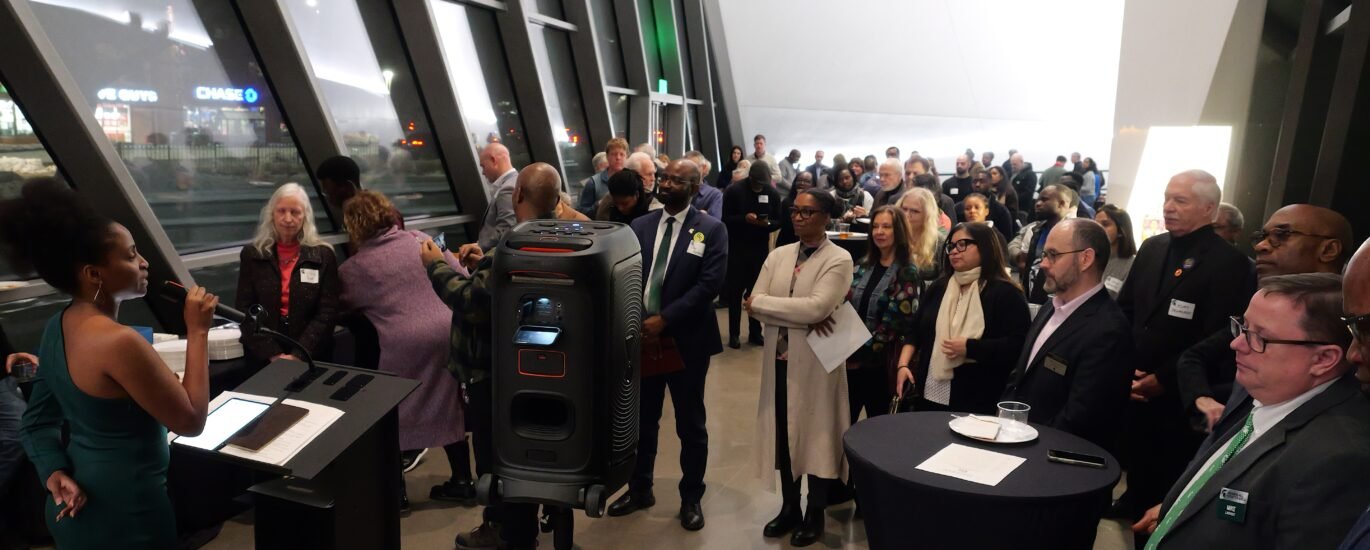
On the 6th of December, 2025, we convened in the MSU Broad Museum of Art, in commemoration of 65 Years of Africa at the Michigan State University.
A celebration of time passed, and a moment to take stock of the work carried forward, the people shaped along the way, and the responsibility that comes with longevity.
The African Studies Center has spent six and a half decades building relationships across the continent, training scholars and practitioners, and sustaining an intellectual commitment to Africa that has outlived trends, funding cycles, and leadership changes. That kind of endurance does not happen accidentally. It happens because institutions choose seriousness, memory, and continuity.
I had the honor of serving as Master of Ceremonies for the evening. I took on the role as a responsibility to hold the room, the history, and the conversation with care.
When the ASC team invited me as an MC, they encouraged me to share on my personal story, and my organizations’ work in Malawi.
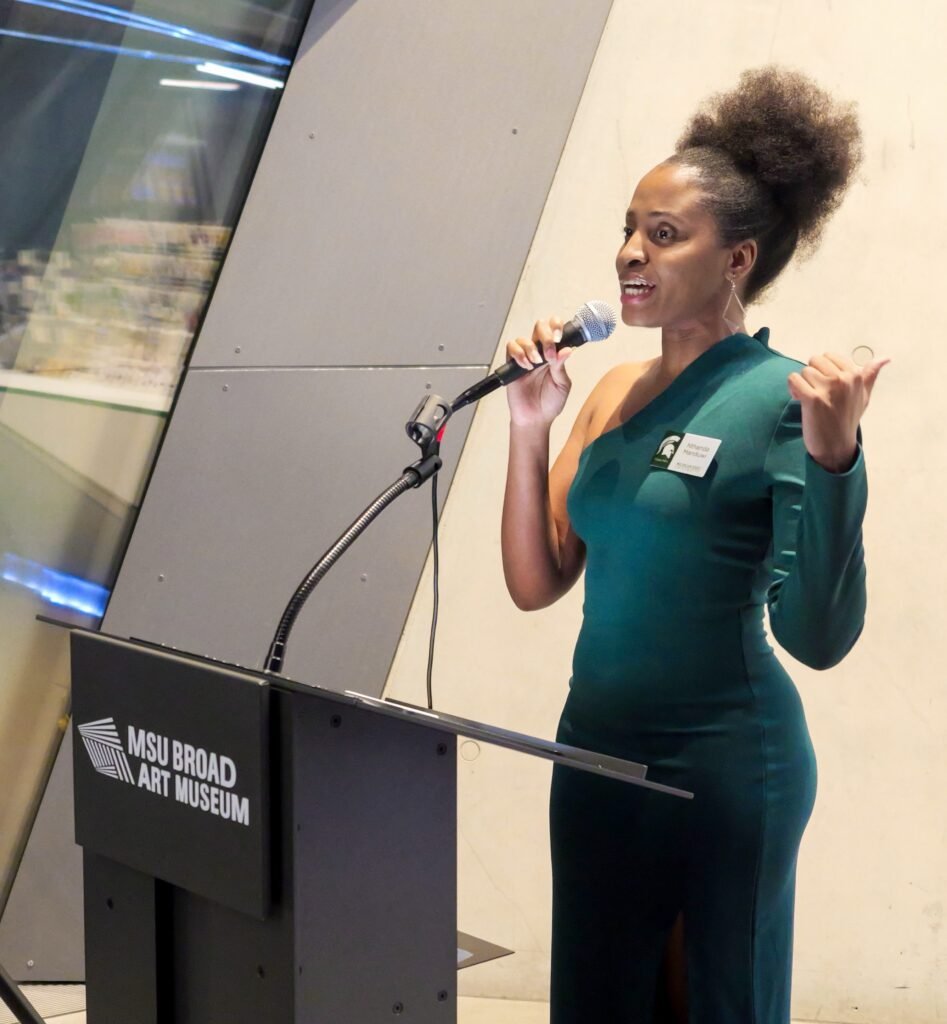
Photography by Michael Green (African Studies Center)
I was born and raised in the beautiful beach town of Mangochi. Growing up there gave me an early understanding of how systems shape outcomes, often invisibly, and how small design decisions compound over time.
Before coming to Michigan State, I spent several years working with the United Nations and engaging closely with global development institutions. These experiences were formative to me. They exposed me to the architectures that govern aid, policy, and international cooperation, and to the distance that can exist between intention and lived reality.
After my UN tenure, I returned home to Malawi to continue building innovation hubs and digital products for young people. The work resonated. People used what we built. Communities engaged. But the economics did not sustain themselves. It became clear that impact alone is not enough. Systems must be viable if they are to endure.
That realization is what led me back to the U.S., and specifically to the Michigan State University.
I came with one central question that I needed to understand properly. Agriculture. How a country with fertile land, water access, and human capital could still struggle to feed itself. I felt there was something I was missing, and I was determined to find it.
I chose MSU deliberately because it is an institution that treats agriculture, education, and supply chains as serious fields of study, not peripheral concerns.
I came looking for rigor, and two months to the completion of my MBA, I am delighted to say that I found what I was looking for, and more.
Dr. Leo Zulu’s reflections during the evening captured something essential about Africa-facing scholarship. Before we strengthen agriculture, logistics, or technology, we must strengthen people. Their skills. Their imagination. Their ability to design, maintain, and adapt systems over time.
That has been the quiet work of the African Studies Center for 65 years.
The Center has trained generations of scholars, teachers, researchers, and practitioners who carry this work forward into classrooms, governments, organizations, and communities. It has functioned not just as a site of study, but as a place where capacity is built and renewed.
That legacy was present in the room. Not as nostalgia, but as continuity.
The evening also reminded us why institutions honor people.
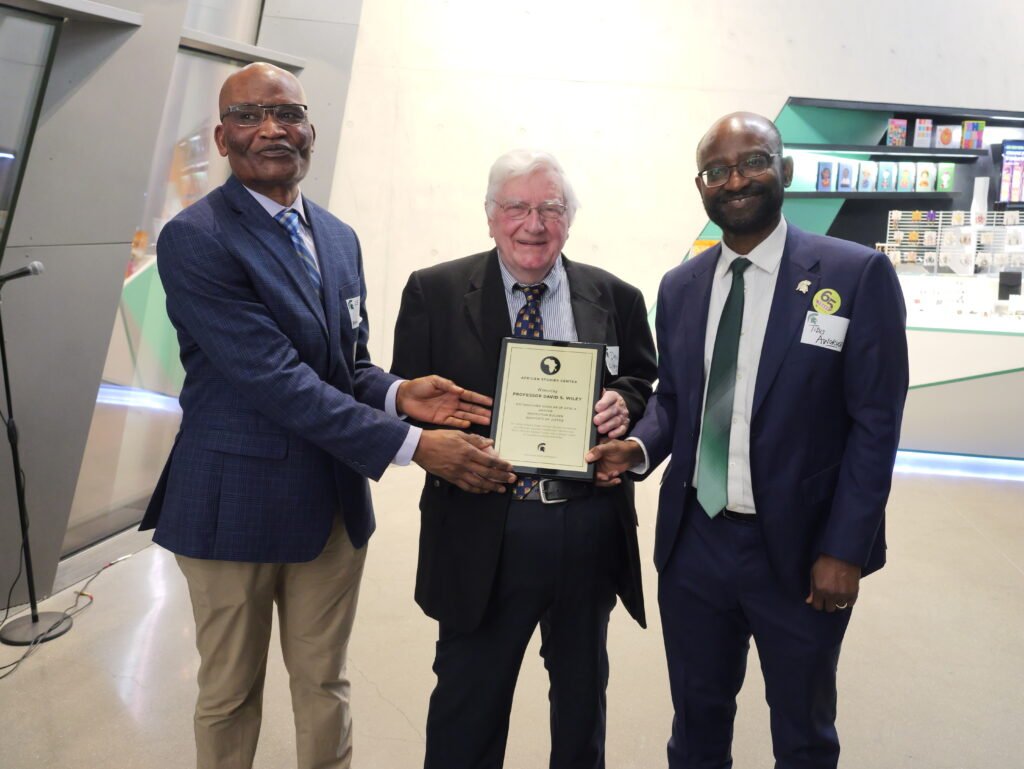
Recognizing Dr. David Wiley was an acknowledgment of leadership that shaped direction and stewardship over time. Welcoming Dr. Kurt Dewhurst was a reminder that archives, arts, and cultural memory are forms of infrastructure. They determine what is remembered, what is taught, and what is possible to build upon.
Institutions endure because knowledge is preserved, documented, and transmitted. Writing, research, and archives are not secondary to progress. They are how progress becomes legible.
As someone who writes and researches alongside building, this resonates deeply with me. Stories, when recorded carefully, become tools for understanding where we are and how we arrived here.
The morning of the event, I was in conversation with the UN Humanitarian Office about hunger in Malawi. The country has declared a state of emergency.
Malawi is one third water. It has fertile land and a population deeply connected to agriculture. Hunger in that context is not a failure of effort. It is a failure of systems.
Institutions that study Africa, teach its histories, and shape its future-facing scholarship carry a responsibility beyond analysis. They help determine what problems are normalized and which are treated as unacceptable.
Hunger should not be a reality on the African continent within our lifetimes. This is more than an abstract aspiration of mine now. It is my call to all of Africa’s partners. I think it is a reasonable expectation if we take systems, training, and long-term investment seriously.
Following the event, I entered conversations with the African Studies Center about how this shared commitment could extend beyond the evening itself.
As I prepare to graduate, we are exploring a partnership to host the next Ntha Foundation Gala in collaboration with the African Studies Center. The gala is an annual gathering rooted in community, scholarship, and responsibility, and it reflects the same values that were present throughout Africa @ MSU at 65.
This potential partnership matters to me because it represents a shift from reflection to collaboration. From convening to building.
The upcoming Ntha Foundation Gala will be a part of our continued fundraising efforts toward the construction of the Kwathu Innovation and Creative Centre in Malawi. The Centre will be housed within the Kwathu Smart Innovation Farms, our flagship initiative focused on integrating education, agriculture, and logistics in a way that is locally grounded and economically sustainable.
The goal is simple and demanding. To create a physical space where learning, creativity, research, and production coexist. A place where young people can build skills that translate into systems that last.
Work like this requires partners who understand long horizons. Institutions willing to invest not only in ideas, but in infrastructure and people. The African Studies Center is exactly that kind of partner.
As a student from Malawi, I am deeply grateful to the African Studies Center for investing in students like me. We are not only beneficiaries of its legacy. We are its next custodians.
Africa @ MSU is not a chapter that closes at 65. It is a living relationship between scholarship and practice, between institutions and the people they shape, and between reflection and responsibility.
I look forward to continuing this work in partnership as I return to Malawi, carrying forward what has been built here and contributing to what comes next.
If you’d like to go deeper into my journey — from Malawi, through the United Nations to Microsoft, you can find it in my books.
P.S. till the end of the year, you can get any of my books via Kindle for only $2.99.
This offer is only valid till the end of the year.
Links to purchase are as below:


Nthanda Manduwi is a Malawian storyteller, entrepreneur, digital transformation advocate, and community builder driven by the mission to empower Africa’s economic landscape through innovation and technology.