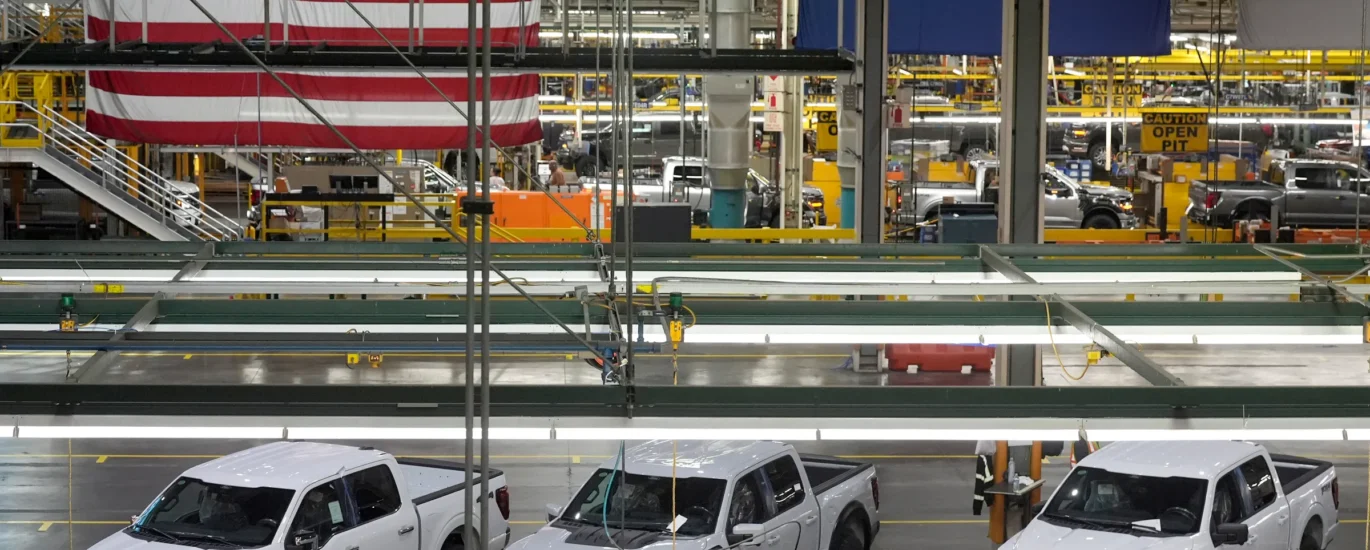
Every thirty seconds, an F-150 truck rolls off the line.
I was standing on the factory floor at the Ford plant in Dearborn, Michigan, and I could not help but focus on the thirty-second mark.
Trevor, our host – my students’ project sponsor, shared with us that every thirty seconds the conveyor belt advances at fixed intervals. Workers complete their precise tasks, and on the other end — a part we did not get to see — robots handle structural assembly.
What struck all of us immediately was the choreography. How tight it is. How coordinated it is.
While my engineering students were focused on the mechanics and the engineering side of things, I found myself looking at the system as a whole.
One detail stayed with me: 600,000 F-150 trucks a year.
With that [alongside other products], Ford generates roughly $187.3 billion in revenue, yet the company takes home only around $10 billion in profit.
10 billion dollars in profits sounds great, but not when you are comparing that to the scale of production and efficiency required to actualize it. In a scale that intricate — every moment matters. Every mistake counts. Small errors are millions of dollars in losses. There cannot be [unneccessary] losses.
For Ford to be in business — for the company to make economic sense — every minute must be a working minute. Even a small interruption cascades across suppliers, logistics networks, labor schedules, and distribution channels.
The assembly line cannot stop.
It must not stop.
The team mentioned that they produce roughly 600,000 F-150 trucks a year. This truck is their bread and butter. This is what keeps the lights on: why they have jobs.
I asked whether that volume — 600,000 meets the demand.
The answer was yes.
So much so that if one plant shuts down, dealerships begin calling almost immediately asking why they are behind on inventory.
That thirty-second rhythm is more than just operational efficiency.
It is an economic requirement.
The system must keep moving.
Every thirty seconds.
I woke up at 7 a.m.
I had to jump on call with my students from the Malawi University of Science and Technology, who are with us at our hub for the final semester of their studies.
One of their current projects focuses on AI and data modeling, and we had to review their progress as they are now in week 6 of their internship. I was too tired, and opted out of the meeting, letting Moriz carry the weight on this one.
This juggle has over the past few years become a fairly normal rhythm in my life — starting the day in Africa [as my teams in Malawi are 6 hours behind] and finishing it somewhere else entirely.
I got up, got ready, and ordered an Uber to Dearborn.
We had been given the precise address for the [new] Ford’s World Headquarters, but I made the mistake of assuming that typing “Ford WHQ” into Uber would simply take me where I needed to go.
Instead, it took me to what I was to later realize is the old Ford headquarters — the glass building from the 1950s designed by Gordon Bunshaft that for decades symbolized the company’s presence in Dearborn.
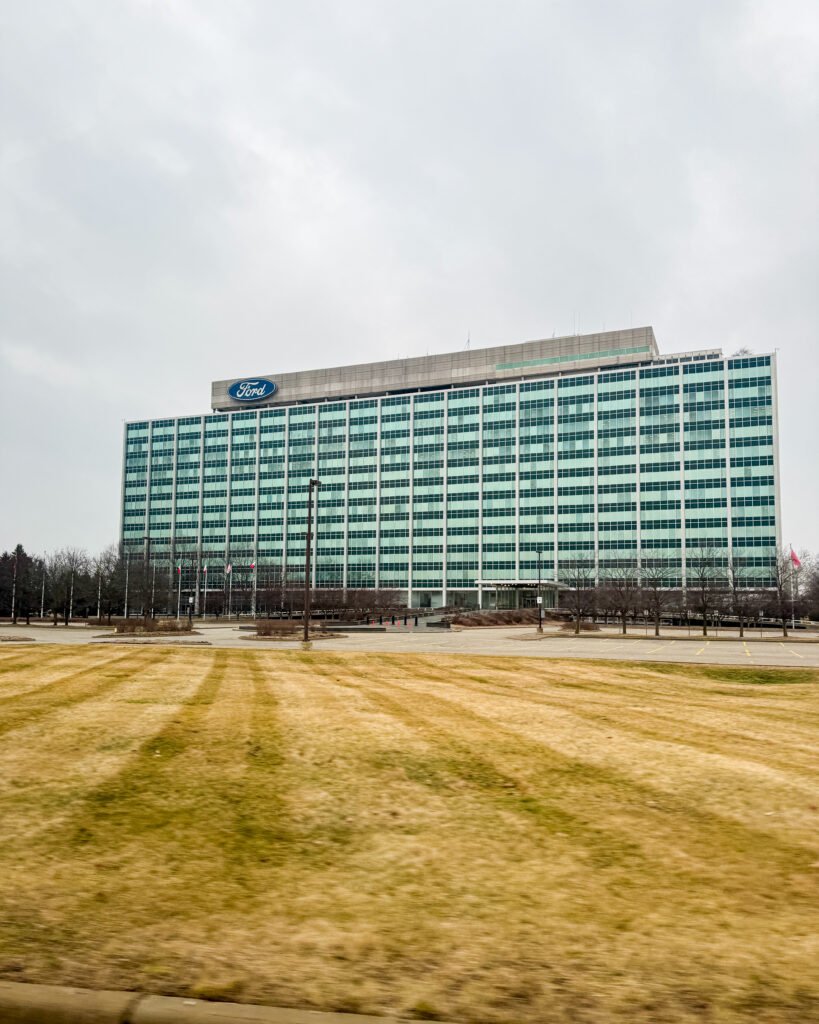
Standing outside the wrong building, waiting for my second ride, I asked the receptionist what would happen to the site once Ford fully relocated.
“They’ll probably tear it down,” she said casually.
The comment stayed with me. As someone struggling to raise even just a few thousands to construct the first HQ of the Kwathu Innovation and Creative Centre in Malawi, I could not for the life of me understand how the consideration of tearing down such a monumental development could be carried so lightly.
Only a few hours later, I would be standing inside one of the most sophisticated industrial systems ever built — watching a conveyor belt move with a precision that has been refined over more than a century.
As I spoke to the Ford team, I paid close attention what $187 billion in revenue actually looks like in practice.
We toured the plant in reverse — beginning with the finished vehicles and gradually moving backward through the stages of assembly. It almost felt like dismantling the product in order to understand how it had been built. We moved all the way back, to where the chassis had just been delivered by train.
The Dearborn Truck Plant (DTP), located within the Ford Rouge Complex, is officially supplied with F-150 chassis and structural frames primarily by Autokiniton and Metalsa. These suppliers provide the high-strength steel frames that are “married” to the aluminum bodies during the final assembly process in Dearborn.
Ford today is supported by a global workforce of approximately 169,000 employees, with roughly 6,000 working at the Dearborn plant alone.
At this scale, profitability depends far less on high margins and way more on continuous throughput.
I came to Michigan originally intending to study supply chain management [my dad convinced me it was a great idea].
Of no surprise to me: I had little interest in the field at the time, and eventually moved toward business analytics and marketing management. Still, I have taken a few courses, and have continued to learn about, as well as contribute to the field of supply chain management by way of my work with the Applied Engineering Sciences and Supply Chain Management course I support in the College of Engineering.
Standing in that plant, I could see the supply chain as a living system.
Every component must arrive exactly when it is needed. Every process must work within extremely narrow tolerances.
Trevor works closely with suppliers, mapping both supply and demand 5-10 years out; and ensuring all supply-chain disruptions are throught of and through.
Ford’s profitability depends less on individual transactions and more on the simple fact that the system must keep moving.
Every thirty seconds.
The assembly line represents the physical expression of a much larger structure:
Together these layers form the backbone of modern industrial capitalism.
The automobile industry illustrates an important economic principle to me. Unfortunately my brain [still] processes in the binaries of supply and demand.
Large-scale production requires extremely efficient systems. I perhaps understood this before; but not so much as I do now.
Factories alone do not create industrial economies.
They require supporting infrastructure that must operate with equal precision:
During our visit, the supply chain team explained how they must anticipate needs years in advance. Components, materials, and production capacity are planned five to ten years ahead.
Everything must arrive at the right place, at the right time. There can be no mistakes.
If one layer fails — even briefly — the entire ecosystem begins to unravel. Every thirty seconds.
Automobile manufacturing therefore functions as a central node within a broader economic architecture.
The vehicle leaving the assembly line every thirty seconds is simply the visible output of that system.
Behind it exists a network of suppliers, engineers, financiers, regulators, and consumers all operating within the same economic organism.
As an African, credit is not something I became [that] familiar with until I moved to the United States.
Growing up, credit was generally viewed as ‘bad”. You do not take credit. Debt was something to avoid.
“Live within your means. Build with what you have. Keep it lean.”
When I arrived in America, one of the dominant narratives I encountered was that the economy functions by keeping people in debt. For a while, I believed it too.
But standing inside this industrial system, and I suppose now having completed my MBA: I for the first time ever, began to see credit differently.
Vehicles are capital-intensive consumer goods. For most households, purchasing a car outright would not be possible without financing.
Automobile companies therefore operate within a dual system:
Factories produce vehicles.
Financial institutions produce loans.
Credit, in this sense, is not simply a financial product. It is a structural mechanism that allows large-scale manufacturing to function.
Without it, demand collapses.
And if demand collapses, the assembly line stops.
There’s a personal dimension, for me, in all of this.
My first experience with Ford was through my father’s Ford Ranger in Malawi — a vehicle that, like many others across the African continent, forms part of the everyday landscape.
When I mentioned this to Trevor, he noted that the Ranger is indeed the model Ford primarily sells across African markets.
Seeing the F-150 at the plant reframed everything.
What had once been a simple vehicle in the background of my life at home suddenly appeared as the output of one of the most sophisticated industrial systems ever built.
I came to Michigan to study business.
Standing inside the plant, I found myself studying something else entirely — capitalism itself: the architecture of industrial civilization.
I joined this trip primarily because my students were having a tour in relation to their project. My presence was a ‘nice to have’, not so much a need on my students’ part. Truth be told — they are so brilliant, they were to be just fine without me.
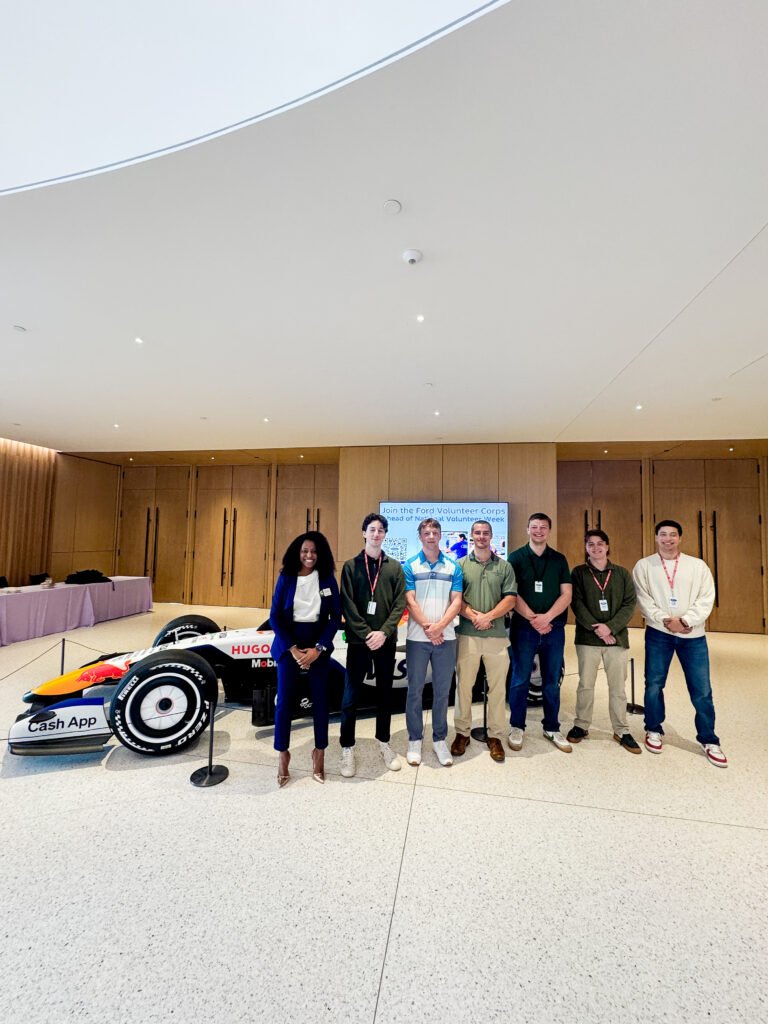
My personal interest: I am building my own venture – an autonomous mobility company, and I could not help but think about the future of industrial systems.
The assembly line to me defined the twentieth century.
But the systems shaping the twenty-first century will [likely] look different.
My bet — they will be:
Autonomous vehicles, artificial intelligence, digital twins, and intelligent infrastructure are already beginning to reshape how large systems operate.
In many ways, the companies building today are designing the next generation of industrial architecture. Taking a walk through what has been left me intimidated, inspired, enthralled.
This is where the visit became particularly meaningful for me as an entrepreneur.
At Q2, we are exploring systems at the intersection of autonomy, infrastructure, and simulation. Our work focuses on how intelligent systems — autonomous mobility, digital twins, and AI-driven environments — can shape the next generation of industrial ecosystems. I am moreso even more invested in the greenfield opportunities posited by emerging markets.
I am not certain innovating in late-stage capitalism is for me. I doubt I’d even attempt to try.
If the assembly line was the defining system of the twentieth century, the defining systems of the twenty-first century may be autonomous networks. In many ways, the companies of the 20th century are already pivoting towards this.
For entrepreneurs building in this space, the question is not simply how to admire existing industrial systems.
Perhaps the bigger question is:
What comes next?
As my day ends… after all these reflections, one image remains with me.
The conveyor belt moving steadily across the factory floor.
Every thirty seconds, another truck.
That rhythm, to me, represents a century of accumulated knowledge — engineering, logistics, finance, labor, and organizational learning all operating together.
I was a lot bit inspired, thinking what my legacy will be, at the end of Q2 of the 21st century.
Standing there, I was reminded that systems of this scale are not built overnight. They are built slowly, deliberately, and with discipline.
And somewhere in Dearborn, the line continues to move.
Every thirty seconds.
If you’d like to go deeper into my journey — from Malawi, through the United Nations to Microsoft, you can find it in my books.
For 2026, you can read any of my books via Kindle for only $2.99.
This offer is valid till the end of the year.
Links to the books are as below:


Nthanda Manduwi is a Malawian storyteller, entrepreneur, digital transformation advocate, and community builder driven by the mission to empower Africa’s economic landscape through innovation and technology.