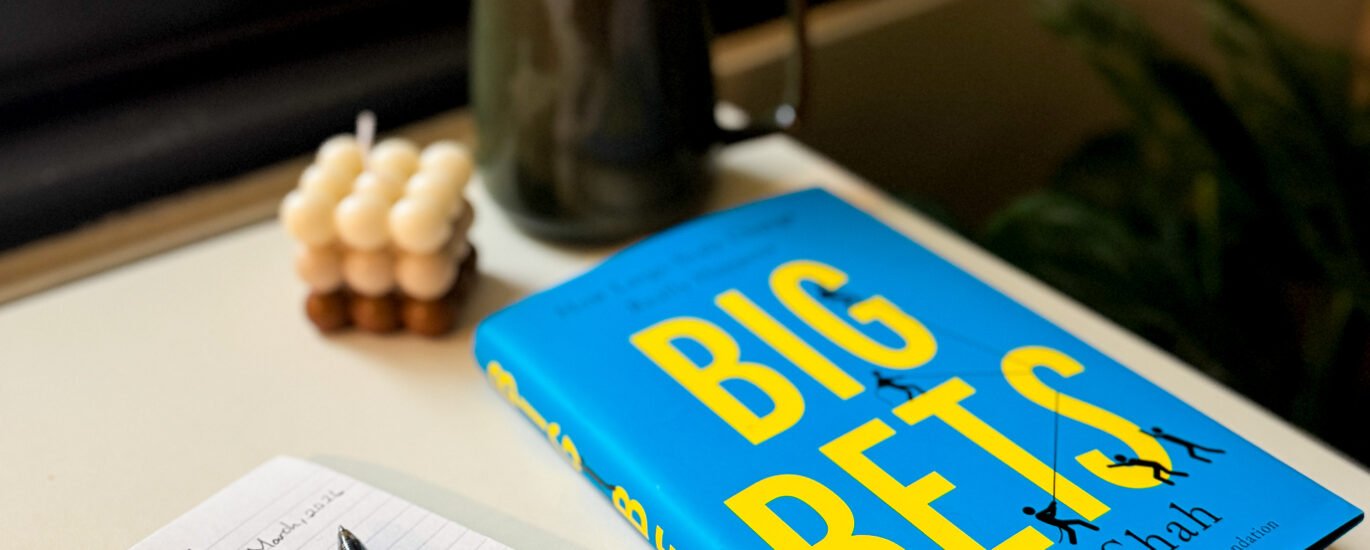
March is reading month, and as a new Detroit resident, I am taking up Mayor Mary Sheffield on the challenge that she has set up for us!
I have picked up Big Bets by Rajiv J. Shah [President of the Rockefeller Foundation] – a Detroit native himself.
The book is not simply about philanthropy or development. It is an argument about how large, stubborn global problems are actually solved. Shah writes about the idea that meaningful change rarely comes from incremental programs or cautious reforms. Instead, it comes from bold, coordinated investments in ideas that seem almost unreasonable at first — ideas designed to move entire systems rather than tweak the edges of them.
Shah defines a big bet as ‘a concerted effort to fundamentally a single pressing problem in your community or our world.’
The book arrives at a moment when I have been asking myself a similar question: what is the big bet I am willing to place on the future?
Throughout the pages, Shah reflects on efforts to tackle issues like energy poverty, food insecurity, and climate resilience. What becomes clear is that the thread behind successful interventions is rarely just funding or policy. It is the willingness to imagine solutions large enough to match the magnitude of the challenge, and to build coalitions capable of pursuing them.
Just a few years ago, I was living in Manhattan, New York, doing similar synthesis work — evaluating development programmes around the world through the United Nations Development Programme.
Monitoring and evaluation teaches a humbling lesson: many initiatives fail not because the people involved lack passion or talent, but because the systems surrounding them were never designed to succeed.
Reading Big Bets feels less like studying someone else’s story, and more to me like holding up a mirror to the same lessons.
The question — what is my big bet? — sent me back through the last several years of my own work.
My entrepreneurial and impact journey began with the work my team and I built through Kwathu Kollective previously known as [and now incorporated in the U.S. as a 501(c)(3)] as the Ntha Foundation.
The idea behind Kwathu was simple: create a network of innovators and creators capable of imagining new futures for African economies.
Running the organization over the past eight years, however, forced me to confront several stubborn realities.
Passion and talent are abundant. Sustainability is not.
Many of the initiatives we cared deeply about were impactful, but the underlying economic models were fragile. The programs mattered, but the systems surrounding them did not always allow them to endure.
These tensions forced me to begin asking a deeper question: where do the real economic engines sit?
Somewhere in 2024, my curiosity drifted toward agriculture.
Food systems remain the backbone of most emerging economies, yet innovation within them often moves slowly. I began exploring ideas in ag-tech — irrigation systems, production networks, agricultural data, and the broader mechanics of how food economies scale. I started speaking with farmers, and trying to hear their painpoints.
That exploration eventually carried me to Michigan State University, where agriculture, engineering, and systems thinking intersect in powerful ways.
What began as a search for agricultural innovation slowly widened into something much larger.
At the same time, my work began intersecting with simulation technologies through my role at Microsoft working within the Xbox ecosystem. The gaming industry, perhaps unexpectedly, is one of the most advanced laboratories humanity has for building simulated environments. Miguel, my mentor at Xbox, would say to me that gaming is almost always 20 years ahead [of reality and innovation as we know it].
Entire worlds are modeled there—physics, ecosystems, human behavior, logistics—everything is rendered, tested, and iterated before it ever exists in reality.
Watching how games construct and test complex systems before they are deployed in the real world reframed how I thought about infrastructure itself. Agriculture, energy networks, and logistics systems are also complex environments. They are simply played out in the physical world rather than on a screen.
That realization quietly connected two worlds in my mind: the systems challenges I had been exploring in agriculture, and the powerful simulation tools emerging from the gaming ecosystem.
At the same time, my work began intersecting with simulation technologies through my role at Microsoft working with the Xbox ecosystem.
The gaming world, perhaps unexpectedly, is one of the most advanced laboratories humanity has for building simulated environments. Entire worlds are modeled there — physics, ecosystems, human behavior, logistics — everything is rendered, tested, and iterated before it ever exists in reality.
And something clicked.
If you step back from the surface, modern games are not just entertainment products. They are complex simulation engines.
Agriculture, infrastructure, and energy systems are also complex worlds. They are simply played out in the real environment rather than on a screen.
Once that connection formed, the threads of the past few years began to weave together.
At the base of all of these systems sits something even more fundamental: energy.
Autonomous machines, sensor networks, and digital infrastructure are elegant ideas until one remembers that none of them function without reliable electricity. This realization came to me during a lunch conversation with the co-chair of the Q2 Systems board, Leo, during the summer of 2025. Power is the quiet foundation beneath every modern system.
Without it, the future I am… we are imagining simply cannot run.
That is why I have been watching with particular interest the growing momentum behind electrification initiatives across Africa, including Mission 300 — an effort supported by the World Bank, the African Development Bank, and the Rockefeller Foundation to connect hundreds of millions of people across the continent to electricity.
Their work is not merely about lighting homes. It is about enabling the infrastructure upon which entirely new economic systems can be built.
In many ways, the success or failure of ventures like the one I am building ultimately rests on these foundations.
Out of these threads, a clearer thesis began to emerge.
My big bet is that the future of emerging markets will be built on autonomous, connected systems that blend the physical and digital worlds.
The next era of development will not be driven only by infrastructure itself, but by the intelligence that designs and governs that infrastructure.
Autonomous systems will monitor fields, logistics networks, and industrial processes. Digital twins will replicate those environments in virtual space. Simulations will allow planners and engineers to experiment with entire systems before committing resources in the physical world.
Together, those layers form what we describe as cyber-physical infrastructure.
All these realizations over the past two years became the foundation of what is now Q2 — a name that itself is a simple wordplay on the pronunciation of Kwathu.
Q2 is built around a loop: real-world autonomous systems, digital twins, and interactive simulations feeding back into one another. The goal is not simply to analyze infrastructure or agriculture, but to design environments where systems continuously improve themselves.
In practical terms, this means creating engines that allow communities, operators, and institutions to model infrastructure before it is built, test scenarios before they are deployed, and refine systems based on real-world data. We are looking at precision production, experiential [applied] learning, and autonomous mobility [logistics].
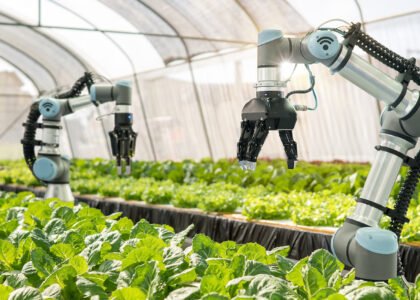
The first expression of that idea is KSIF — Kwathu Smart Innovation Farms.
KSIF is not only about farming. It is a living laboratory where autonomous machines, environmental sensing, digital modeling, and human learning intersect.
It is a digital triplet model that allows us to explore how connected systems might reshape production and infrastructure in emerging markets.
It is, in many ways, the first small experiment inside a much larger thesis. A thesis I am completely and absolutely willing to bet on.
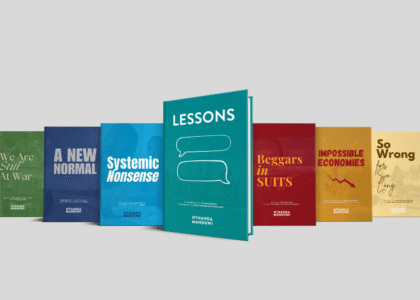
If you’d like to go deeper into my journey — from Malawi, through the United Nations to Microsoft, you can find it in my books.
For 2026, you can read any of my books via Kindle for only $2.99.
This offer is valid till the end of the year.
Links to the books are as below:


Nthanda Manduwi is a Malawian storyteller, entrepreneur, digital transformation advocate, and community builder driven by the mission to empower Africa’s economic landscape through innovation and technology.